This is a mismatch on purpose — a whole country against one island. Greece is a nation of some six thousand islands and a mainland of ancient sites, crossed by ferry from Athens. Sardinia is a single large Italian island you drive, built around some of the clearest water in the Mediterranean — water you increasingly have to book in advance. Same sea, same euro, same Schengen border; almost nothing else in common.
Be honest about what this compares: a nation of islands and mainland on one side, a single island on the other.
~131,900 km²Greece — a whole countryAbout five and a half times Sardinia, spread across some 6,000 islands and islets, around 227 of them inhabited, plus a mainland
24,100 km²Sardinia — one island1,850 km of coast, toured on a single hire car; a week covers a region, not the island
Country vs islandwhy it is an odd match-upA country you plan like a region-by-region campaign, against one island you plan like a road trip
Every other comparison on this site weighs two like things — two islands, two countries, two regions. This one does not, and it is worth saying plainly: Greece is a country and Sardinia is an island inside another country. Greece has more than six thousand islands and islets across several distinct archipelagos, a mainland carrying the heavyweight ancient sites, and a capital that is a European city in its own right. Sardinia is one island — large, Mediterranean, unmistakably Italian — with one broad decision to make: which coast.
That difference in scale is not a footnote; it is the whole reason the two trips feel nothing alike. Planning Greece means choosing a region of a country and accepting you will not see the rest this time. Planning Sardinia means choosing a corner of one island and driving it properly. People reach this page because both came up as "a Mediterranean island holiday," and at the level of sea and sunshine they are cousins. At the level of what you actually do for a week, they are not competing for the same trip at all — which, usefully, makes the choice easy once you know what you want.
Entry & money
Entry and money: effectively identical
Here the two are the same — both Schengen, both eurozone, same border, same currency, same EES/ETIAS clock.
Greece
Sardinia
Currency
Euro
Euro (Italy)
Border
Schengen
Schengen (Italy)
Non-EU arrival
EES biometric check, fully live since 10 Apr 2026; ETIAS expected 2027 (€20, under-18s and over-70s fee-exempt)
Identical — the Schengen rules are the same whichever you pick
Nightly tourist tax
Climate Crisis Resilience Fee, scaled by accommodation class and season
Imposta di soggiorno, set per comune — a few euro a night
Driving licence
Non-EU/non-UK visitors need an International Driving Permit
Same — an IDP alongside your home licence
On paperwork and money there is almost nothing to choose between them. Both are Schengen and eurozone, so the same border formalities, the same currency and the same EES/ETIAS timeline apply either way. The real differences are all in the holiday, not the formalities — which is why the rest of this page ignores entry rules entirely.
One genuine money difference, and it is small: Greece cut VAT by 30% on roughly two dozen smaller Aegean islands from 2026 (the old five of Chios, Kos, Leros, Lesvos and Samos, now joined by Patmos, Karpathos, Ikaria and more), so the lesser-known islands are quietly cheaper again. Sardinia has no equivalent island discount, but its booked beaches charge a modest per-person fee (€2–7) that Greek beaches do not. Neither moves a budget much. The full tax detail for each is on the Greece guide and the Sardinia guide.
Sea & season
The same sea, a longer Greek season
Both hold a swimmable sea deep into autumn — but what stays open around it is not the same.
22°C+sea temperature both hold into October
The water is the easy part — both are warm Mediterranean, both still swimmable in October. Greece runs warmest around Crete and the Dodecanese in the far south-east, roughly 24–26°C in September and 22–24°C into October; Sardinia runs warmest in its south, around Cagliari and Villasimius, which hold about 22.5°C in late October. The sea will not decide this. What decides it is the season around the sea — the wind, the ferries and what is actually open.
AMJJASO
Greece — smaller islands open (hotels, tavernas, ferries)Apr – late Oct
Apr – late Oct
Greece — the meltemi wind (strongest Jul–Aug)Jun – mid-Sep
Jun – mid-Sep
Sardinia — bathing season (regional ordinance)1 Apr – 31 Oct
1 Apr – 31 Oct
Sardinia — beach concessions obliged to open15 Jun – 15 Sep
15 Jun – 15 Sep
Crimson bars are the windows that catch people out. Note the asymmetry: Athens, Crete, Rhodes and Corfu run year-round, so Greece keeps a usable winter that Sardinia does not — much of Sardinia’s tourist coast simply shuts outside April–October.
On both, June and September are the sweet spot: warm sea, thinner crowds, lower prices. The difference is at the edges of the season. Greece has a genuine year-round layer — Athens as a city break, and the big islands of Crete, Rhodes and Corfu stay open and served through winter — while its small Cyclades largely close from November to March. Sardinia has no winter tourist season to speak of: its bathing season is nominally April to October, but beach concessions are only obliged to open 15 June to 15 September, so the shoulder months are permission, not a promise.
High summer is where Greece carries a hazard Sardinia does not: the meltemi, a Force 5–7 wind gusting to gale 8 across the central Aegean from June to September, which cancels the high-speed catamarans first and turns exposed Cycladic beaches unpleasant. Sardinia has its own wind — the Costa Smeralda is one of the island’s windiest corners — but a windy day there means driving to a sheltered cove, not a cancelled crossing. Both guides carry the if-this-blows-go-here detail: Greece and Sardinia.
The island question
Pick an island — or pick the island
The single biggest planning difference: Greece makes you choose which islands; Sardinia is already chosen.
Greece hands you a decision Sardinia does not: which islands. The famous groups — the Cyclades (Mykonos, Santorini, Naxos, Paros, Milos), the Dodecanese (Rhodes, Kos, Patmos), the Ionian (Corfu, Kefalonia, Zakynthos) and Crete — are separate spokes radiating from Athens, not a single chain you hop along. The rule that saves a Greek trip is one group per trip: hopping from the Cyclades to the Dodecanese usually means routing all the way back through Athens, and the Ionian is reached from the western mainland ports, not from Athens at all.
Sardinia removes that whole layer of choice — there is only one island — and replaces it with a driving decision. The island is one landmass, so the question is which coast to base on and how far you are willing to drive to the rest. Neither model is better; they suit different planners. If choosing between islands sounds like the fun part, that is Greece. If it sounds like work, Sardinia has already made the choice for you.
Greece
Sardinia
The unit of a trip
One island group — the Cyclades, the Dodecanese, the Ionian, or Crete
One coast of the one island — the north-east, the south, or the west
How you choose
Which archipelago first, then which islands within it to hop
Which region first, then a base and a hire car
The trap
The groups are separate spokes from Athens’ port of Piraeus — you cannot easily hop between them without routing back through Athens
A week is a region, not the island; 1,850 km of coast is far too much to tour in one trip
Changing your mind mid-trip
A ferry, or a 35–55-minute domestic flight, to another island
You drive — fast on the SS131 spine, slow the last 30 km to any beach
A corollary worth planning around: on Greece the island network itself is the holiday, so a week can take in three or four islands by ferry. On Sardinia, trying to "see the island" in a week is the classic mistake — it is 24,100 km² with 1,850 km of coast, so a week sensibly covers one region (the Gallura north-east, the Cagliari south, or the Alghero west) and leaves the rest for another time.
Beaches
The best water, rationed — or the widest choice
Sardinia wins the water outright. The catch is that its best beaches now cap numbers and check a QR code.
7+Sardinian beaches you must book in advanceDaily cap, per-person fee, QR code checked at the gate
250people a day allowed at Cala GoloritzéSardinia’s tightest cap — and reachable only on foot, not by boat
~6,000Greek islands and islets to find a beach onAround 227 inhabited — variety and ease over show-stoppers, and no booking
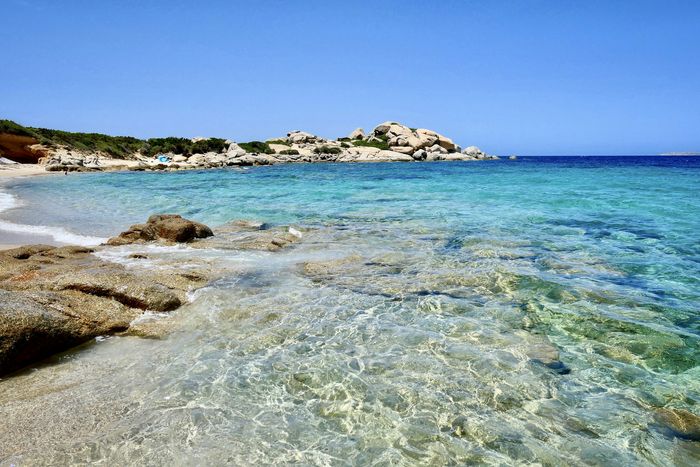
For the water itself, Sardinia is hard to beat. Its bays and coves — La Pelosa in the north-west, the Baunei coast in the east, Tuerredda in the south — are Caribbean-clear and routinely rated among the Mediterranean’s finest, and the whole trip is built around them. The price of that fame is bureaucracy: at least seven of the headline beaches now cap daily numbers, charge a per-person fee and check a booking QR at the entrance, and the windows are short. The binding constraint is no longer what time you arrive — it is whether you booked. The full table of caps, fees and release times is on the Sardinia guide.
Greece trades depth for breadth. You will not find many single beaches to rival Sardinia’s best, but you get good swimming almost everywhere, across thousands of islands, with no daily cap and nothing to book — turn up and swim. The look changes by island too: the Cyclades for whitewashed-village-and-blue-sea, Crete for long sweeps of sand and the pink-tinged Elafonisi, Zakynthos for the cliff-framed Navagio. So the beach question is really a question about effort: Sardinia if the perfect cove is worth a booking window, Greece if you would rather not think about it.
Two honest caveats. Sardinia’s caps draw a steady complaint that they do not actually stop the crowding on the biggest beaches — and taking sand or shells home carries a €500–3,000 fine that is enforced at the airports, not merely written down. Greece’s most famous "beaches" can disappoint for a different reason: Santorini’s are dark volcanic sand, not the postcard white, and its draw is the caldera, not the swimming. Treat the booked-beach detail on both as a yearly thing — caps and fees are set by annual ordinance.
History & culture
Ancient Greece, or Bronze-Age Sardinia
Both have a deep past. Only one of them is a reason to plan the trip around it.
~7,000Bronze-Age nuraghe towers across Sardinia
Sardinia’s ancient layer is genuinely its own: roughly 7,000 nuraghi — conical dry-stone towers built by the Nuragic civilisation, found nowhere else — dot the island, and Su Nuraxi di Barumini is UNESCO-listed. But Sardinia is a beach-and-landscape trip first; the towers are a curiosity you fit around the coast. Greece is where you go for antiquity as the main event — the Acropolis in Athens, the oracle at Delphi, the clifftop monasteries of Meteora, Olympia, Mycenae and the theatre at Epidaurus, and the Minoan palace of Knossos on Crete.
For history, Greece wins without a contest — not because Sardinia lacks a past, but because in Greece the past is the point. The ancient sites are a core reason to go, woven through the islands and concentrated on the mainland the Cyclades crowds never reach: Delphi, Meteora, Nafplio and the Peloponnese absorb visitors far better than Santorini does. Plan Greece and you are choosing a trip where ruins, villages and swimming all share the week.
Sardinia’s culture runs the other way — it is lived, not monumental. The nuraghi are extraordinary and quiet, and the island guards a distinct identity (its own language, Sardo, and inland festivals), but you do not go to Sardinia for the monuments any more than you go to Greece purely for the sand. If a holiday with serious antiquity in it matters to you, that alone settles the choice.
If you do go for the Greek sites, plan the big one: the Acropolis is now a flat €30 year-round, timed one-hour slots are compulsory with a 20,000-a-day cap, so book ahead on the official hhticket.gr rather than turning up — and in red-alert heat it has closed for the hottest midday hours. Knossos and Delphi are €20 each. The detail is on the Greece guide; at Meteora, note the enforced dress code.
Cost
What each really costs
Both are eurozone, so no currency friction — the difference is in the shape of the spending, not the paperwork.
Bar two islandsGreece is reliably cheap day to dayTavernas and lodging run good value — Santorini and Mykonos are the hard cost outliers
Budget → luxurySardinia spans the widest range in the MedAgriturismi and town B&Bs at one end, the Costa Smeralda at the other
Both eurozoneno currency friction either wayBoth now add a modest nightly accommodation tax; neither is cheap in its own luxury pockets
We keep exact daily figures off this page on purpose — ferry fares, lodging and car hire all move within a season, and a stale price is worse than none. What is stable is the structure. Greece is the more reliably cheap, day to day: tavernas and lodging are good value once you steer clear of the two hard outliers, Santorini and Mykonos, and the lesser-known islands (Naxos, Milos, Paros, the Dodecanese) plus the shoulder season are the strong value play — now with a VAT cut on about two dozen small islands on top.
Sardinia has the wider spread. At one end sit genuine budget options — agriturismi and town B&Bs that Corsica across the strait cannot match — and at the other the Costa Smeralda, as expensive as anywhere in the Mediterranean. That means Sardinia can come out cheaper or far pricier than Greece depending entirely on the corner you pick. The rule of thumb: for predictable value, Greece away from its two famous islands; for either a true budget trip or outright luxury on one island, Sardinia.
Both carry a nightly tourist tax that is not in the headline room rate — Greece’s Climate Crisis Resilience Fee (scaled by hotel class and season) and Italy’s imposta di soggiorno (set per comune). Neither is large, but budget a few euro per night either way, and remember Sardinia’s per-person beach fees and Greece’s €30 Acropolis ticket are the small fixed extras that catch people out.
Getting around
Ferries and a wind, or one hire car
Two completely different machines: a ferry network that the weather can stop, against a car that mostly cannot.
Greece runs on ferries, and the ferry is a weather decision as much as a budget one. Conventional car ferries are cheaper, slower and ride out the meltemi; the high-speed catamarans are roughly twice as fast, pricier, and the first off the board when the wind blows. Add the recurring seamen’s strikes — the May Day general strike halted every island sailing in 2026 — and the planning rule writes itself: build in slack and never put a ferry on the day you fly home. Within that, Greece is the easier car-free trip by far; Athens itself is better without one.
Sardinia is one island and one hire car. It is genuinely motorway-like on the SS131 that runs its length, and then slows to mountain-road pace the moment you turn off toward the coast — so the distances mislead, and the Costa Smeralda is the most car-dependent corner of all. Only Cagliari (airport on the rail network, summer beach buses to Poetto) and Alghero work without a car. The full route times are on the Sardinia guide, and the Greek ferry-and-meltemi detail on the Greece guide.
Greece
Sardinia
How you move
Ferries from Piraeus, plus short domestic flights (Athens–Mykonos ~35–45 min)
One hire car for the whole trip
The catch
The meltemi (Jun–Sep, Force 7–8) cancels high-speed catamarans first; nationwide seamen’s strikes recur
Fast on the SS131 spine (70–89 km/h), then slow the last 30 km to every beach
Car-free?
Easy — ferries and flights do the work, and Athens needs no car at all
Only Cagliari and Alghero; the Costa Smeralda has one direct bus a day
The mistake to avoid
Booking a ferry on your fly-home day — strikes and wind cancel sailings
Reading distance as time — 30 km to Porto Cervo is three quarters of an hour
The clean split: if the idea of island-hopping by boat is part of the appeal, that is Greece, and you can do the whole trip without renting anything. If you would rather have a car on the doorstep and never consult a timetable, that is Sardinia — but then you are committed to driving, because away from Cagliari and Alghero there is no real alternative.
Food
Two very good, very different tables
Both eat well — but one is Greek taverna and the other is island Italian, and they do not taste alike.
Greece is taverna food and a late rhythm. Expect meze to share, Greek salad heavy with feta and good olive oil, grilled fish straight off the day boat, souvlaki and slow-baked dishes like moussaka, washed down with ouzo or tsipouro — and dinner that does not really start until about nine. It is sociable, generous and cheap outside the two luxury islands, and it is a big part of why a Greek trip feels unhurried.
Sardinia surprises people by being more inland than its coastline suggests. The island’s signatures are not all seafood: pane carasau (the crisp "music-paper" flatbread), culurgiones (hand-pleated stuffed pasta), porceddu (spit-roast suckling pig), sharp pecorino sardo, and bottarga — cured grey-mullet roe grated over pasta. The reds are Cannonau, the after-dinner pour is myrtle-berry mirto, and the dessert to find is seadas, fried pastry with cheese and honey. It is distinctly Sardinian rather than generically Italian, and well worth eating around.
A small practical difference: Italians, Sardinians included, tend to dine a touch earlier than Greeks — from around eight rather than nine — and Sardinian kitchens in the smaller places can close by the time a Greek taverna is just filling up. On both, the best meals are inland and in the towns, not on the beach.
Who suits which
Who each actually suits
Same sea, opposite holidays — and on several rows the answer inverts, so the one that wins overall can lose for you.
The inversions are the useful part. Greece is the broader, easier, better-value trip and the one for history and for travelling without a car — but Sardinia takes the water outright, and it is the better choice if what you actually want is one island, a hire car and a single region done slowly rather than a network to work across. "Which is better" has no answer here; "which is better for the week you have in mind" does.
If you want…
Greece
Sardinia
The best beaches and water
Good swimming, few show-stoppers
Wins clearly. Among the Med’s finest — but book the famous ones
Ancient history and sights
Wins clearly. Acropolis, Delphi, Meteora, Olympia
Bronze-Age nuraghi aside, not why you go
Island-hopping and variety
Wins. Whole groups to ferry between
One island, done by region
A car-free trip
Wins. Ferries and short flights do the work
Only Cagliari and Alghero; everywhere else you drive
Reliable day-to-day value
Wins. Cheap bar Santorini and Mykonos
Widest spread — budget to luxury
One island, a car, a region done properly
Means picking a group and keeping moving
Wins. This is exactly Sardinia’s shape
Genuine luxury on tap
Santorini and Mykonos, at a price
Ties. The Costa Smeralda
Doing both
Two trips, not one — and what each costs you
They sit at opposite ends of the Mediterranean, and Sardinia already has a much closer partner.
Via the mainlandthere is no easy direct hop between them
Greece and Sardinia are roughly 1,500 km apart at opposite ends of the sea, with no natural ferry or convenient direct flight — pairing them almost always means connecting through the Italian mainland and burns a travel day for two trips that do not complement each other. If you want to combine Sardinia with somewhere, its natural partner is Corsica, 50 minutes away by ferry, not Greece.
Each of these fills its own holiday comfortably, so treat them as separate decisions rather than two halves of one trip. If you are drawn to Sardinia and want a second island on the same journey, the sensible pairing is Corsica — see Corsica vs Sardinia. If you are drawn to Greece, give it the whole trip: pick one island group and do it properly rather than diluting it with a long connection to Italy.
What you give up either way is the honest summary. Choose Greece and you trade away Sardinia’s single best beach day and the simplicity of one island and one car — you take on ferries, the meltemi and a bigger country to navigate, in return for range, ruins and reliable value. Choose Sardinia and you give up the island-hopping, the great ancient sites and the easy car-free trip — you take on booking windows and a hire car, in return for the clearest water of the two and a region you can actually know by the end of the week. The detail that drives each lives on the two guides: Greece and Sardinia.
Greece or Sardinia, month by month
Which of the two is the better bet for each month of the year, scored on
how well the season suits each place.
The beaches themselves are the whole point — Sardinia’s water is as good as the Med gets.
You want one island, a car and a single region done properly, not a ferry network to work across.
You want the choice of a real budget tier or genuine luxury on the same island.
You would rather not plan which islands to visit — Sardinia has already made that call for you.
Common questions
Is Greece or Sardinia better for beaches?
Sardinia, for the water itself — its coves and bays are widely rated among the finest in the Mediterranean, Caribbean-clear and backed by white sand. The catch is access: the famous ones increasingly cap daily numbers, charge a per-person fee and check a QR code at the gate, so you book ahead. Greece’s draw is broader than beaches — island-hopping, ancient sites and village life — with good swimming almost everywhere but fewer show-stopping sands and nothing to book.
Is Greece or Sardinia cheaper?
Greece is the more reliably cheap day to day — tavernas and lodging are good value once you steer clear of Santorini and Mykonos, the two hard outliers, and from 2026 about two dozen smaller Aegean islands carry a 30% VAT cut. Sardinia has the wider spread: a genuine budget tier of agriturismi and town B&Bs at one end, Costa Smeralda resort prices at the other. Pick your corner of Sardinia and it can be cheaper or far pricier than Greece. Both are eurozone, so there is no currency friction either way.
Is Greece or Sardinia easier to get around?
Different machines. Greece runs on ferries from Athens’ port of Piraeus, and the island groups are separate spokes that connect through Athens rather than to each other — so you pick one group per trip, and in summer the meltemi wind and the occasional seamen’s strike can cancel sailings. Sardinia is one island you drive: only Cagliari and Alghero work car-free, and everywhere else — above all the Costa Smeralda — needs a car. Greece is the far easier car-free trip; Sardinia is the easier if you want a car on the doorstep.
Which has better history, Greece or Sardinia?
Greece, clearly — the Acropolis, Delphi, Meteora, Olympia and the ancient sites are a core reason to go, alongside the islands. Sardinia has its own ancient layer — the roughly 7,000 Bronze-Age nuraghe towers are unique to the island, and Su Nuraxi di Barumini is UNESCO-listed — but it is a beach-and-landscape trip first; you do not go for the monuments. If serious antiquity matters to your trip, that alone settles it in Greece’s favour.
Should I do both Greece and Sardinia in one trip?
Not really — they sit at opposite ends of the Mediterranean with no easy direct hop, so pairing them means a long connection through the Italian mainland for two trips that do not complement each other. Each comfortably fills its own holiday. If you want to pair Sardinia with something, its natural partner is Corsica, 50 minutes away by ferry. Treat Greece and Sardinia as separate decisions and pick by what you want: range and ruins on one side, the best water on one island on the other.