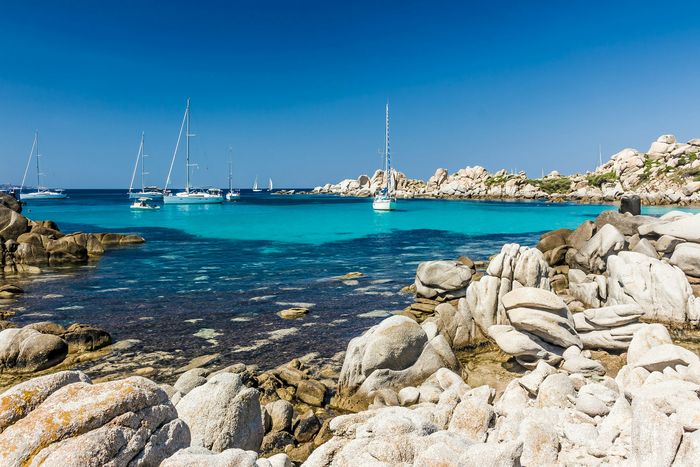
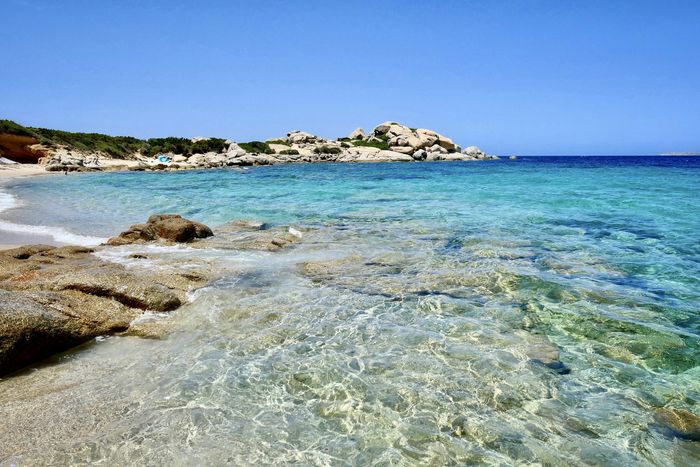
Twelve kilometres of water apart, and the same sea. The real differences are season, access and booking rules — here they are, measured, with a verdict on which suits which trip.
So choose on the month you can travel, not on which island sounds warmer.
A monthlonger swimming season in southern Sardinia
From August onward the warmest water on either island is southern Sardinia’s — Cagliari and Villasimius run 0.3°C above the warmest Corsican reading in August, 0.9°C in September and 1.1°C in October, exactly when it decides the trip. Of the ten spots we checked (all published below) they are the only two still holding 22°C in late October; by November even they cool below 20°C. Earlier in the summer the gap vanishes — in May and July the single warmest reading is actually Bastia’s.
Corsica (Bonifacio) S. Sardinia (Villasimius) Warm enough to swim (21°C)
Northern Sardinia is not plotted because it tracks Corsica to within 0.1°C — drawing it would put one line exactly on top of the other. Its figures are in the table below.
Everything else is noise. Bonifacio on Corsica’s southern tip and Santa Teresa Gallura on Sardinia’s northern tip sit 12 km apart and their August sea differs by a tenth of a degree — they are the same water. The spread within Sardinia, Santa Teresa at the top to Villasimius at the bottom, is nine times larger in August than the gap between the islands. The gradient runs north to south, not island to island.
Month
Corsica (Bonifacio)
N. Sardinia (Santa Teresa)
S. Sardinia (Villasimius)
May
17.6°C
17.6°C
18.1°C
June
21.4°C
21.4°C
22.0°C
July
24.6°C
24.6°C
25.3°C
August
25.5°C
25.6°C
26.5°C
September
23.9°C
23.8°C
25.1°C
October
21.2°C
21.2°C
22.5°C
Monthly averages from seatemperature.info, calculated over the past ten years. Note the baseline matters: the older Copernicus 1991–2020 normals run about 2°C cooler for the same places. Sources disagree on what counts as swimmable — one puts the comfortable season at June–October, another at July–September only. June is the first month that is warm rather than merely tolerable.
All ten spots we checked, May to November — the full table
May
Jun
Jul
Aug
Sep
Oct
Nov
Bonifacio (Corsica)
17.6
21.4
24.6
25.5
23.9
21.2
18.6
Porto-Vecchio (Corsica)
17.9
22.0
25.3
26.1
24.2
21.2
18.4
Ajaccio (Corsica)
18.0
21.8
24.8
25.4
23.8
21.4
18.8
Calvi (Corsica)
17.8
21.7
24.6
25.3
23.7
21.2
18.6
Bastia (Corsica)
18.3
22.5
25.6
26.2
24.2
21.4
18.6
Santa Teresa (Sardinia)
17.6
21.4
24.6
25.6
23.8
21.2
18.6
Olbia (Sardinia)
17.7
21.4
24.6
25.8
24.1
21.4
18.5
Alghero (Sardinia)
17.9
21.5
24.1
24.9
23.7
21.6
18.9
Cagliari (Sardinia)
18.0
21.7
25.0
26.3
25.0
22.5
19.4
Villasimius (Sardinia)
18.1
22.0
25.3
26.5
25.1
22.5
19.3
Monthly average water temperature, °C, from seatemperature.info — read 7 August 2026. This is the complete set behind every “ten spots we checked” claim on this page.
What’s open
What is actually open
A climate table tells you May and October are pleasant. It does not tell you what is shut.
JFMAMJJASOND
Sardinia — bathing season1 Apr – 31 Oct
1 Apr – 31 Oct
Sardinia — beach concessions obliged to open15 Jun – 15 Sep
15 Jun – 15 Sep
Porto Cervo Waterfront, 202611 Jun – 7 Sep
11 Jun – 7 Sep
Corsica — beach restaurants (2024 rule)Apr – Nov
Apr – Nov
Corsica — Calvi CDG + international flightslate Jun – mid Sep
late Jun – mid Sep
Crimson bars are the ones that catch people out — the windows are far narrower than the weather suggests.
In Sardinia, under the regional bathing ordinance, beach concessions are only obliged to open between 15 June and 15 September, 08:30–19:30. Outside that three-month core, whether a given lido, bar or sunbed operator opens at all is voluntary — the April-to-October bathing season is permission, not a promise.
The Costa Smeralda makes the point sharply. Porto Cervo’s Waterfront — the promenade of shops and bars that is much of the reason to be there — runs 11 June to 7 September 2026. Under thirteen weeks, and that is its longest season ever: local press noted it opened a full month earlier than previous years, meaning it historically did not open until mid-July. The big hotels run longer (Cala di Volpe reopened 16 April, Cervo Hotel 27 March), timed to the late-April Italian holidays.
Corsica has a structural access problem in the shoulder season that Sardinia does not: essentially every international flight to Corsica is seasonal. Year-round service is close to entirely domestic French — Air Corsica keeps Calvi–Paris Orly running all year, but Calvi’s CDG link and the international routes across the island run roughly late June to mid-September. Flying in from outside France in May or October usually means connecting through the mainland, so sort the flights before anything else.
August
August, in actual numbers
Both islands are busy. The statistics show how unevenly — and where the escape route is.
26%of Corsica’s annual overnight stays fall in August aloneJuly and August together: 47%
1.59×Sardinia’s August overnight stays vs June5,456,409 stays; July–August is 47.4% of the annual total
1.42×Olbia airport’s August traffic vs JuneThe Costa Smeralda gateway — it spikes hard
1.13×Cagliari’s August traffic vs JuneBarely moves. Alghero the same
Olbia against Cagliari is the useful pair. The crush is regional, not island-wide: southern and western Sardinia in August feel nothing like the north-east. If you have to travel in August, that is the lever to pull.
The other trap is the date. Corsica’s three busiest days of 2023 were 9, 11 and 14 August — the peak is the run-up to 15 August, not the end of the month. That is a public holiday in both France and Italy (l’Assomption and Ferragosto), and Italian firms commonly shut for a fortnight around it. In 2026 it falls on a Saturday, so both islands peak on the same weekend.
Beach booking
Sardinia rations its best beaches. Corsica does not.
Sardinia’s best beaches now cap numbers, charge per person and check a QR code at the gate. The booking windows are short.
7+Sardinian beaches you must book in advanceFee per person, QR code checked at the entrance
0Corsican beaches charging entry or capping numbersCorsica limits boats and parking instead
250people a day allowed at Cala GoloritzéThe tightest cap of the lot
Turn up at La Pelosa, Cala Goloritzé, Tuerredda or the San Teodoro beaches without a booking and you will not get on the sand — and the windows bite: Tuerredda opens at 08:00 for the following day, La Pelosa’s 09:00 release is reported gone within minutes, and Goloritzé is released only 72 hours ahead. On these beaches the binding constraint is the booking window, not what time you arrive. The full table — all seven beaches with windows, caps, fees and release times — is on our Sardinia guide, along with the sand-removal fines that are enforced at the airports.
On the Corsican side we could not find a single beach charging entry or running a per-person quota for 2026. Corsica restricts boats rather than people — navigation and mooring around the Îles Lavezzi are limited under a 2023 order running to 2028 — and its real constraint is car parking. Rules around the Scandola reserve are actively changing, so check before booking a boat trip there.
Wind
When the wind blows, change beaches — not islands
The Costa Smeralda is one of the windiest corners of Sardinia, not a sheltered one.
1 day in 3blows hard on the Costa Smeralda
Sardinia’s regional weather service logs strong west/north-west wind at its La Maddalena station on 33.8% of days — right in the Costa Smeralda’s corner, and beaten only by uninhabited Asinara off the far north-west. And where most of Sardinia’s wind peaks in winter, this is one of the few stations where it is just as frequent in summer. The genuinely sheltered coast is central and southern-eastern Sardinia: Olbia southward through San Teodoro, Cala Gonone and Villasimius.
Locals do not write off the day — they move a few kilometres and put a headland between themselves and the wind. The full if-this-blows-go-here lookups are on the island guides: Sardinia’s Maestrale swaps (La Pelosa is the one to skip; Alghero and the south-east have the shelter) and Corsica’s (an easterly ruins Palombaggia’s clarity — neighbouring Santa Giulia is usually spared).
One more correction worth making: the Mistral is not Corsica’s dominant wind. Corsican wind inventories put the south-westerly Libeccio at roughly 60% against the Maestrale’s 5%, though those figures come from a regional rather than a meteorological source, so treat them as indicative. By the time it reaches Corsica the Mistral arrives as a westerly anyway, and its real footprint is Cap Corse, the Balagne, the west coast and the Strait of Bonifacio. A Libeccio at Palombaggia is actively good — it blows offshore and flattens the water — though it will carry an inflatable out to sea.
Complaints
What will actually annoy you
Every comparison page lists the good bits. These are the recurring complaints.
Sardinia: the caps do not stop the crowding. This is the most common complaint on the rationed beaches, and it is not what the booking system implies. At Cala Brandinchi reviewers report reservations sold "beyond the actual capacity", umbrellas packed together with no room to move, and a beach only one or two people deep. At La Pelosa the 09:00 release is gone by about 09:03, the QR check has failed at the gate, and the beach-mat rule is enforced with on-the-spot fines — a towel alone will get you moved on.
Sardinia: Spiaggia Rosa is not pink and you cannot reach it. The famous beach on Budelli has been closed since the mid-1990s. You view it from a boat behind a buoy line, walking on it draws fines that have run from about €300 to €1,800, and the recurring verdict from people who have made the trip is that the pink is long gone.
Corsica: Santa Giulia divides people sharply. Sheltered and genuinely calm — which is why it is the right answer when the wind blows — but it draws more complaints than any other Corsican beach: dried posidonia banked on the sand and floating in the shallows, jet skis and parascending boats, one reviewer’s summary that "it looks like a water park, not a beach". Weed is the variable part — plenty of visitors report none at all, so treat it as luck rather than a permanent flaw. The boat traffic is not variable. Go early either way.
Corsica: the Îles Lavezzi are the classic let-down. The boat trip out of Bonifacio is the island’s most-sold excursion, and in high season reviewers keep arriving at the same verdict — one describes waiting for a paradise island and finding it "not worth it", another counts an uncountable number of boats in the bay and notes that in midsummer a possible paradise also takes a holiday. It is uninhabited: no shops, no food, almost no shade. The fix people who enjoyed it give is the same every time — take the first boat around 09:00 and come back before midday.
Corsica: the famous wild beaches are a project. Saleccia and Lotu in the Agriates are reachable only by boat, on foot, or down about 10 km of rough track that reviewers cover at walking pace — and the boat is cancelled when it blows. Ostriconi is beautiful and notoriously dangerous to swim in rough seas, with currents that carry people offshore.
Two smaller ones worth knowing. Cala Goloritzé is small, and it falls into shade in the afternoon — go in the morning, and carry water, because there are no facilities at the bottom of that walk. And dried seagrass on the sand is normal on both islands rather than a sign of a dirty beach: it is protected, it is left in place deliberately, and how much of it there is varies through the year.
Driving & car-free
Do you need a car? Almost certainly.
The first question every forum regular asks, and the one no comparison page answers.
17 kmof trunk-grade road on Corsica. Sardinia has 1,371.
Measured off OpenStreetMap for both islands — road classed trunk, summed via an Overpass query anyone can re-run. Corsica has no motorway at all — just short 2×2 express sections at the approaches to Bastia and Ajaccio. Everything else is single-carriageway mountain road, limited to 80 km/h — Corsica declined to go back up to 90 when France did.
The consequence shows up in every journey. Across thirteen Corsican routes on two open routing engines — OSRM and BRouter, with the full workings published on our Corsica guide — not one averages better than 62 km/h. There is no fast road to escape onto, which is why distances mislead: 130 km from Ajaccio to Bonifacio is somewhere between a two- and a three-hour drive.
Sardinia is a different problem. It is fast on the SS131 spine — 70 to 89 km/h, genuinely motorway-like — and then just as slow as Corsica the moment you turn off toward a beach. Olbia to Porto Cervo is 30 km and takes three quarters of an hour.
Route
Distance
Driving
Average
Ajaccio – Bonifacio
130 km
2h07 – 3h16
40–62 km/h
Bastia – Porto-Vecchio
144 km
2h32 – 2h37
55–57 km/h
Calvi – Porto-Vecchio
202 km
3h31 – 3h50
53–58 km/h
Olbia – Cagliari
263 km
2h58 – 3h45
70–89 km/h
Alghero – Olbia
137 km
1h33 – 1h56
71–89 km/h
Olbia – Porto Cervo
30 km
0h46
38–46 km/h
Cagliari – Villasimius
61 km
1h04 – 1h10
52–58 km/h
Checked 7 August 2026 on the public OSRM and BRouter instances — free-flow, no traffic modelling; August on the Costa Smeralda and around Porto-Vecchio will be worse. The scheduled coaches run 30–50 minutes slower than these figures, which is about right for stops.
Car-free is possible in four places, and nowhere else. On Corsica: the Balagne, where a local train runs Calvi to Île-Rousse five times a day — more in July–August — calling at beach halts, and Porto-Vecchio, which has an airport shuttle from Figari plus summer buses to Palombaggia and Santa Giulia — July and August only. On Sardinia: Cagliari, where the airport has its own railway station and CTM runs eight dedicated summer beach lines to Poetto, the busiest every quarter-hour, and Alghero, with the Lido every 20–40 minutes. Everywhere else needs a car. There is no railway at all south of Ajaccio, and the Costa Smeralda has one direct bus a day from Olbia to Porto Cervo.
Where to base
Where to base, and for how long
Neither island works as a single base. Pick two, or accept the driving.
On how long: no tourist board on either island publishes a minimum. What Corsica’s own board does publish is telling — two separate one-week itineraries, one for the north and one for the south, rather than one week for the island. Its own line is that in Corsica distances are measured in time, not miles. Rough Guides puts a week on Sardinia.
Scale is the other half of it. Sardinia is 24,100 km² to Corsica’s 8,680 — about 2.8 times the size, with 1,850 km of coast against 1,000. A week on Sardinia is a region, not the island.
Base
Island
Suits
Car needed
Porto-Vecchio
Corsica
Beach-first trips and families — Palombaggia, Santa Giulia, Bonifacio 40 min away
Not in Jul–Aug
Bonifacio
Corsica
The setting, and the ferry to Sardinia. No beach shuttle at all
Yes
Calvi / Île-Rousse
Corsica
The car-free option — one train links them and the beaches between
No
Ajaccio
Corsica
Widest flight choice, rail and coach hub. Ordinary beaches
Partly
Cagliari
Sardinia
The only base on either island where a car is genuinely optional
No
Alghero
Sardinia
Best all-rounder — a real town, plus Capo Caccia and Bosa
No
Olbia / Costa Smeralda
Sardinia
The classic north-east, and the most car-dependent
Yes
San Teodoro
Sardinia
Gallura beaches without Porto Cervo prices
Yes
Who suits which
Who each island actually suits
On several of these the answer inverts — the island that wins overall loses for you.
If you are…
Corsica
Sardinia
Travelling with small children
Only the south-east. Palombaggia, Santa Giulia, Tamaricciu and Rondinara shelve gently into sand. The west and north-west are pebbly and shelve steeply, and the west-coast guides warn of undercurrents that pull swimmers off the shore at Portiglio and Baracci — two separate parents describe beaches near Porto turning dangerous in wind
Better served: an official Green Flag standard certifies beaches whose sea "does not suddenly become deep near the shore", including Poetto, Is Arutas, Capo Coda Cavallo and Alghero Lido
Without a car
Two pockets only, and mostly July–August: the Balagne train, and Porto-Vecchio’s summer beach buses
Wins clearly. Cagliari and Alghero both work year-round, with an airport on the rail network
Hiking
Wins clearly. The GR20 is widely rated the hardest and finest long-distance trek in Europe
Real but second: the Selvaggio Blu and the Supramonte
Travelling in May or October
Hard. International routes are almost all summer-only — flying in from outside France usually means connecting through the mainland
Wins. Southern Sardinia holds its sea temperature a month longer and the airports run year-round
After the single best beach day
Rondinara and Palombaggia, no booking, no fee — the constraint is parking
Arguably better beaches, but the famous ones need booking days ahead
Doing both
Doing both is genuinely easy
Plenty of people asking “which one?” are really asking “can I do both?” — you can.
50 minBonifacio to Santa Teresa Gallura
A daytime crossing with a same-day return possible. It runs year-round — about four sailings each way daily even in winter, thickening through the summer. The crossing takes 50 minutes with Moby, about an hour with Ichnusa. These two islands are a short hop apart, not a logistical project.
It survives the winter because it is a subsidised public service, not a commercial route: Moby and Ichnusa Lines run it under a Sardinian regional contract that currently expires on 31 October 2026, so treat anything after that as unsettled. Blu Navy no longer operates this crossing, though older guidebooks still list it.
Your hire car almost certainly cannot come with you. The ferries carry vehicles perfectly happily — the block is entirely on the rental side, and travellers reasonably assume the opposite. Reading the actual terms of Europcar, Hertz, Sixt and Avis plus the local island firms, none permits the crossing as a matter of course. Local firms ban leaving the island outright: one Sardinian contract voids all insurance if you do. Europcar bans sea transport without written authorisation, and its Italian carve-out for ferries covers Italian islands only — which Corsica is not. Hertz’s Italian terms bar its mainland cars from Corsica and Sardinia altogether, and Sixt and Avis leave ferries to the fine print. Assume no unless your contract says otherwise in writing, or hire separately on each island.
What we leave out
What we deliberately leave out
One thing is deliberately missing: current prices. Dinner, hotels and car hire all move faster than we could keep them accurate, and a stale price is worse than none — so the page compares what each island costs in effort, access and crowding instead.
Beach caps, fees, ferry dates and opening seasons are all set annually, so treat anything seasonal on this page as worth a re-check before you travel.
Sources
Where this comes from
The detail above was read off primary sources
on
— operator timetables, municipal ordinances, regional tourism boards, national statistics offices and first-hand traveller reports, rather than other travel articles.
Researched and maintained by Dmitrii Romashchin — how we research.
You are travelling in May or October — year-round airports, and a sea that stays warm a month longer.
You want to go car-free — Cagliari and Alghero genuinely work without one.
You are bringing small children — Green Flag beaches with shallow, gradual water.
August is your only window — the south and west absorb it far better than the Costa Smeralda.
Common questions
Is Corsica or Sardinia cheaper?
Sardinia has a budget tier Corsica lacks — agriturismi, town B&Bs and low-cost flights into three airports — while the Costa Smeralda is as expensive as anywhere in the Mediterranean. We keep exact daily figures off this page because they go stale within a season; the reliable rule is that Corsica has no true budget end.
When is the best time to visit Corsica vs Sardinia?
June and September on both. Southern Sardinia adds real shoulder room: its sea holds 22°C into October and its airports run year-round, while Corsica’s international flights are almost all summer-only.
Is Corsica or Sardinia better in August?
Neither is at its best — August is the crush month on both islands, peaking in the run-up to the 15th. If August is your only window, Sardinia absorbs it better once you avoid the north-east: Cagliari and the south barely notice the spike that hits Olbia and the Costa Smeralda.
How long do you need in Corsica vs Sardinia?
A week per island region. Corsica’s own tourist board publishes two separate one-week itineraries — one north, one south — rather than one for the island; Sardinia is 2.8 times Corsica’s size, so a week there covers a region, not the island.
Should I choose Corsica or Sardinia?
Corsica for mountains-plus-coves and unbooked beach days; Sardinia for shoulder-season trips, car-free travel, small children, and August. And if you cannot decide, the 50-minute Bonifacio–Santa Teresa ferry means you do not have to.