Two of Central Europe’s most rewarding, best-value trips, differently shaped. Czechia is built around one of the world’s most beautiful cities — Prague, a fairy-tale of spires, bridges and beer — in a compact country you can see quickly, with Český Krumlov and the spa towns an easy hop away. Poland is bigger and far more varied — Kraków’s medieval splendour, Warsaw’s rebuilt energy, Gdańsk’s Baltic charm, the Tatra mountains, and a profound, often sombre history — that rewards a longer trip. One is a perfect city break; the other a country of cities.
Both are beautiful, affordable, and steeped in Central European history — but Prague is a compact, polished long-weekend while Poland is a bigger, even better-value country. Czechia is the classic: fairytale Prague, medieval Český Krumlov, and the world's best beer, all easily done in a few days, if increasingly touristy.
Go to Czechia for a short, gorgeous city break with almost no planning. Go to Poland for more of everything at lower cost: Kraków is every bit as pretty as Prague with fewer crowds, Gdańsk and Wrocław add variety, the Tatra Mountains give you real hiking, and the history runs deeper and heavier (Auschwitz, the Warsaw Uprising). Czechia if you have a weekend and want the postcard; Poland if you have a week and want range and value.
Side by side
Emphasised where they differ. Muted rows are much the same either way.
Both are cheap, beautiful, historic Central Europe on their own non-euro currency — but one is a single fairy-tale capital, the other a bigger, history-rich, multi-city country.
One vs manythe shape of the tripPrague, or several cities each worth the journey
Beauty vs historythe headline drawA storybook cityscape, or profound WWII-era memory
Weekend vs weekthe natural lengthA perfect long weekend, or a longer, varied trip
Czechia is built around Prague — a fairy-tale of spires, bridges and squares, and the world’s great beer culture, in a compact country you can cover quickly. Add Český Krumlov, the spa town of Karlovy Vary and the beer pilgrimages of Plzeň and České Budějovice, and you have a tight, easy, low-cost loop with one knockout city at its centre. Poland is bigger and more varied: medieval Kraków, rebuilt Warsaw, Baltic Gdańsk, the Tatra mountains at Zakopane, and a profound, often sombre history — Auschwitz, the WWII story, Solidarity — that rewards a longer, more deliberate trip.
The two feel like siblings. Both sit in the EU and Schengen, both deliberately kept their own currency rather than the euro, both are among the best value in Europe, and both run on handsome historic centres and good beer. The difference is not east-versus-west or cheap-versus-dear — it is concentration versus range. The operational detail — Czechia’s koruna and Prague logistics; Poland’s złoty and the timed booking for Auschwitz and Wieliczka — lives on the two guides: Czechia, know before you go and Poland, know before you go. This page is the head-to-head.
Entry & currency
Both Schengen, both non-euro — and that trips people up
The single most common mistake on either trip is the same one: assuming EU means eurozone. It does not — each country kept its own koruna or złoty.
Koruna vs złotytwo currencies, neither the euroCzech koruna (CZK, Kč) and Polish złoty (PLN, zł), no switch date for either
EES livebiometric entry/exit now replaces the stampFully deployed since April 2026 — fingerprint-and-photo on arrival
ETIAS: not yetthe travel authorisation is delayed to 2027Nothing extra to buy for a 2026 trip; €20 when it comes
Neither country adopted the euro, and neither has a target date. Czechia uses the koruna, Poland the złoty, and in both places euros range from poorly accepted to refused. The practical upshot differs slightly: Poland is one of the most card- and contactless-friendly countries in Europe — a tap card covers almost everything, even small cafés and milk bars — while in Czechia cards are widely taken but the exchange traps are more aggressive, above all the "0% commission" street booths and Euronet ATMs around Prague’s Old Town that bury dreadful rates.
The border mechanics are now identical and shared: both are Schengen, so there is no passport control crossing between them, and the EU’s biometric Entry/Exit System (EES) is fully deployed — expect a fingerprint-and-photo registration on first arrival rather than a stamp. The separate ETIAS authorisation is still not required — repeatedly delayed, now expected in 2027 at a €20 fee — so there is nothing extra to arrange for a 2026 trip. The country guides carry the full detail for each.
Czechia
Poland
Currency
Czech koruna (CZK, Kč) — euros poorly accepted
Polish złoty (PLN, zł) — euros generally refused
Cards
Widely accepted; use bank ATMs, not street booths
Exceptionally card-friendly — contactless is the norm
The trap
Street "0% commission" exchange + DCC prompts
Assuming you can pay in euros; keep a little cash
Border
Schengen; EES live, ETIAS 2027
Schengen; EES live, ETIAS 2027
Both are in the EU and Schengen, so there is no internal border check between them, and visa-exempt visitors get 90 days in any 180. Neither uses the euro. At every ATM and card terminal in both countries, decline "dynamic currency conversion" and choose to be billed in the local currency — it typically saves 8–15%.
The one rule worth internalising for both countries: at any ATM or card machine, when asked whether to charge you in your home currency or in koruna/złoty, always choose the local currency. Dynamic currency conversion into pounds or dollars typically costs 8–15%. In Czechia, add two more: skip the street exchange booths and Euronet ATMs for a Czech bank’s machine, and you keep 10–20% that the tourist default loses.
When to go
Same shoulder seasons — then the calendars diverge
Both peak in July–August and both reward the May–June and September–October shoulders. The difference is what each does with winter.
JFMAMJJASOND
May–Jun — mild, long days, the sweet spot (both)May – Jun
May – Jun
Jul–Aug — hot, crowded city peak (both)Jul – Aug
Jul – Aug
Sep–Oct — autumn colour, thinner crowds (both)Sep – Oct
Sep – Oct
Czechia — Christmas markets, the winter drawlate Nov – Dec
late Nov – Dec
Poland — Tatras ski season at ZakopaneDec – Mar
Dec – Mar
The crimson bars are where the two part company. Czechia’s winter highlight is the Christmas-market season (late Nov–Dec) — Prague’s Old Town Square, Brno and more, genuinely worth travelling for. Poland’s winter is for skiing the Tatras at Zakopane (roughly Dec–Mar). Poland also has a short Baltic beach window at Gdańsk, really just July–August.
For both countries the easy answer is May–June or September–October: mild, long days or autumn colour, and far thinner than the hot, shoulder-to-shoulder July–August peak, when Prague, Kraków and Warsaw are all at their busiest and priciest. If you can only travel in high summer, Poland’s greater spread of cities absorbs the crowds better than Prague’s compact centre, which concentrates everyone into the same few squares and the same bridge.
Winter is where the trips become different holidays. Czechia’s cold-season draw is the Christmas-market season, late November to late December — Old Town Square in Prague, plus Brno and other cities, fill with wooden stalls, mulled svařák and roast sausages; it is the most atmospheric time to visit, if still busy. Poland’s winter is alpine: Zakopane and the Tatras ski roughly December to March. Poland adds a short Baltic beach season at Gdańsk — really only July–August with June and September shoulders — that Czechia, landlocked, simply cannot offer.
If the Christmas markets are the reason you are choosing between them, that tilts hard to Prague — Old Town Square under the markets is one of Europe’s great festive scenes. If it is snow and mountains, that is Poland’s Zakopane, not anything Czechia has at that scale. Book accommodation well ahead for either: both the Prague markets and the Tatra ski weeks fill their best dates early.
The headline
A storybook weekend, or a history country
The core trade: Czechia offers one of the world’s most beautiful cities; Poland offers several cities, mountains, a coast, and profound history.
The largestPrague Castle — the world’s biggest ancient castle (Guinness)
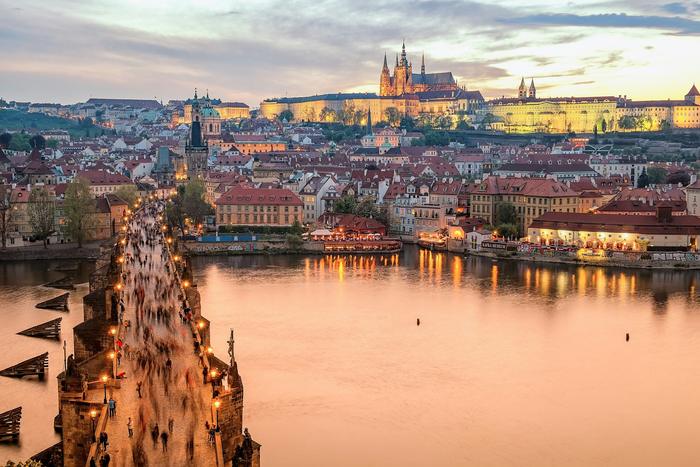
Prague Castle holds the Guinness World Record as the largest ancient castle complex on earth — roughly 570 metres long and seven hectares, a thousand-year-old citadel crowned by the soaring Gothic St Vitus Cathedral. Below it the statue-lined Charles Bridge crosses the Vltava to an Old Town where the medieval Astronomical Clock performs on the hour. Prague’s Historic Centre is UNESCO-listed (1992), and the whole thing is walkable in a long weekend — the concentrated wow that is Czechia’s entire pitch.
Czechia wins on the single-city break. Prague is a complete, gorgeous long weekend — the castle and St Vitus on one bank, the Charles Bridge and Old Town on the other, the Jewish Quarter of Josefov between them, and beer halls throughout — with Český Krumlov, the Kutná Hora bone church and the spa town of Karlovy Vary as easy add-ons. No single Polish city has quite Prague’s concentrated, instant storybook effect. If you want one knockout cityscape and a tight, low-effort trip, this is it.
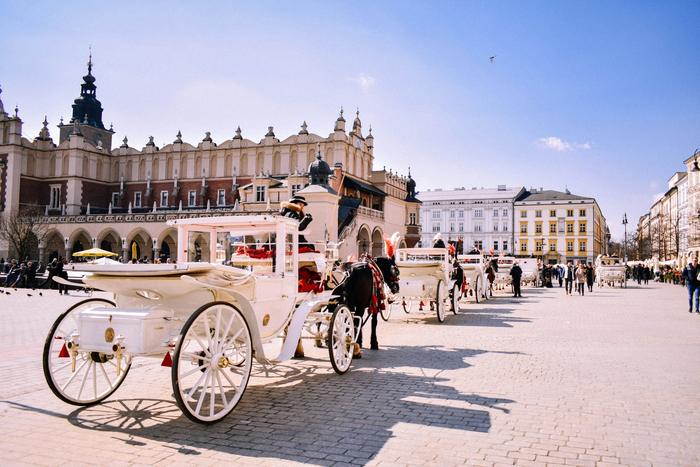
Poland wins on range and depth. Kraków’s medieval Old Town surrounds Europe’s largest medieval market square; Warsaw’s Old Town was rebuilt so faithfully after wartime destruction that it was UNESCO-listed precisely as a reconstruction; Gdańsk brings Hanseatic grandeur, amber and the Solidarity story; the Tatras at Zakopane add real mountains; and the memorial at Auschwitz-Birkenau and the WWII story give the trip a weight Prague does not reach for. It is a country of cities and memory, not a single perfect one — choose the fairy-tale weekend, or the history-and-variety country.
Cost
Both cheap — Poland a shade cheaper, Prague the exception
This is the closest call on the page. Both are excellent value by Western-European standards; the gaps are structural, not dramatic.
A few złotythe milk-bar lunch that undercuts anything in Prague
Poland’s "bar mleczny" (milk bar) — the plain, state-subsidised canteen that survived from the communist era — serves pierogi, soups and potato pancakes for a few złoty, the cheapest proper lunch in either country. Czechia’s equivalent value is the neighbourhood pub, where a half-litre of world-class lager can still cost less than a soft drink. Both countries are genuinely cheap; Poland simply has a lower floor, and central Prague the higher ceiling.
If budget is the deciding factor, the honest answer is that it should not be — both are among the best value in Europe, and the difference between them is a shade, not a tier. Poland edges it, with a lower floor set by the milk bars and generally cheaper food, transport and lodging outside the very centre of the big cities. Czechia is close behind, and cheaper than Western Europe throughout — but central Prague is the exception, having risen enough that the heart of the Old Town can cost as much as a Western capital.
The practical move in both is the same: step a few streets off the main square and prices fall sharply. In Czechia that means the neighbourhood pub over the Old Town Square terrace; in Poland it means the milk bar over the Rynek café. Beer is where Czechia reclaims ground — its lager is a genuine value as well as a cultural fixture — while Poland’s cheap vodka is a feature rather than the point.
Czechia
Poland
Overall
Good value; cheaper than Western Europe
A touch cheaper across the board
The cheap end
Neighbourhood pubs, outside Prague
Milk bars — a notch lower still
The pricey spot
Central Prague — risen, the dearest in either
Central Kraków/Warsaw in peak season
Beer / drink
Famously cheap lager — a national value
Cheap vodka and beer; not the headline
Tipping
~10%, usually by rounding up
~10% for good service
We keep exact daily figures off this page — they go stale within a season and both countries are rising with inflation. The reliable structural rule: both are cheap, Poland runs marginally cheaper, and the one spot that breaks the pattern is central Prague, which has crept up to be the most expensive corner of either country.
Getting around
Good trains and buses in both — but Poland is a bigger map
Both countries run on good, cheap rail and coaches, and you can skip the car in both. The difference is distance: Poland’s cities are far enough apart that the train becomes the trip.
~2h15Warsaw–Kraków by fast train — and Prague–Brno in similar time
Poland’s PKP Intercity runs premium Pendolino services on the busy routes — Warsaw to Kraków in about 2h15, Warsaw to Gdańsk under three hours — while Czechia’s České dráhy, RegioJet and Leo Express run frequent reserved-seat trains along the Prague–Brno–Ostrava spine. The networks are comparable in quality; the difference is scale. In Czechia most sights are day trips from one Prague base. In Poland the cities are destinations in their own right, far enough apart that you move your base as you go.
The two transport systems are more alike than different: fast, comfortable, cheap intercity trains; a dense cheap FlixBus layer for the gaps; and good city tram and metro networks that make a hire car a liability in town. You can do either country entirely car-free and most people should — a car earns its keep only for Poland’s Tatras and Białowieża, or the odd Czech backroad.
Where they genuinely differ is how the map shapes the trip. Czechia is a one-base country: Prague sits central, and Český Krumlov, Kutná Hora, Karlovy Vary, Plzeň and even Brno all work as day trips, so you unpack once. Poland is a move-as-you-go country: Kraków, Warsaw and Gdańsk are too far apart and too individually rewarding to day-trip, so a proper trip is a rail circuit of two or three bases. That is the scale difference in practice — not better or worse trains, but a weekend of spokes versus a week of hops.
Czechia
Poland
Intercity rail
ČD / RegioJet / Leo Express; Prague–Brno–Ostrava
PKP Intercity + Pendolino; Warsaw–Kraków–Gdańsk
Buses
RegioJet / FlixBus to towns off the rail line
FlixBus — dense, cheap, often the budget option
City transit
Prague metro/tram/bus — validate or be fined
Trams and metro, all tap-and-go
Car needed?
Rarely — most sights day-trip from Prague
Only for the Tatras, Białowieża and backroads
The model
One base (Prague), spokes out
Move between bases by train
Both are easy car-free trips. In Czechia one Prague base reaches almost everything — Český Krumlov, Kutná Hora, Karlovy Vary — as a day trip. In Poland the rail links are fast and cheap but the cities are genuine destinations, so a week is a circuit of two or three bases, not spokes from one. Book Czech trains on the operators’ sites and Polish rail on the official intercity.pl for the cheapest advance fares.
One Czech-specific rule that fines tourists where Poland does not: in Prague, validate your single transit ticket in the yellow machine the moment you board or enter the metro. Plainclothes inspectors check, and an unvalidated ticket now costs CZK 1,200 on the spot (2,000 if you pay late), with just a one-minute activation window — raised in January 2026. A day or time pass validated once removes the gamble. Poland’s trams and metro are simple tap-and-go by comparison.
Beer & food
The world’s best lager, versus dumplings and the milk bar
Both tables are hearty, meaty and cheap — but Czechia’s beer is the headline, while Poland’s is the pierogi-and-milk-bar comfort food that goes lower on price.
No. 1 for decadesCzechia — the world’s top beer-drinking nation
Czechs drink more beer per head than any nation on earth — around 180 litres a year, and the top spot for decades. Pilsner, the pale lager that conquered the world, was born in Plzeň in 1842 (Pilsner Urquell), and České Budějovice is the original Budweiser. The traditional pub runs on a paper tally slip: a fresh beer arrives the moment your glass runs low, and a coaster on top means "no more". It is the most Czech ritual there is — and beer this good is nowhere near this cheap in Poland.
Czech food is hearty and meat-and-dumpling-heavy — the national svíčková (beef sirloin in a cream sauce with bread dumplings), the everyday vepřo-knedlo-zelo (roast pork, dumplings, sauerkraut), rich guláš — but the real heart of it is the beer. Czechia drinks more lager per head than anywhere on earth, invented pilsner in Plzeň, and runs a pub culture with its own etiquette of tally slips and coasters. If beer is the point of a trip, Czechia is in a class of its own and Poland, for all its vodka, is not competing.
Poland’s table is the mirror image — the strength is the food and the price, not the drink. Pierogi in a dozen fillings, bigos hunter’s stew, tangy żurek sour-rye soup, crisp potato pancakes, and in the mountains the smoked sheep cheese oscypek. And its signature value is the milk bar (bar mleczny), the subsidised canteen that survived from the communist era and still serves a genuinely cheap, authentic lunch for a few złoty. Both are comfort-food countries; Czechia leads on beer, Poland on the bargain plate.
Czechia
Poland
The headline
Beer — world-class lager, cheapest around
Food — pierogi, soups, the milk bar
National dish
Svíčková; vepřo-knedlo-zelo; guláš
Pierogi; bigos; żurek sour-rye soup
Street / snack
Bramboráky (potato pancakes)
Zapiekanka (toasted baguette)
Cheapest lunch
The neighbourhood pub
The milk bar — a few złoty
Drink
Pilsner Urquell, Budvar lager
Vodka; bison-grass żubrówka
Both cuisines are pork-, dumpling- and cabbage-heavy Central-European comfort food, and both are cheap. One tourist-trap caveat for Prague: the trdelník "chimney cake" sold everywhere is NOT a traditional Czech pastry — it is a recent import. Poland’s equivalent sweet is the jam-filled pączek doughnut, which is the real thing.
History
A velvet revolution, or the full weight of the century
Both have deep, dramatic histories — but one wears it lightly as backdrop, the other puts it front and centre.
VelvetCzechia’s defining modern turns were peacefulThe 1989 Velvet Revolution and the 1993 Velvet Divorce — both bloodless
WWII + SolidarityPoland’s history is front-and-centre and sombreAuschwitz-Birkenau, Warsaw’s destruction and rebuilding, the Solidarity movement
1978–80Kraków, Wieliczka, Auschwitz and Warsaw were early UNESCO sitesAmong the very first inscribed — history is the explicit draw
Czechia wears its history lightly. Prague’s Habsburg and Bohemian past, Franz Kafka, the composers Dvořák and Smetana, the Art Nouveau of Mucha — and a modern story defined by two famously peaceful turns: the 1989 Velvet Revolution that ended communism and made the playwright Václav Havel president, and the amicable 1993 "Velvet Divorce" that split Czechoslovakia without a shot. It is rich history as civilised backdrop to a beautiful-city break, not the reason you came.
Poland puts its history at the centre, and it is heavier. The country was partitioned off the map for over a century, devastated in WWII, and spent four decades under communism until Solidarity broke it. That weight is unavoidable and deliberate on a Polish trip: the Auschwitz-Birkenau memorial near Kraków, Warsaw’s meticulously reconstructed Old Town, the Gdańsk shipyards where Solidarity began. For a history-led, often sombre and moving trip, Poland is the clear choice; for fairy-tale atmosphere with history as texture, Czechia.
If you plan to visit Auschwitz-Birkenau — the single most-booked thing on a Poland trip — you must reserve a free timed entry card online at visit.auschwitz.org, from 90 days to about a week ahead; none are sold at the gate, and summer slots go weeks out. In the busier morning hours a paid guided tour is effectively required. It is about 1.5 hours from Kraków; allow at least 3.5 hours on site. Czechia has no single site that needs this kind of planning.
Who suits which
Who each actually suits
On several of these the answer inverts — the country that wins overall is the wrong one for your trip.
If you are…
Czechia
Poland
After one perfect city break
Wins clearly. Prague is a complete long weekend
Wants more time and more cities
Chasing world-class beer
Wins clearly. The No.1 beer nation, cheap pilsner
Good, but it is a vodka country
History-led and willing to be moved
Velvet Revolution, Habsburg — as backdrop
Wins clearly. Auschwitz, WWII, Solidarity
Wanting mountains or a coast
Landlocked; gentle hills only
Wins. The Tatras at Zakopane and the Baltic at Gdańsk
On the tightest budget
Cheap — but central Prague is the dear spot
Edges it. Milk bars set a lower floor
Travelling several cities by train
One great city; the rest are day trips
Wins. Kraków–Warsaw–Gdańsk is the trip
Short on time (a weekend only)
Wins. Prague is made for it
Feels rushed below four days
The inversions are the point. Czechia is the better country for the single best city weekend and for beer; Poland is the better country for range — history, mountains, coast, several cities, and the lowest prices. Pick on the shape of the trip you actually want, not on which country sounds grander. A beer-and-architecture long weekend is Prague even though Poland is the bigger, more varied place.
Doing both
Neighbours you can pair — Prague with Kraków
Plenty of people asking "which one?" are really asking "can I do both?" — you can, because they share a border.
By rail or roadPrague to Kraków — a direct hop between neighbours
Czechia and Poland share a border, so pairing them is easy: Prague and Kraków are linked by direct trains, cheap FlixBus coaches and short flights, with no passport check between them (both Schengen) and no currency to change until you arrive. Treat it as two separate itineraries stitched together — a storybook Prague weekend, then a history-and-cities Kraków base — rather than one circuit, and allow extra days for the move.
Because they are neighbours, a longer trip can pair Prague with Kraków without much trouble — direct rail, cheap coaches and short flights link them, and being in the same Schengen area means no border formalities in between. The natural shape is a Prague long weekend followed by a Kraków base with its day trips (Auschwitz, Wieliczka), rather than a single loop, so budget travel time for the hop and don’t try to cram both into a short break.
Each country also compares more naturally with its other neighbours. Poland lines up against Hungary, Romania and Croatia; Czechia against Italy and Spain. The full operational detail for each half of a combined trip lives on the country guides: Czechia and Poland.
If you only have three or four days, do not try to do both — pick Prague for the compact fairy-tale weekend or Kraków for the history base, and keep the other for next time. The pairing earns its keep over a week or more, when you have the days to let Prague be the storybook city and Poland be the country of cities, each at its own pace.
What you give up
What each choice costs you
Choose Czechia and you give up range. There is no coast, no high mountains, no second city on Prague’s level, and no history site with the weight of Auschwitz — it is one magnificent city with pretty satellites, and a week can start to feel like you have seen the country. If variety, mountains, a beach or a profound historical journey is what you are after, the compact brilliance of Czechia will feel thin.
Choose Poland and you give up concentration. There is no single city that lands the instant, storybook wow of Prague, the distances mean more travel time between bases, and the headline history is often sombre rather than charming. A long weekend is not really enough to do it justice — it is a country that rewards the week you give it, and punishes the trip that is too short.
And one thing both choices leave out deliberately: exact current prices. Food, hotels and transport in both countries move with season and inflation faster than a page like this can stay accurate, and a stale price is worse than none — so this compares the shape of the difference, with the live detail kept on the two country guides. The shared entry mechanics (both Schengen, koruna vs złoty) and Poland’s timed Auschwitz and Wieliczka bookings are covered there rather than restated here.
Czech Republic or Poland, month by month
Which of the two is the better bet for each month of the year, scored on
how well the season suits each place.
Multiple cities, mountains and a coast — Kraków, Warsaw, Gdańsk and the Tatras — beat a single destination.
You want a history-led, often moving trip: Auschwitz, the WWII story and Solidarity are the reason you are going.
You have a week or more and want range and variety over one perfect city.
Every złoty counts — the milk bars and generally lower prices give Poland the cheaper floor.
Common questions
Is Czechia or Poland better for a short city break?
Czechia — Prague is one of Europe’s great city breaks, a compact fairy-tale of Old Town squares, the Charles Bridge and the castle, easily enjoyed in a long weekend, with the world’s best (and cheapest) beer culture on top. Poland rewards a longer, multi-city trip — Kraków at a minimum, ideally with Warsaw and the coast, and it feels rushed below four days. For a focused weekend, Prague; for a week with more variety, Poland.
Which has the deeper history?
Poland — its history is profound and front-and-centre, from Kraków’s medieval core and the Auschwitz-Birkenau memorial nearby to Warsaw’s meticulous post-war reconstruction and the WWII and Solidarity stories. Czechia has rich history too (Prague’s Habsburg and Bohemian past, the peaceful Velvet Revolution and Velvet Divorce), but it wears it more lightly, as backdrop to a beautiful-city break. For a history-led, often sombre trip, Poland; for fairy-tale atmosphere, Czechia.
Do they use the euro, and which is cheaper?
Neither uses the euro — both kept their own currency (Czechia the koruna, Poland the złoty) despite being in the EU and Schengen (EES is live, ETIAS expected 2027). Both are very good value by Western-European standards; Poland runs a shade cheaper across the board — its milk bars set a low floor — while the one expensive spot in either country is central Prague. Czech beer is the standout bargain. The country guides carry the detail: Czechia and Poland.
Which is better for mountains, beer or the Christmas markets?
Different winners. For beer, Czechia is in a class of its own — the world’s top beer-drinking nation, the birthplace of pilsner, with the cheapest great lager anywhere. For mountains and a coast, Poland wins outright: the Tatras at Zakopane and the Baltic at Gdańsk, neither of which landlocked Czechia can offer. For Christmas markets, Prague’s Old Town Square is the headline scene, though Poland’s cities have fine ones too.
Can I combine them?
Yes, easily — they’re neighbours, linked by direct road, rail and short flights with no border check between them (both Schengen), so a longer trip can pair Prague with Kraków without much trouble (separate itineraries rather than one circuit — allow extra days for the move, and skip the pairing if you only have a weekend). Each also compares with its other neighbours — Poland with Hungary, Romania and Croatia, Czechia with Italy and Spain.