
Denmark
A long weekend in Copenhagen — design, cycling, and new-Nordic food.
Denmark is, for most visitors, a Copenhagen trip. The city does design, cycling, and new-Nordic cooking better than almost anywhere, packed into a few flat, walkable days. Add the Tivoli gardens, harbour swimming in summer, and easy day trips, and a short stay covers it. It is polished and effortless — and one of the most expensive cities in Europe.
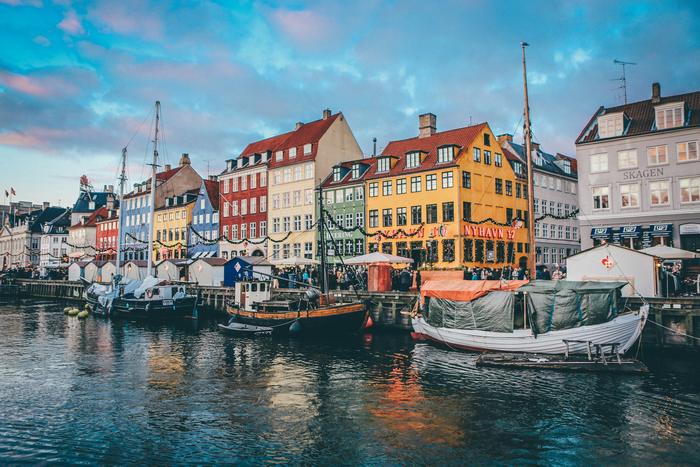
Three or four days is about right. You rent a bike on the first morning and barely stop — out to Nyhavn's painted waterfront, the design museum, the food halls, a harbour-bath swim when the weather allows. Evenings run from a cheap smørrebrød lunch counter to a once-a-trip new-Nordic tasting menu, and both ends justify themselves. Tivoli is worth an evening, and the coast or the Louisiana art museum makes an easy day out. Everything is flat, close, and runs on time.
The honest part: Copenhagen is genuinely expensive — drinks, dinner, and hotels all land higher than you expect, and the celebrated restaurants book out far ahead and cost accordingly. The weather is the other catch: grey, wet, and windy for much of the year, with the city only reliably bright from late spring through summer. There is also not a great deal beyond the capital for a first-timer, so this is a short city break rather than a two-week country trip. Come for a focused long weekend and it delivers.
Highlights
-
Copenhagen & Nyhavn
A flat, cyclable city with a painted harbourfront at its centre.
-
New-Nordic dining
From smørrebrød counters to the tasting menus that reset the genre.
-
Tivoli Gardens
A century-old pleasure garden, best on a summer evening.
-
Harbour baths & cycling
Swim in the clean harbour and get everywhere by bike.
Practical info
- Visa
- Schengen — visa-free for most Western passports (90 days).
- Currency
- DKK (Danish Krone). Not in the euro.
- Language
- Danish. English near-universal.
- Safety
- Very safe.
- Getting around
- Bike-first city; excellent metro, trains, and buses.
- Tap water
- Tap water excellent.
- Plug type
- Type C Type F 230V
- Money
- Effectively cashless. Cards and phone payments everywhere.
General guidance — visas, safety, and health change, so check your government's travel advisory and the official sources before you go.
Common questions
- Does Denmark use the euro?
- No — it’s in the EU but not the eurozone, and uses the Danish krone (DKK), pegged to the euro at about 7.46. Pay in kroner (almost always by card); euros get poor rates. See entry.
- Do I need a car?
- No — the DSB trains, Copenhagen’s 24/7 driverless metro and cycling cover a city-and-rail trip; it’s flat and compact. Rent a car only for rural Jutland touring. See getting around.
- How expensive is it?
- Very — Eurostat ranks Denmark the EU’s most expensive country (about 140% of the EU average), with restaurants, hotels and alcohol the sharpest. The 25% VAT is baked into prices. See the cost section.
- Do I need cash?
- Almost never — Denmark is one of the world’s most cashless countries; contactless cards, Apple/Google Pay and local MobilePay work everywhere, and some places no longer take cash.
- Is Tivoli open year-round?
- No — Tivoli Gardens runs seasonal periods (summer, Halloween, Christmas) and closes entirely between them, so check the dates before building a trip around it. See the Copenhagen section.
- Can I get to Sweden easily?
- Yes — the Øresund Bridge train reaches central Malmö in about 35 minutes from Copenhagen, running every 10–20 minutes. An easy half-day in another country.
Entry & money
Schengen, but the krone, not the euro
Standard EU entry — with one catch travellers get wrong: it’s not the eurozone.
Denmark is Schengen, so entry is the standard European affair — 90 days in 180 visa-free for the main Western passports, with the EES biometric system now live and ETIAS expected in 2027. The thing people misjudge is the money: Denmark is in the EU but not the eurozone, and uses the Danish krone, pegged to the euro at roughly 7.46.
Some tourist spots accept euros, but at poor rates with change in kroner — so pay in DKK, which in practice means paying by card almost everywhere.
Don’t arrive expecting euros to work smoothly — it’s the krone, and the real answer is to pay by card or phone (Denmark is near-cashless), skipping currency entirely. There’s nothing to arrange for the EES beyond your passport; ETIAS isn’t live yet.
Copenhagen
Canals, Tivoli and design
The capital is the headline — Nyhavn, Tivoli and the palaces — and seriously expensive.
Copenhagen packs the set-pieces: the painted 17th-century harbour of Nyhavn, the royal palaces of Amalienborg and Rosenborg (the crown jewels), the Little Mermaid (brace for how small she is), and Tivoli Gardens, one of the world’s oldest pleasure gardens — but strictly seasonal, closing between its summer, Halloween and Christmas runs.
It’s a city of superb museums and design-and-hygge atmosphere — and one of Europe’s most expensive, so budget accordingly.
Check Tivoli’s calendar before you plan around it — it shuts entirely between its three seasons (so a May or late-September visit can find it closed), and the Christmas season is arguably the most magical. Book the big museums and Tivoli online to skip queues.
Cycling, design & food
Bikes, Danish design, and New Nordic
Copenhagen runs on bikes, invented much of modern design, and reshaped fine dining.
To feel Copenhagen, get on a bike — separated lanes line nearly every street, and the elevated orange Cykelslangen ramp is a small landmark. The city gave the world mid-century Danish design (Arne Jacobsen, Hans Wegner, the PH lamp), and it reshaped dining through the New Nordic movement.
But note the Noma reality: Noma closed as a conventional fine-dining restaurant at the end of 2024 and is now “Noma 3.0,” a food-innovation lab with pop-ups and products — not an everyday bookable table. The New Nordic influence lives on across the city’s other restaurants.
Don’t plan a trip around dinner at Noma — it’s no longer a regular restaurant. And as a pedestrian, stay out of the cycle lanes: they look like pavement but carry fast, constant bike traffic with priority. Hire a bike yourself (city shops or the station OV-fiets equivalent) to see the city as locals do.
Beyond Copenhagen
Jutland, Funen and the north
The rest of Denmark is a short train ride — art, fairy tales, Vikings and cliffs.
Denmark beyond the capital is small and well-connected. Aarhus, the Jutland second city, has the ARoS gallery crowned by Olafur Eliasson’s circular rainbow walkway; Odense on Funen is Hans Christian Andersen’s town; Roskilde holds five original Viking ships and a royal-burial cathedral. At the northern tip, Skagen is where the Skagerrak and Kattegat seas meet in a visible line, under the clear light that drew a school of painters.
Add the chalk cliffs of Møns Klint and Legoland at Billund, and there’s a week here beyond Copenhagen — all reachable by train.
- Design and modern artSkiponly doing CopenhagenGoAarhus — ARoS and its Rainbow Panorama
- Fairy tales and familiesSkipskipping JutlandGoOdense (Hans Christian Andersen) and Legoland Billund
- Vikings and royal historySkipstaying in the capitalGoRoskilde — the Viking ships and the cathedral
| Place | What | Note |
|---|---|---|
| Aarhus | ARoS + “Your Rainbow Panorama” | The second city, in Jutland |
| Odense | Hans Christian Andersen’s birthplace | On the island of Funen |
| Roskilde | The Viking Ship Museum | Five original 11th-c. ships; UNESCO cathedral |
| Skagen | Where two seas meet (Grenen) | The painters’ light, at the northern tip |
Plus the white chalk cliffs of Møns Klint and Legoland Billund (seasonal). All are an easy DSB train ride from Copenhagen.
Don’t stop at Copenhagen — the trains make the whole country a day-trip radius, and Aarhus, Odense and Roskilde each justify an outing (or an overnight). For families, Jutland’s Legoland Billund is the draw, but it’s seasonal, so check it’s open for your dates.
Getting around
Trains, a 24/7 metro, and a bridge to Sweden
Fast, flat and car-free — with a 35-minute hop to another country.
Denmark runs on trains and bikes. The DSB network links the cities, Copenhagen’s driverless metro runs 24/7, and the airport has a station ~15 minutes from the centre. The showpiece is the Øresund Bridge: a 35-minute train ride delivers you to central Malmö, Sweden.
A car is only worth it for rural Jutland; if you drive, note the Great Belt Bridge toll between Zealand and Funen. Pay for transit with Rejsekort or contactless.
| Journey | How | Note |
|---|---|---|
| Copenhagen → Malmö (Sweden) | Øresund Bridge train | ~35 min, every 10–20 min |
| Airport → city centre | Metro or train | ~15 min; the metro runs 24/7 |
| Across the country | DSB intercity trains | Copenhagen–Odense–Aarhus–Aalborg |
| Zealand ↔ Funen by car | Great Belt Bridge | Tolled (~DKK 235 one way) |
Pay with Rejsekort or contactless. Drive on the right — but a car isn’t needed for a city/rail trip; cycling and trains cover almost everything.
Skip the car for a city-and-rail trip — Denmark is flat, compact and superbly trained, and parking is costly. Use the 35-minute Øresund train to Malmö for an easy day in Sweden (carry your passport — it’s an EU internal crossing but ID checks happen), and pay everything by contactless.
When to go
Long summers, hygge winters
A mild, damp climate with a bright summer and a cosy, dark winter.
~17 hours of daylight at midsummer
Tivoli closes entirely between its seasons (summer, Halloween, Christmas), so check dates. The climate is mild and damp year-round with no extremes — pack a rain layer whenever you come.
Summer (June–August) is the peak — long days, outdoor life, festivals — with spring and autumn the quieter shoulders. Winter is short-lit and cold, but it’s the hygge season of candlelit cafés, Christmas markets and Tivoli’s Christmas garden, which has its own appeal.
The climate is otherwise mild and maritime — grey, damp and changeable rather than extreme — so pack for rain in any season.
The cost
The EU’s most expensive country
Budget hard: Denmark tops Europe for restaurants and hotels.
~140% of the EU average price level — the highest
There’s no softening it: Denmark is the EU’s most expensive country, around 140% of the European average and dearest of all for eating out and hotels. The upside is transparency — the 25% VAT is in every displayed price, and tipping isn’t expected (service is included), so the sticker is close to the total.
It’s also near-cashless: contactless, Apple/Google Pay and local MobilePay are accepted virtually everywhere, and you can travel without touching a banknote.
| On the bill | Detail | Note |
|---|---|---|
| Prices | The EU’s most expensive country | ~140% of the EU average; restaurants/hotels sharpest |
| VAT | 25% | Baked into displayed prices — no surprise at the till |
| Payment | Near-cashless | Cards, Apple/Google Pay and MobilePay everywhere |
Currency is the Danish krone (DKK), pegged ~7.46 to the euro. Tipping is not expected (service is included); tap water is free and excellent.
Save where Danes do: bakeries, smørrebrød lunches, hot-dog stands and the free tap water beat restaurant dinners, and a city card or the free museum days trim the sightseeing. You never need cash — but you do need to accept that even modest meals cost more here than almost anywhere in Europe.
Culture & side-trips
Hygge, happiness, and two far-flung territories
A high-trust, happy society — with Greenland and the Faroes flying its flag.
Denmark is a high-trust, egalitarian welfare society that reliably sits near the top of the world happiness rankings — the home of hygge — with near-universal fluent English. On the plate it’s smørrebrød (open rye-bread sandwiches), the pastries the world calls “Danish,” and the Carlsberg brewing heritage.
Two autonomous territories fly the Danish flag far afield — the Faroe Islands and Greenland — each a self-governing long-haul destination in its own right, not a day trip.
If the Faroes or Greenland tempt you, treat them as separate expeditions reached via Copenhagen, not Danish add-ons — each has its own weather, cost and logistics. In Denmark itself, lean into hygge: the country is at its best not in grand sights but in a candlelit café on a grey afternoon.
Compare Denmark
If you like Denmark, also consider

France
Paris is only the opening act — wine country, the Alps, and two coastlines.

Italy
The benchmark for food, history, and beauty.

Greece
Ruins in the morning, a swim by noon, taverna until dark.

Japan
Extraordinary food, culture, and cities. Nothing quite prepares you for it.
United States
A continent pretending to be a country — cities, deserts, and the best national parks anywhere.
China
Ancient history and hypermodern cities at a scale that's hard to grasp until you're there.
Not sure where to go
Take the 5-minute quiz
Answer a few honest questions and get matched to destinations that actually fit how you travel.
Start the quiz