Brazil
A continent of a country. Pick two or three things and commit.
- January: peak
- February: peak
- March: fine
- April: fine
- May: fine
- June: fine
- July: fine
- August: fine
- September: peak
- October: peak
- November: fine
- December: peak
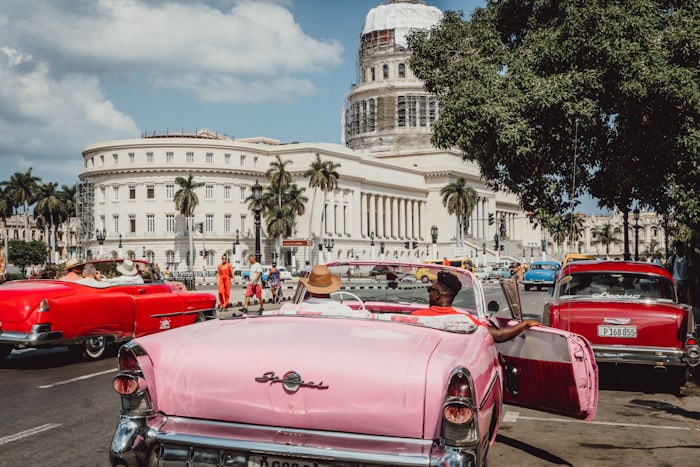
Two Latin destinations with a shared love of music and rhythm but opposite realities. Brazil is the vast, vibrant giant — Rio’s beaches, the Amazon, Iguaçu Falls and the world’s biggest Carnival — a big, varied, forward-moving trip (now needing a visa for some). Cuba is the Caribbean time-capsule — Havana’s classic cars and crumbling grandeur, son and salsa everywhere — intoxicating in atmosphere but, in 2026, a country in deep economic crisis. One is a sprawling, functional adventure; the other a singular, challenging cultural experience.
A continent of a country. Pick two or three things and commit.
Music, classic cars, and crumbling grandeur — go for the country, not the comfort.
Read our full guides about Brazil and Cuba.
Emphasised where they differ. Muted rows are much the same either way.
| Brazil | Cuba | |
|---|---|---|
| Best time | September, October, December–February | November–April |
| Climate | warm | warm |
| Budget | Good value with a soft real — domestic flights across a huge country are the cost | Cash-only — bring every euro/dollar you’ll need; cards don’t work |
| Trip length | 2–4 wks | 1–2 wks |
| Visa | Visa-free for many Western passports; US, Canadian, and Australian visitors need an eVisa. | Tourist card required for most Western passports; buy before travel. Verify rules first. |
| Currency | BRL (Real), roughly 5 BRL ≈ 1 USD. | CUP (Cuban Peso). Bring cash (USD or EUR); most Western cards do not work. |
| Language | Portuguese. Limited English outside tourism. | Spanish. Limited English. |
| Tap water | Stick to bottled water. | Tap water not safe to drink; stick to bottled. |
| Safety | Exercise caution in big cities; petty crime is common, so keep valuables low-key. | Low violent crime; watch for scams and petty theft in Havana. |
General guidance — visas, safety, and health change, so check your government's travel advisory and the official sources before you go.
The split
Both are Latin and musical — but one is a vast, functional, forward-moving country, the other a singular time-capsule under great strain.
Brazil is the vast, vibrant giant — Rio’s beaches, the Amazon, Iguaçu Falls and the world’s biggest Carnival — a big, varied, forward-moving trip (now needing a visa for some). Cuba is the Caribbean time-capsule: Havana’s classic cars and crumbling grandeur, son and salsa everywhere — intoxicating, but in 2026 a country in deep economic crisis.
The operational detail — Brazil’s reinstated e-visa, yellow fever and internal flights; Cuba’s US-travel rules, cash-only reality, shortages and ESTA knock-on — lives on the two guides: Brazil, know before you go and Cuba, know before you go. This page is the head-to-head.
The real difference
The trade: Brazil offers variety and functional travel; Cuba offers a one-of-a-kind atmosphere at the cost of real hardship.
Brazil wins on scale, variety and function. Beaches, the Amazon, the Pantanal and Carnival come in a big, functional country where cards work — a rewarding adventure, with the planning and entry admin a continent-sized country needs.
Cuba wins on singular atmosphere — with eyes open. Nothing feels like Havana, and the music and faded grandeur are unforgettable, but in 2026 it means genuine hardship: shortages, blackouts, all-cash budgeting and an “all but essential travel” advisory. Choose the vibrant giant, or the time-capsule.
Who suits which
Both are Latin and musical — but one leans variety and function, the other atmosphere and accepted hardship.
| If you want… | Brazil | Cuba |
|---|---|---|
| Functional, varied travel | Wins. Big but working | In deep crisis |
| A one-of-a-kind atmosphere | Vibrant and modern | Wins. Havana time-capsule |
| Beaches and the Amazon | Wins. Rio and the rainforest | Beaches, smaller scale |
| Working cards and infrastructure | Wins. Cards and Pix | Cash-only, blackouts |
| Carnival and music | Wins. The world’s biggest | Son and salsa |
| No US-travel complications | e-visa for some | Neither simple. OFAC + ESTA knock-on |
Doing both
South America and the Caribbean, with different demands.
Brazil and Cuba are far apart and make very different demands, so they’re separate trips — you’d connect via a hub, and most people choose one. Brazil pairs more naturally with its neighbours (see Argentina vs Brazil and Brazil vs Peru); Cuba with Colombia vs Cuba and Argentina vs Cuba.
What we leave out
Exact prices beyond the structural comparison — Brazil’s flight-heavy budget and Cuba’s cash budgeting both move — so the figures here are the shape of the difference, not a quote; the country guides carry the live detail. Each country’s volatile specifics (Brazil’s e-visa and yellow fever, Cuba’s US rules, rates, shortages and advisory) are covered on its guide, to be checked before you commit, rather than restated here.
Which of the two is the better bet for each month of the year, scored on how well the season suits each place.
Mexico City is world-class. Add the coast, ruins, and food culture.
A continent pretending to be a country — cities, deserts, and the best national parks anywhere.
Surfing, rainforest, volcanoes, and wildlife in extraordinary density.
Seven hundred islands of impossibly clear water, from cruise-port Nassau to the empty Out Islands.
The Caribbean with a US plug socket — old-city romance, rainforest, and a bioluminescent bay.
Three islands, one national park, and no passport needed if you hold a US one.
The dry, breezy Caribbean island that sits below the hurricane belt — sunshine you can actually bank on.
Two coasts on one small island — calm Caribbean west, wild Atlantic east — with the best rum in the world.
Still undecided
Three matches. Often answers comparison questions for you.
Start the quiz