Two of Europe’s cheapest, most under-the-radar trips, pulling in opposite directions. Albania is a rising summer-sun destination — the Riviera’s turquoise Ionian coast, backed by Ottoman towns and serious mountains. Bosnia is a history-and-mountains country of Ottoman bridges, a moving 1990s war legacy and Olympic ski slopes — and, almost landlocked, it is not a beach trip at all. Same bargain prices, opposite holidays.
Both are cheap, under-the-radar Balkan trips — but one is a beach holiday, the other a history-and-mountains one.
Coast vs landlockedthe basic differenceAlbania’s Ionian Riviera, or Bosnia’s ~20 km of coast at Neum
Sun vs historywhat each is really forBeaches and boat days, or bridges and the siege story
Both dirt cheapthe thing they shareAmong Europe’s cheapest, cash-first trips
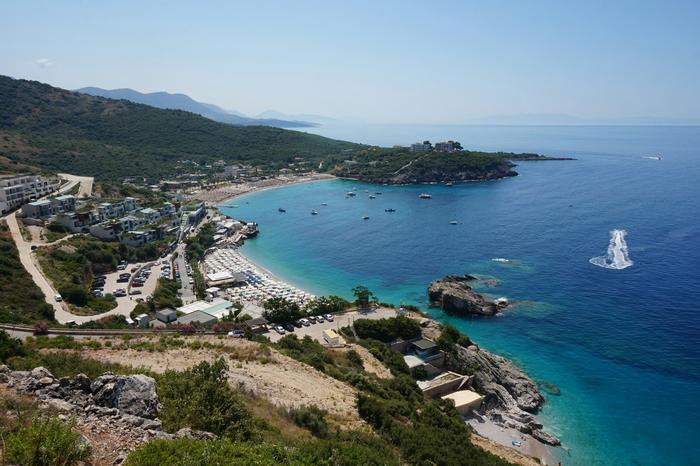
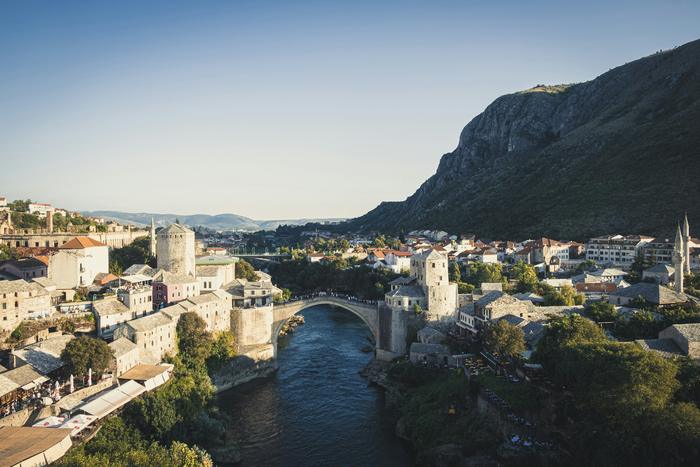
Albania is the rising sun destination. The Riviera’s turquoise Ionian coast around Ksamil, Dhërmi and Himara is the headline, backed by the UNESCO Ottoman towns of Berat (the "city of a thousand windows") and Gjirokastër (the grey-stone "city of stone"), the layered ruins of Butrint, and the serious hiking of the Accursed Mountains — a sun-and-sea trip with real range. Bosnia is the history-and-mountains one. Mostar’s rebuilt Stari Most, Sarajevo’s Ottoman Baščaršija bazaar and the weight of its 1992–96 siege, whitewater rafting and the 1984 Olympic ski mountains — and, almost landlocked, it offers no beach holiday at all.
The operational detail for each — Albania’s seasonal Riviera and chaotic, railless roads, Bosnia’s scenic Neretva train and landmine-safety guidance — lives on the two guides: Albania, know before you go and Bosnia, know before you go. This page is the head-to-head.
Entry & money
Two currencies, no Schengen, cash in hand
Neither is in the EU or the euro — and crucially, neither spends your Schengen days.
Non-Schengenboth — EES/ETIAS don’t apply at either borderTime here doesn’t count against your Schengen 90/180
1 year vs 90 daysAlbania’s unusually generous US visa-free stayBosnia gives everyone the standard 90 days in 180
Entry is easy for Westerners in both, and the headline quirk is Albania’s: US citizens may stay visa-free for up to a year, where Bosnia gives everyone the standard 90 days in 180. The money is where they differ in feel — Albania’s lek floats, Bosnia’s convertible mark is locked to the euro by a currency board, so prices in Bosnia convert in your head to a clean half-of-the-number-in-euros. Both are famously cheap, and both want cash: euros are accepted in the tourist coast and bigger hotels, but furgons, markets and small cafés want local notes.
Albania
Bosnia
Visa-free (US)
Up to a full year — unusual
90 days in any 180
Visa-free (UK/EU/CA/AU)
90 days in any 180
90 days in any 180
Currency
Lek (ALL), ~96–100 to the euro
Convertible mark (KM), pegged ~1.96 to the euro since 1997
EU status
Non-EU, non-Schengen (EU candidate)
Non-EU, non-Schengen (EU candidate since 2022)
Cards vs cash
Cash-first; euros taken and priced on the coast
Cash-first; marks for everyday spending
Because both sit outside Schengen, the EU’s EES and ETIAS systems don’t bite at their borders — they apply only when you cross onward into the EU (for Bosnia, typically into Croatia). That makes either a handy "reset" on a long Europe trip. Draw cash in the cities: ATMs thin out in the Albanian mountains, and much of Bosnia runs on cash.
When to go
Summer sea, winter slopes — opposite calendars
Their best months barely line up: Albania peaks in beach summer, Bosnia adds a winter Albania doesn’t have.
JFMAMJJAS
Shared shoulder — mild, quiet, everything openmid-May – Jun
mid-May – Jun
Albania — Riviera beach season (Aug busiest)Jun – Sep
Jun – Sep
Albania — Theth–Valbona hiking windowJun – early Oct
Jun – early Oct
Bosnia — rafting on the Una and TaraMay – Sep
May – Sep
Bosnia — ski season on the 1984 Olympic mountainsDec – Mar
Dec – Mar
The crimson bars are each country’s signature season — Albania’s warm-water coast and Bosnia’s winter ski flip — and they fall at opposite ends of the year. The shared sweet spot is the shoulder, mid-May to June and September to October: mild, quiet, and with venues open on both sides.
For the Sarajevo–Mostar circuit and for inland Albania (Tirana, Berat, Gjirokastër), the mild, quiet shoulders — May–June and September–October are ideal on both sides. After that the calendars diverge. Albania’s Riviera is a summer product that switches off in winter: the beach bars, sunbeds and boat tours set up in spring and the coast largely shuts from late autumn, so a winter coast trip means an empty, closed Riviera. Bosnia does the opposite in winter — the same mountains above Sarajevo that host summer hikers become cheap ski resorts (Jahorina and Bjelašnica) from December, with the most reliable snow in January. For activities, Albania’s mid-summer gives the Accursed Mountains’ Theth–Valbona hiking window; Bosnia’s gives rafting on the Una and Tara and the famous late-July bridge-diving at Mostar.
The cost
Both dirt cheap — the choice isn’t about money
Two of the cheapest trips in Europe, and neither is meaningfully pricier than the other.
A fractionof Western-European prices, in both countries
Food, lodging and transport in both Albania and Bosnia cost a fraction of Western Europe — these are genuine budget trips, not merely cheaper versions of a pricey one. Bosnia even extends that to skiing: the 1984 Olympic mountains are among the cheapest places to ski in Europe, 30 minutes from Sarajevo. The practical difference is the wallet, not the price tag: Albania counts in lek, Bosnia in the euro-pegged mark, and both run far more on cash than card.
Cost is the one axis where these two are near-identical, so it should rarely decide the trip. Both sit at the bottom of Europe’s price tables; both are cash-first; both deliver outsized value for the money. The honest takeaway is that you choose between them on what the holiday is — sun or history, coast or mountains — not on which is cheaper, because the gap is not real. We keep exact daily figures off this page because they move within a season; the live detail is on the country guides.
Carry the local cash. In Albania draw lek in the cities — ATMs thin out fast in the mountains, and furgons, markets and cafés want notes even where coastal hotels quote euros. In Bosnia carry convertible marks; cards work in city hotels and bigger restaurants, but everyday spending runs on cash. Euros are taken in tourist zones on both sides, but don’t rely on them away from the coast.
The sea
The sea: Albania’s to win
This is the cleanest split on the page — Albania is a coast, Bosnia is almost landlocked.
~20 kmof Adriatic coast is all Bosnia has, at Neum
Bosnia touches the sea only at Neum — about 20 km, the world’s second-shortest coastline — so it is not a beach trip in any meaningful sense. Albania, by contrast, runs a long turquoise Ionian Riviera, which is the whole reason the country is rising as a summer-sun destination. If sun and swimming are what you want from a cheap Balkan week, there is only one answer here.
Ksamilthe near-Maldivian islets down by the Greek borderWith Dhërmi, Himara, Borsh and Qeparo strung along the Ionian
Corfu hopSarandë is a short ferry from the Greek islandThe Riviera’s southern gateway
Rivers, not seaBosnia’s water is the turquoise NeretvaSwimming at Mostar, rafting on the Una and Tara
In Albania the sea is the headline: a summer-sun coast of turquoise water, boat days and a lively scene at Dhërmi and Sarandë, cheap enough to be one of the Mediterranean’s best-value beach trips — with the catch that the coast is seasonal and largely shuts in winter. In Bosnia the water you swim in is a river: the turquoise Neretva under Mostar’s bridge, and the rafting rivers of the Una and Tara. For sea alongside Bosnia, the standard move is to pair Mostar or Trebinje with the Croatian or Montenegrin coast next door — the sea is borrowed from a neighbour, not found at home.
The two legacies
Two 20th centuries, still visible
Both wear their recent history in the open — isolation in one, war in the other.
Isolation vs warthe legacy each country carries
Albania spent 1944–1985 under Enver Hoxha in near-total isolation, declared itself the world’s first officially atheist state, and was "bunkerised" with up to ~170,000 concrete domes against an invasion that never came — two of them, in Tirana, are now the Bunk’Art museums. Bosnia’s is the 1992–95 war: Sarajevo endured the longest siege of a capital in modern warfare, and Mostar’s Ottoman Stari Most was shelled into the Neretva in 1993 and painstakingly rebuilt from the original stone, reopening in 2004.
The mood of each trip comes from these legacies. Albania’s isolation left a strikingly secular, tolerant and fiercely hospitable present — Muslim-plurality with easy interfaith coexistence, the code of besa that led Albanians to shelter Jews in the Second World War, and a culture that greets you with insistent generosity and a glass of raki. Bosnia is a country of three peoples and three faiths (Bosniak, Serb, Croat), the reason Sarajevo is called "the Jerusalem of Europe" — a mosque, a Catholic cathedral, an Orthodox church and a synagogue within a few minutes’ walk — and its 1990s war is recent and visible in shell scars, cemeteries and memorials. It is a moving place to travel precisely because that history is so present and so openly reckoned with; tread thoughtfully around ethnic politics and let locals lead.
For LGBTQ+ travellers, the picture is similar on both sides: same-sex activity is legal (Albania since 1995, Bosnia since 2003) and the capitals have a scene and Pride events, but neither country recognises same-sex marriage or partnership, and attitudes stay conservative — especially outside Tirana and Sarajevo. The usual discretion applies in both.
The food
Ottoman home cooking, and a coffee ritual each
Near-identical roots — grilled meat, filo pastry and endless coffee — with a different signature plate and a different cup.
No. 1 in the worldAlbania’s coffee houses per capita
Albania has more coffee houses per head than any country on earth, overtaking Spain for the title in 2016 — the café is the centre of social life, and lingering over one is close to the national pastime. Bosnia’s coffee is about ceremony rather than count: brewed Turkish-style in a copper džezva, served with sugar and Turkish delight, and meant to be nursed for an hour. Different expressions of the same Ottoman habit.
If you love cheap, generous, meat-and-pastry eating, neither disappoints — and they share more than they differ. Albania’s table centres on tavë kosi, byrek and fresh Ionian seafood on the coast; Bosnia’s on ćevapi (Sarajevo’s version earned a PGI in 2024), burek, and hearty stews like bosanski lonac. The real divergence is the coffee: Albania drinks the most of it per head in the world, where Bosnia turns a single cup into an unhurried social ritual.
Albania
Bosnia
National plate
Tavë kosi — lamb and rice baked under a yogurt custard
Ćevapi — grilled minced-meat fingers in somun bread
Everyday snack
Byrek — flaky filled pastry, sold by the slice
Burek and pita — filo coils (meat, or cheese/spinach), by weight
The coffee
Strong, Turkish- or Italian-style, drunk everywhere
Bosnian coffee in a copper džezva, with a square of Turkish delight
The welcome shot
Raki — homemade grape or plum brandy
Rakija — usually plum (šljivovica)
Both cuisines are Ottoman-meets-Mediterranean and consistently cheap: grilled meat, filo pastry, yogurt and fresh produce, and a brandy poured the moment you’re welcomed. The dishes rhyme — byrek and burek are cousins — but the signature plate differs, and so does the coffee culture.
Getting around
No trains vs the Balkans’ best train
Albania runs on cars and shared minibuses; Bosnia has one of Europe’s great scenic rides.
Albania has no useful passenger rail and never feels like it: a hire car is the flexible way around (widest choice at Tirana airport), with the chaotic, assertive driving as the trade-off, and the budget alternative is the furgon — the shared minibus that is the country’s real public transport. Bosnia runs mainly on intercity buses, but its showpiece is a train: the Sarajevo–Mostar line through the Neretva gorge, on a modern Talgo set, widely rated among the best-value scenic rides in Europe, with a summer weekend extension across the border to Ploče on the Croatian coast. One country you drive; the other you can largely let the bus and the train carry you.
Albania
Bosnia
Passenger rail
None useful — Tirana has had no train since 2013
Thin, but the scenic Sarajevo–Mostar line is a highlight
The workhorse
Furgons — shared minibuses that leave when full, cash only
Intercity buses (Sarajevo–Mostar about 2h25)
The ride to take
The coastal SH8 drive over the Llogara Pass
The Neretva-gorge train on a modern Talgo set
Main airport
Tirana (TIA); Vlorë began scheduled flights in 2026
Sarajevo (SJJ); also Tuzla, Banja Luka, Mostar
Both are mountainous, so roads are slow and distances deceive — budget more time than the map suggests on either side. The difference is the backbone: Albania leans on hire cars and furgons, Bosnia on intercity buses plus the one train ride worth seeking out for its own sake.
Two local gotchas. In Albania there is no fuel on the ~55 km of mountain road over the Llogara Pass between Vlorë and Himara, so fill up in Vlorë before you climb, and remember furgons are cash-only and leave when full, not to any timetable. In Bosnia, Sarajevo has two bus stations — the main one in the Federation and the East Sarajevo (Lukavica) one in Republika Srpska — so check which one your bus uses.
Who suits which
Who each actually suits
Same bargain prices, opposite holidays — and on a few rows the answer inverts.
The inversions are the useful part. The country that wins overall for a summer holiday — Albania, for the coast — is the one to skip in winter and the wrong call if what you are really after is history, a great train ride, or snow. Bosnia loses the sun comparison outright and still wins the trip for anyone who would rather stand on a rebuilt bridge with 450 years of divers than lie on a beach. Read down the column that matches your trip, not the overall verdict.
If you want…
Albania
Bosnia
Beaches and summer sun
Wins clearly. The Ionian Riviera coast
Almost landlocked — not a beach trip
History and meaning
Ottoman towns and Hoxha’s bunkers — real depth
Wins clearly. Mostar, Sarajevo’s siege, the "Jerusalem of Europe"
Mountains and hiking
Edges it in summer. The Accursed Mountains, Theth–Valbona
Strong too — Sutjeska and the primeval forest
Winter
The coast shuts; little draw
Wins. Cheap skiing on the 1984 Olympic mountains
A lively coastal scene
Wins. Dhërmi and Sarandë nightlife
Quieter, more reflective
A great train journey
No useful rail at all
Wins. The Neretva-gorge ride
A rock-bottom budget
Ties. Among Europe’s cheapest
Ties. Among Europe’s cheapest
Doing both
Chainable — with Montenegro in the middle
Both Balkan, and they pair beautifully — but they’re not neighbours.
Montenegro betweenwhy there’s no single short hop
These combine into a wider Balkan road trip, but Montenegro sits between them, so there is no one short crossing. The natural loop runs Tirana → the Albanian Riviera → the Montenegro coast → Mostar and Sarajevo, often routed via Croatia or Trebinje, and it works by car or by bus — with the Montenegro leg as the connective tissue in the middle.
If you have the time, pairing them is genuinely worthwhile precisely because they are so different: a beach trip and a history trip back to back gives the contrast that a single-country week can’t. The practical shape is a loop rather than a there-and-back — down the Albanian coast, along Montenegro’s shorter, scenic shore, then up into Herzegovina for Mostar and on to Sarajevo. Both legs are cheap; the middle stretch is the planning cost.
If you want a bridge between the two trips, Trebinje in Bosnia’s deep south is a serene, wine-country add-on only about 30 km from Dubrovnik, which makes a Croatia-and-Montenegro coastal leg flow naturally into the Herzegovina half. Budget the Montenegro portion as its own mini-trip rather than a transfer, and the whole thing reads as one coherent Balkan arc.
What you give up
What you give up either way
Each choice has a real cost — name it before you book.
Choose Albania and you give up the weight. You trade Bosnia’s one-of-a-kind history — Sarajevo’s siege story, Mostar’s rebuilt bridge — plus one of Europe’s great scenic train rides and genuinely cheap skiing, for sun and sea. And you accept a seasonal coast that largely shuts in winter and the fast, assertive, railless driving that comes with getting around. Choose Bosnia and you give up the sea. There is no beach holiday here, no lively summer coastal scene, no warm swimming beyond a river — about 20 km of Adriatic at Neum is the whole of it — and the mood is more sober than a beach week. Neither is a compromise on price; both are a compromise on what kind of trip you are taking.
A few items move season to season, so re-check before you travel: Albania’s Riviera opening and the still-developing Vlorë airport route list, and Bosnia’s scenic-train seasons (including the summer Ploče weekend extension) and the landmine-safety guidance for off-trail rural areas. The country guides carry the live detail.
Albania or Bosnia & Herzegovina, month by month
Which of the two is the better bet for each month of the year, scored on
how well the season suits each place.
You want history and meaning — Mostar’s rebuilt Stari Most, Sarajevo’s siege story and Ottoman corners.
Mountains, whitewater rafting and even cheap skiing on the 1984 Olympic peaks over beach days.
A reflective, inland trip where the weight of recent history is the point — you are not here for the sea.
You would plan a trip around a single great train ride — the Neretva-gorge line is one of Europe’s best.
Common questions
Is Albania or Bosnia better for beaches?
Albania, with no contest — its Riviera (Ksamil, Dhërmi, Himara, Sarandë) is a genuine summer-sun coast with turquoise Ionian water. Bosnia is almost landlocked, with only about 20 km of Adriatic coast at Neum (the world’s second-shortest coastline), so it is simply not a beach destination. If sun and sea are the point, it is Albania; if they are not, Bosnia’s strengths lie elsewhere.
Is Albania or Bosnia cheaper?
Both are among Europe’s cheapest countries and broadly comparable — genuine budget trips where food, lodging and transport cost a fraction of Western Europe. Both are cash-first: Albania uses the lek (around 96–100 to the euro), Bosnia the convertible mark, pegged to the euro at about 1.96 to 1. Neither is meaningfully pricier than the other; the choice is not about cost.
What is each trip really for?
Albania is a sun-and-coast trip first — beaches and boat days on the Riviera, with the UNESCO Ottoman towns of Berat and Gjirokastër and the Accursed Mountains as range. Bosnia is a history-and-mountains trip — Mostar’s rebuilt Stari Most, Sarajevo’s Ottoman bazaar and siege history, rafting on the Una and Tara, and winter skiing on the 1984 Olympic mountains. One is holiday-warm, the other reflective and inland.
Is either one unsafe?
Both are very safe for tourists on normal routes, and both are rated Level 2 by the US. The one real caveat is Bosnia’s landmine legacy from the 1990s war — uncleared mines remain in some rural and former front-line areas (never on tourist routes, paved roads or in towns), so stick to marked paths and avoid off-trail wandering in unknown country. Albania has no such issue; its genuine day-to-day risk is the fast, assertive driving. Petty crime is low in both.
Can you combine Albania and Bosnia?
They are both Balkan and chain into a wider road trip, but they are not adjacent — Montenegro sits between them, so there is no single short hop. A natural loop runs Tirana to the Albanian Riviera to the Montenegro coast to Mostar and Sarajevo (often via Croatia or Trebinje). Driving or buses both work; just budget for the Montenegro leg in the middle.