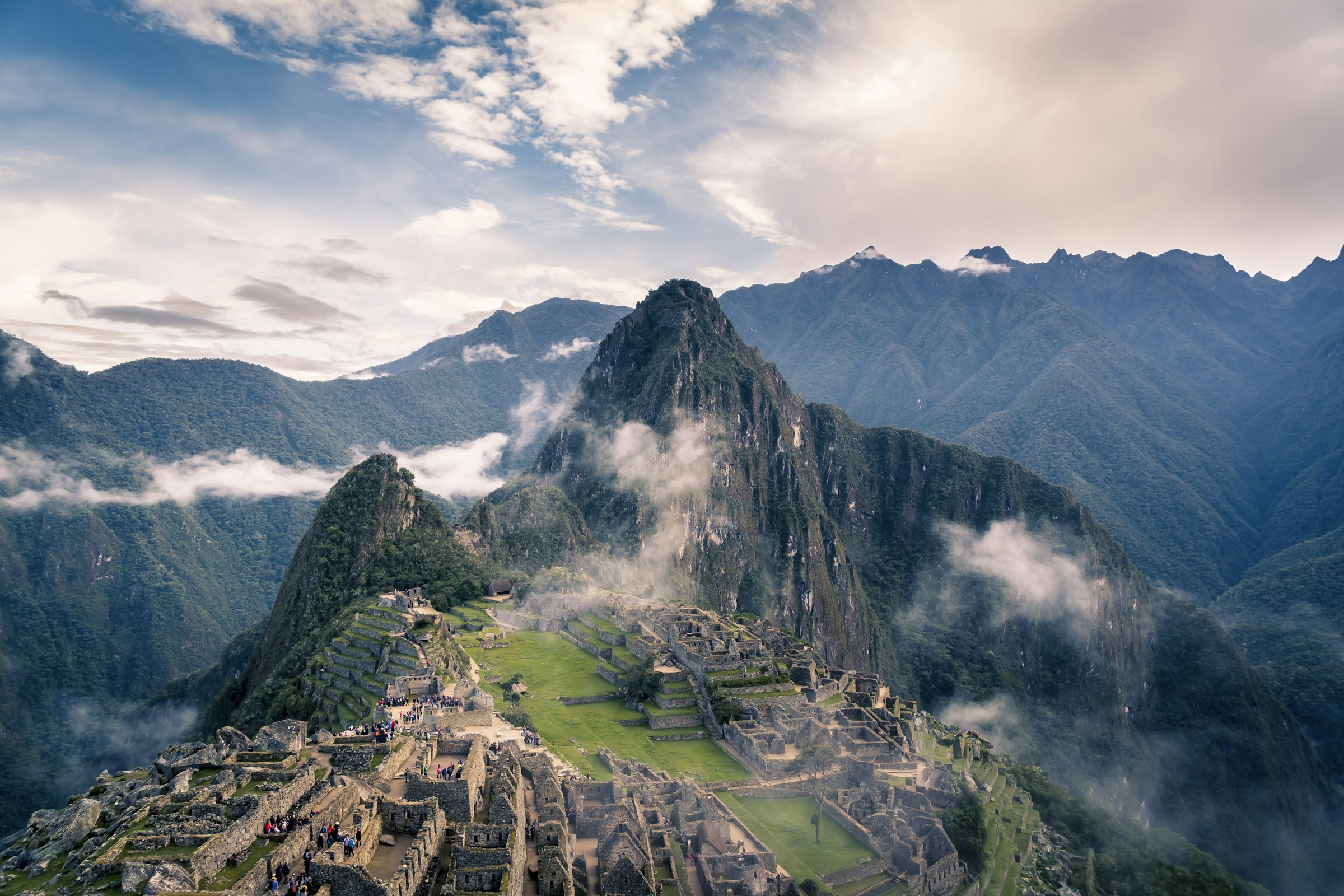
Peru
Machu Picchu, the Sacred Valley, Lima's food scene, and the Amazon.
Peru packs three completely different trips into one country. Machu Picchu and the Sacred Valley are the headline act, and they earn it. Lima has become South America's serious food destination. Add the Amazon, the high desert at Arequipa and Colca Canyon, or the rainbow mountain trekking — the variety is unusual.
The standard route works: a couple of days eating in Lima — ceviche in Barranco, a splurge tasting menu if you book far ahead — then fly to Cusco and drop straight down to the Sacred Valley to acclimatize. Ollantaytambo makes a calmer base than Cusco itself. Machu Picchu comes by train or the four-day Inca Trail, and then you branch: Arequipa and Colca Canyon, or a flight into the Amazon. Permits, trains, and entry tickets are where the money goes.
The honest part: Cusco sits at 3,400 meters and the altitude flattens most arrivals for a day or two — plan for it. Machu Picchu runs on timed tickets and feels like it, and Inca Trail permits sell out months ahead. Lima is grey and traffic-choked, worth visiting mostly for the food. December through March means rain in the highlands. None of it dims the payoff: ruins, mountains, and a food scene this good rarely share a border.
Highlights
-
Machu Picchu & Sacred Valley
Acclimatize in the valley first — Ollantaytambo beats Cusco as a base.
-
Lima
World-class food. Stay in Miraflores or Barranco.
-
Arequipa & Colca Canyon
The white city plus condors and one of the deepest canyons on earth.
-
Amazon (Iquitos or Puerto Maldonado)
Jungle lodge — caiman, monkeys, macaws.
Practical info
- Visa
- Visa-free for most Western passports (90 days).
- Currency
- PEN (Sol). Roughly 3.7 PEN ≈ 1 USD.
- Language
- Spanish (Quechua in highlands). Limited English.
- Safety
- Generally safe in tourism. Altitude sickness in Cusco is the bigger concern.
- Getting around
- Domestic flights for distances. PeruRail to Machu Picchu.
- Tap water
- Tap water not safe.
- Plug type
- Type A Type B Type C 220V
- Money
- Cash dominant outside Lima; cards in tourism.
General guidance — visas, safety, and health change, so check your government's travel advisory and the official sources before you go.
Common questions
- When is the best time to visit Peru?
- The dry season, May to September–October, is the Andean window — the time for Cusco, the Sacred Valley, Machu Picchu and the Inca Trail, with clear skies and open trails. The wet season (November–April, wettest January–March) brings mud and cloud to the highlands, and the classic Inca Trail closes entirely every February for maintenance (in 2026, 31 January to 28 February, reopening 1 March — though the citadel itself stays open that month). Peru has three climates at once, though: Lima and the coast sit under a grey fog — the garúa — from about May to October, just as the mountains are at their best. Plan around the highlands and the rest follows.
- How does the Machu Picchu ticket system work now?
- You buy a timed ticket in advance from the official Ministry of Culture platform (tuboleto.cultura.pe) — standard adult entry is S/64 (about US$19), students and 3–17s pay S/32. Entry is organised into three fixed circuits, and your ticket locks you to one of them on a one-way route with an hourly slot; you follow a set path rather than roaming the citadel. Daily caps apply — 4,500 off-peak, 5,600 in the roughly mid-June to early-November high season — and peak dates sell out, so book ahead. The mountain climbs (Huayna Picchu, Machu Picchu Mountain, the Gran Caverna) are separate S/112 tickets that cap tightly and go first. A licensed guide is officially required. The system is revised often — confirm the current rules close to travel.
- What do I need to know about the Inca Trail?
- Three things. The classic four-day trail cannot be done independently — permits are sold only through licensed operators, are strictly capped (guides and porters count against the cap), and sell out six to eight months ahead for the June–August season. It closes for the whole of February each year for maintenance. And confirm what your permit covers: after a spell when the trail permit and the citadel ticket were sold separately, the 2026 permits again bundle the same-day Machu Picchu entry — but check with your operator rather than assume. If the classic trail is full, operators run the Salkantay and Lares alternatives, which reach the same area with no trail permit.
- Is altitude a problem in Peru?
- It can be. Cusco sits at about 3,400 m and Puno on Lake Titicaca higher still at roughly 3,800 m; altitude sickness — soroche — typically hits 6 to 12 hours after you arrive, and it ignores fitness. The counter-intuitive fix is that Machu Picchu itself is lower (around 2,340 m), so many people feel better there than in Cusco. Give yourself a day or two to acclimatise lower in the Sacred Valley (Urubamba and Ollantaytambo are around 2,800 m) before any hard hiking, hydrate hard, and skip alcohol and strenuous exercise for the first 48 hours. Mate de coca tea helps mild symptoms; many travellers start Diamox a couple of days ahead on a doctor’s advice.
- Is Peru safe, and what about the protests?
- The tourist core — Lima, Cusco, the Sacred Valley, the Inca Trail and Machu Picchu — sits well outside the areas advisories warn against. The US State Department rates Peru Level 2 overall (reissued September 2026) and explicitly notes that Cusco, the Sacred Valley, the Inca Trail and Machu Picchu are not in its Level 4 "do not travel" zones (the VRAEM and the far-northern Colombian-border jungle). The everyday risk is petty theft and scams in Lima and Cusco, and tap water is not safe to drink. The bigger issue is political: Peru has had recurring protests and road-and-rail blockades, concentrated in the southern Andes, and these can strand travellers with little notice — check the current picture right before you go and build in slack.
- How long do I need, and how should I split a trip?
- A week realistically covers one region done well — for almost everyone that is Lima plus Cusco and the Sacred Valley, including Machu Picchu. Add a second region only with ten days or more: Arequipa and Colca Canyon pair with Lake Titicaca in the south, the Amazon is a short flight from Cusco, and the Nazca–Paracas desert is an easy add-on down the coast from Lima. The far north (Chan Chan, the Lord of Sipán tombs, the Huaraz trekking) is really a trip of its own. See the regions section for how they fit together.
When to go
The dry-season window — and February
One country, three climates, but the highlands set the calendar: dry May–October, with February off-limits on the Inca Trail.
Crimson bars are the ones that catch people out. The Andean dry season and the Lima grey season overlap exactly — when the mountains are at their best, the capital is at its greyest — and February takes the classic trek off the table entirely.
Peru runs on the dry season, May to September–October — the window for the Andes, the Sacred Valley, Machu Picchu and the treks, with reliable skies and walkable trails. The wet season (November–April, wettest January–March) muddies the highlands and clouds the views, and the classic Inca Trail closes every February for maintenance, reopening 1 March; the citadel stays open, reachable by train.
The twist is that Peru has three climates at once. While the mountains are at their best, Lima and the coast sit under the garúa — a grey, damp fog from roughly May to October — and the warm, sunny coastal summer (December–April) is the Andean wet season. The Amazon is hot and humid year-round; its low-water months (June–November) open the forest trails and bring wildlife to the riverbanks, while the high-water season floods the forest for boat access. Plan around the highlands; the coast and jungle fit around that choice.
Machu Picchu
Circuits, caps and booking ahead
The headline sight is now tightly rationed — timed tickets, fixed one-way circuits, daily caps and a fee per route — and the rules keep moving.
Machu Picchu is no longer a turn-up-and-wander site. You buy a timed ticket in advance from the official Ministry of Culture platform — high-season dates sell out, and only about a thousand tickets a day are held back for in-person sale in Machu Picchu town, where they go fast. Since 2024 entry has run on three fixed, one-way circuits with hourly slots; your ticket pins you to one route rather than the whole citadel.
The fee is per route: S/64 for foreign adults on the standard circuits (students and 3–17s S/32), and a separate S/112 for the mountain climbs. A licensed guide is officially required for the citadel; enforcement has fluctuated, so arrange one to be safe. This whole system has changed repeatedly in recent years — treat the specifics as live and confirm close to travel.
| Circuit | What you walk | Best for |
|---|---|---|
| 1 · Panorámico | Upper terraces, the Sun Gate (Intipunku) and the Inca Bridge | The classic high view down over the citadel |
| 2 · Clásico | The main designed route plus the lower terrace — the fullest walk through the ruins | First-timers who want the complete site |
| 3 · Realeza | The designed route and the royal/lower sector, with Huchuy Picchu added in high season | A shorter, lower loop |
Entry is S/64 for foreign adults on the standard routes (students and 3–17s S/32); the separate mountain climbs — Huayna Picchu, Machu Picchu Mountain, the Gran Caverna — are S/112 and cap tightly, so they sell out first. Timed hourly slots run 06:00–16:00 with about a 30-minute grace period. Read off the Ministry of Culture tariff (tuboleto.cultura.pe) in October 2026.
There is no road up to Machu Picchu. You arrive by train (next section) and then ride the only authorised shuttle — Consettur, about US$24 return, every 10–15 minutes from around 05:30 — up the switchbacks, or walk up in 60–90 minutes. One warning the brochures skip: the bus concession expired in September 2025 and the dispute is unresolved. In that episode it brought a strike, rocks on the rail line and some 900 visitors stranded until they were evacuated — the single most likely thing to disrupt a Machu Picchu day at short notice.
The Inca Trail
Permits sell out months ahead
The classic trek is capped, operator-only and closed every February — plan it before almost anything else.
The classic four-day Inca Trail cannot be done independently: permits are sold only through licensed operators, are strictly capped each day (guides and porters count against the cap), and sell out six to eight months in advance — especially for the June–August high season, when they can go within days of release. If the classic trail is full, reputable operators run the Salkantay and Lares alternatives, which reach the same area with their own scenery and need no trail permit.
Two fixtures. The trail closes for the whole of February for maintenance — in 2026, 31 January to 28 February, reopening 1 March — though the citadel stays open that month, reached by train. And a long-running headache has eased: after a spell when the trail permit and the citadel ticket were sold separately (and people arrived permit-in-hand without an entry ticket), the 2026 permits again bundle the same-day Machu Picchu entry. Confirm it with your operator all the same.
2026 permits were released in staggered batches from late October 2025, and the peak dates go within days of opening. If your trip hinges on the classic trail, pick the operator and the date first and build the rest of the itinerary around what you can actually get — not the other way round.
Altitude
Soroche, and the fix that surprises people
Altitude is a planning factor, not a footnote — but the headline sight is lower than the city you fly into.
2,340 m Machu Picchu sits lower than Cusco
Soroche — altitude sickness — typically arrives 6 to 12 hours after you land in Cusco, and it is no respecter of fitness: headache, breathlessness and broken sleep hit seasoned hikers as readily as anyone. The practical moves: give yourself a day or two before any hard walking, ideally acclimatising lower in the Sacred Valley (Urubamba and Ollantaytambo sit around 2,800 m, gentler than Cusco); hydrate hard; and — on the clearest medical advice — skip alcohol and strenuous exercise for the first 48 hours, since alcohol blunts the very breathing response your body needs to adjust.
Mate de coca (coca-leaf tea) is legal and everywhere in the highlands and eases mild symptoms; many travellers also start acetazolamide (Diamox) a couple of days ahead on a doctor’s say-so. One border note: the leaf is legal to use inside Peru but illegal to carry out — do not pack coca tea for the flight home, where several countries, the United States included, treat it as contraband.
Getting around
Fly the distances, book the train
Peru is big and slow overland — flights save days, and the Machu Picchu train must be booked.
Peru is big and slow overland, so domestic flights do the heavy lifting — Lima–Cusco is the workhorse, flown by LATAM, Sky and JetSMART, all now through Lima’s new Jorge Chávez terminal (opened June 2025, same airport name). On the ground the premium overnight “cama” buses — Cruz del Sur, Oltursa — are comfortable and cover the long corridors, but the distances are serious: Lima to Cusco is a 22–25 hour haul by road against a 90-minute flight.
For Machu Picchu the train is the only way in for most visitors. PeruRail and Inca Rail both run year-round, mostly from Ollantaytambo (about 1h45 down to Machu Picchu town), and seats need booking well ahead in the June–August peak. There is no broad national passenger railway otherwise — the one other line that matters to visitors is the scenic Andean Explorer between Cusco, Puno and Arequipa.
| Route | By air | By road | Notes |
|---|---|---|---|
| Lima – Cusco | ~1h30 | 22–25 h | The core route — fly it |
| Cusco – Ollantaytambo – Machu Picchu | — | ~2 h car + 1h45 train | No road to the town; train only |
| Cusco – Puerto Maldonado (Amazon) | ~45 min | ~10–12 h | For the Tambopata river lodges |
| Lima – Iquitos (Amazon) | ~1h45 | no road at all | Air or river only — the city has no road out |
Flight times are block times on the main carriers; road times are typical scheduled-coach figures. Indicative only — checked October 2026.
The regions
A week covers one region, not the country
Peru runs from Pacific desert to high Andes to Amazon — pick a corner and do it properly.
A week realistically covers one region done well — almost everyone’s is Lima plus Cusco and the Sacred Valley. Add a second only with ten days or more: Titicaca and Arequipa pair naturally in the south, the Amazon is an easy flight from Cusco, and the far north (Chan Chan, the Lord of Sipán tombs, the Huaraz trekking) is a trip in its own right.
Weighing Peru against its neighbours? See Peru vs Bolivia — the two share Lake Titicaca and the high-altitude Andes — plus Peru vs Ecuador and Peru vs Chile for the measured differences.
| Region | What it’s for | Good to know |
|---|---|---|
| Lima | The coast and the food — Miraflores, Barranco, the world-ranked kitchens | Sea level; grey May–Oct, sunny Dec–Apr |
| Cusco & the Sacred Valley | The headline — Cusco, Pisac, Ollantaytambo and Machu Picchu | ~3,400 m; the valley is lower and easier |
| Arequipa & Colca Canyon | The white city, and condors on the thermals at Cruz del Cóndor | Condors a morning event; dry May–Nov |
| Puno & Lake Titicaca | The Uros reed islands and Taquile / Amantaní homestays | ~3,800 m — higher than Cusco, acclimatise first |
| The Amazon | Rainforest lodges — Puerto Maldonado from Cusco, or Iquitos by air | Yellow-fever jab advised; air / river access only |
| The south desert | Nazca Lines, the Ballestas, Huacachina’s dunes, Ica’s pisco | Easy add-on from Lima down the coast |
Beyond the citadel
Beyond Machu Picchu — and around the crowds
The famous sights now come with queues and caps of their own — but most have a quieter twin a short move away.
Air or river only Iquitos has no road out
Rainbow Mountain (Vinicunca, ≈5,036 m — not the 5,200 m the brochures round up to) has become a conga line of day-trippers on a steep, breathless ridge. Colca Canyon’s condors are a morning event — they ride the thermals at Cruz del Cóndor roughly 07:00–10:00, which is also when the tour buses mass. And the Nazca Lines are seen properly only from a light aircraft; note that a sightseeing flight crashed in August 2026, so check the current operating and safety picture before booking one.
Most of the crush has a quieter alternative a short move away — the trick is knowing the swap before you go:
- Cusco floors you on day oneSkipstarting a hard trek the day you landGosleep lower first — Urubamba or Ollantaytambo in the Sacred Valley, around 2,800 m
- Vinicunca is mobbedSkipthe single-file queue up the main ridgeGoPalccoyo — flatter, far quieter, three coloured ridges and a stone forest
- the classic Inca Trail is sold outSkipabandoning the idea of a trekGoSalkantay or Lares — no trail permit needed, their own scenery, the same finish
Good to know
Safety, money and the political weather
The practical footnotes — which warnings actually apply, how to pay, and the one risk that is genuinely Peru’s own.
On safety, keep the map in proportion. The advisories’ "do not travel" zones — the VRAEM and the far-north jungle on the Colombian border — are nowhere near the tourist circuit, and the US State Department (Level 2 overall, reissued September 2026) explicitly notes that Cusco, the Sacred Valley, the Inca Trail and Machu Picchu are not in them. The everyday risk is ordinary: petty theft and scams in Lima and Cusco, and tap water you should not drink. Emergency help is the police line 105 — a unified 911 has been announced but is not yet working nationwide, so use 105.
On money, the currency is the sol (S/, about 3.3–3.5 to the dollar); cards work in city hotels and bigger restaurants, but cash rules markets, small towns, tips and trail fees, so carry small notes and pay in soles rather than dollars for the better rate. Entry is visa-free for most Western visitors, and the immigration card (the TAM) is now digital, generated automatically when your passport is scanned at the border.
The one risk that is genuinely Peru’s own is political. The country has run through seven presidents in under a decade — President Boluarte was removed in October 2025, an interim government is in place, and a general election is set for 12 April 2026. Recurring protests and road-and-rail blockades, concentrated in the southern Andes and the Cusco corridor, can strand travellers or cut Machu Picchu access with little notice (as the September 2025 bus-concession strike did). None of it should put you off — it should make you build in slack and check the current situation in the days before you travel.
Compare Peru
If you like Peru, also consider
Mexico
Mexico City is world-class. Add the coast, ruins, and food culture.
United States
A continent pretending to be a country — cities, deserts, and the best national parks anywhere.

France
Paris is only the opening act — wine country, the Alps, and two coastlines.
Italy
The benchmark for food, history, and beauty.

Greece
Ruins in the morning, a swim by noon, taverna until dark.
Not sure where to go
Take the 5-minute quiz
Answer a few honest questions and get matched to destinations that actually fit how you travel.
Start the quiz