Georgia (Caucasus)
Extraordinary food, wine, hospitality, mountains, and old cities — all cheap.
Georgia is the most underrated country in the region. Tbilisi is one of Europe's most atmospheric capitals; the food and wine deserve their own pilgrimage; and the Caucasus mountains rival the Alps for beauty without the crowds. Visa-free for most, cheap, and still a fraction of the crowds the Alps pull.
Base in Tbilisi and work outward: a day for the old town and sulphur baths, a day trip up the Georgian Military Highway to Kazbegi, a couple of days drinking qvevri amber wine in Kakheti. With more time, make the long haul to Svaneti and trek village to village from Mestia to Ushguli. Eating is the main event — khinkali, khachapuri, supra feasts that run for hours — and the bill barely registers. Guesthouses, not hotels, are the move.
The rough edges are part of the deal. Marshrutkas are cramped and driven with alarming confidence, mountain roads close without notice, and outside Tbilisi the infrastructure is basic — don't expect polished hotels in Svaneti. English stays thin beyond the capital, and Tbilisi isn't the bargain it was five years ago. If you need things to run on schedule, you'll be frustrated. The hospitality, the food, and the Caucasus scenery cover a multitude of inconveniences.
Highlights
-
Tbilisi
Atmospheric old town, sulphur baths, the best wine bars in the region.
-
Kazbegi & Mestia
High Caucasus villages — trekking and dramatic scenery.
-
Kakheti wine region
Birthplace of wine. Try the qvevri amber wines.
-
Batumi
Black Sea coast, faded grandeur, summer escape.
Practical info
- Visa
- Visa-free for most nationalities — up to one year. Verify before travel.
- Currency
- GEL (Lari). Roughly 2.7 GEL ≈ 1 USD.
- Language
- Georgian. Russian widely understood. English growing in Tbilisi.
- Safety
- Very safe. Avoid the Russian-occupied regions of Abkhazia and South Ossetia.
- Getting around
- Marshrutkas (shared minivans) everywhere. Cheap and slow.
- Tap water
- Tap water in Tbilisi is safe; bottled in mountain villages.
- Plug type
- Type C Type F 220V
- Money
- Cards in cities; cash in rural areas.
General guidance — visas, safety, and health change, so check your government's travel advisory and the official sources before you go.
Common questions
- When is the best time to visit Georgia?
- May–June and September–October are the all-round sweet spots — the "velvet season" of mid-September to mid-October is especially good, and overlaps the Kakheti wine harvest (rtveli). The High Caucasus has a short window: trekking in Svaneti, Kazbegi and Tusheti runs roughly late June to mid-October, and the 4x4-only road to Tusheti over the Abano Pass is open only from about late May/June to mid-October. Batumi and the Black Sea coast are a summer scene; Tbilisi is hot in midsummer; and Gudauri’s ski season runs early December to mid-April.
- How long can I stay — is it really a year?
- Yes. Georgia has one of the world’s most generous policies: citizens of around 90-plus countries (including the US, UK, EU, Canada and Australia) can enter visa-free for up to 365 days — a full year — which is a big part of its appeal to remote workers and long-stay travellers. There’s no visa sticker and no arrival card, just an entry stamp. Note that remote work for a foreign employer sits in a legal grey area, and actually working for a Georgian employer needs a permit. Check your own nationality on the official consular portal before you go.
- Do I need travel insurance to enter Georgia?
- Yes — as of 1 January 2026 Georgia requires every incoming visitor to hold health-and-accident insurance covering the whole stay (Regulation No. 602), with a stated minimum of 30,000 GEL of cover, and it applies even to visa-free visitors. This is a change from the days when cover was effectively optional. Because the rule is new, buy a policy that covers your full trip and confirm the current requirement before you travel — and, quite apart from the rule, insurance is sensible here given the mountain roads and remote trekking.
- How do you get around Georgia?
- The backbone is the marshrutka — shared minibuses that link towns cheaply and leave when full. Modern Stadler trains connect Tbilisi with Batumi (a fast daytime run) and with Zugdidi, the gateway to Svaneti (you continue by marshrutka up to Mestia, about four hours). The real caveat is the mountain roads: the Georgian Military Highway to Kazbegi is the main paved route north but is subject to weather closures and landslides, and the road to Tusheti over the Abano Pass is 4x4-only, seasonal and regularly called one of the world’s most dangerous. For Tusheti, Svaneti side-valleys and Kazbegi, hiring a driver with a 4x4 is the standard, sensible choice.
- Is Georgia safe, given the protests?
- For everyday travel, yes — crime is low, Georgia carries the lowest advisory tier (US Level 1), and its hospitality is famous. Two caveats matter. First, the Russian-occupied regions of Abkhazia and South Ossetia are a firm no-go: advisories say do not travel, there’s a landmine risk near the boundary lines, and you must never try to enter from Russia. Second, Tbilisi has seen sustained nightly anti-government protests since late November 2024 — ongoing into late 2026, centred on Rustaveli Avenue outside Parliament and heaviest after dark, with mass detentions in October 2026. They rarely threaten tourists who steer clear, but avoid all demonstrations (joining one can affect your exit or re-entry), and re-check the advisories before travelling.
- What is Georgian food and wine like?
- Singular, and a reason to visit in itself. Georgia is the cradle of wine — winemaking here goes back some 8,000 years, and the traditional buried-clay-qvevri method is UNESCO-listed — so Kakheti is a pilgrimage for amber-wine lovers. The food is big and generous: khachapuri (cheese bread — the Adjaruli version is a boat of molten cheese topped with butter and an egg), khinkali (juicy soup dumplings; hold the knotted top and don’t eat it), bean lobio and walnut-stuffed aubergine. Meals become a supra, a feast led by a tamada (toastmaster), fuelled by wine and the grappa-like chacha.
When to go
Velvet season, and the mountain window
A long, pleasant shoulder for the lowlands — and a short, strict season for the High Caucasus.
The lowlands (Tbilisi, Kakheti) have a long, kind shoulder — May–June and September–October, with the mid-September to mid-October "velvet season" the connoisseur’s pick, overlapping the wine harvest. The mountains run a tighter calendar: the trekking window is roughly late June to mid-October, before snow shuts the high passes. The crimson July–August bar is the hot, crowded lowland peak (and Batumi’s beach season). Gudauri’s ski season wraps the turn of the year.
For Tbilisi, Kakheti and the lowlands, the May–June and September–October shoulders are ideal, with the "velvet season" of mid-September to mid-October the connoisseur’s pick — warm days, cool nights, and the Kakheti wine harvest (rtveli) in full swing. Midsummer Tbilisi is hot, and the Black Sea coast at Batumi is a summer resort scene.
The mountains run a tighter calendar. High Caucasus trekking — Svaneti, Kazbegi, Tusheti — works roughly late June to mid-October, and the 4x4 road to Tusheti over the Abano Pass is open only from about late May/June until mid-October before snow closes it for the winter. For skiing, Gudauri runs early December to mid-April. Pick lowlands or mountains, then the month that fits.
- you want to trek the High CaucasusSkipMay or anything after mid-OctoberGolate June to mid-October, when the passes are open
- you’re entering Georgia in 2026Skipassuming travel insurance is optionalGobuying health cover (min 30,000 GEL) for the whole stay before you arrive
- you want to reach TushetiSkipdriving the Abano Pass yourselfGohiring a local driver with a 4x4 — it’s seasonal and famously dangerous
Entry
A year visa-free — and a new insurance rule
Georgia’s entry terms are famously open, with one new 2026 requirement now in force.
Georgia’s policy is among the world’s most generous: citizens of around 90-plus countries — the US, UK, EU, Canada, Australia and many more — can enter visa-free for up to 365 days, a full year, which is why it draws remote workers and long-stay travellers. There’s no visa sticker and no arrival card, just an entry stamp; check your own nationality on the official consular portal to be sure, and remember that remote work for a foreign employer sits in a legal grey area while local employment needs a permit.
The change to note is that from 1 January 2026 Georgia requires every incoming visitor to hold health-and-accident insurance covering the stay (Regulation No. 602) — a minimum of 30,000 GEL of cover, applying even to visa-free arrivals, where previously it was effectively optional. Buy a policy that covers the whole trip and confirm the current requirement before you travel. Given the mountain roads and remote trekking, cover is worth having regardless.
The insurance rule is new enough that enforcement and the fine print (exemptions, spot checks, exactly what counts as valid cover) are still settling. Don’t gamble on it being unenforced: a standard travel-medical policy that names at least 30,000 GEL / the full stay satisfies it, costs little, and is the sensible choice for a country of 4x4 passes and remote treks anyway.
Getting around
Marshrutkas, trains, and mountain roads
Cheap and easy in the valleys — but the mountain roads are the real logistics, and some need a 4x4.
The marshrutka — the shared minibus — is the backbone of intercity travel: cheap, frequent, and leaving when full. Modern Stadler trains handle the longer flat runs, linking Tbilisi with Batumi (a fast daytime service) and with Zugdidi, the gateway to Svaneti, from where you transfer up to Mestia by road (about four hours). In the cities, cards are fine; carry cash for the regions, marshrutkas and village guesthouses.
The caveat is the mountains. The Georgian Military Highway to Kazbegi is the main paved route north but closes for weather and landslides; the road to Tusheti over the Abano Pass (around 2,826 m) is 4x4-only, seasonal and frequently cited as one of the world’s most dangerous (an upgrade of the Pshaveli–Abano–Omalo route is in progress). For Tusheti, the Svaneti side-valleys and Kazbegi excursions, hiring a driver with a 4x4 is the standard choice — self-driving is possible but means aggressive local traffic, livestock on the road and rough tracks.
| Way | Use it for | Note |
|---|---|---|
| Marshrutka (shared minibus) | Town to town, cheaply | Leaves when full; carry cash |
| Train (Stadler) | Tbilisi–Batumi / Tbilisi–Zugdidi | Fast daytime; Zugdidi is the Svaneti gateway |
| Hired 4x4 + driver | Tusheti, Kazbegi, Svaneti side-valleys | The sensible choice for the mountain roads |
| Georgian Military Highway | Tbilisi north to Kazbegi | Main paved route; winter snow/landslide closures |
| Cards vs cash | Cities vs the regions | Cards in Tbilisi/Batumi; cash everywhere else |
The road to Tusheti over the Abano Pass (~2,826 m) is 4x4-only, seasonal (~late May/June to mid-October) and routinely ranked among the world’s most dangerous — though a Pshaveli–Abano–Omalo upgrade is underway. Hire a local driver. Checked October 2026.
Mountains & regions
Tower villages, a church under Kazbek, the coast
The High Caucasus is the headline — UNESCO tower-villages and a church beneath a 5,000-metre peak — with a resort coast and a western hub besides.
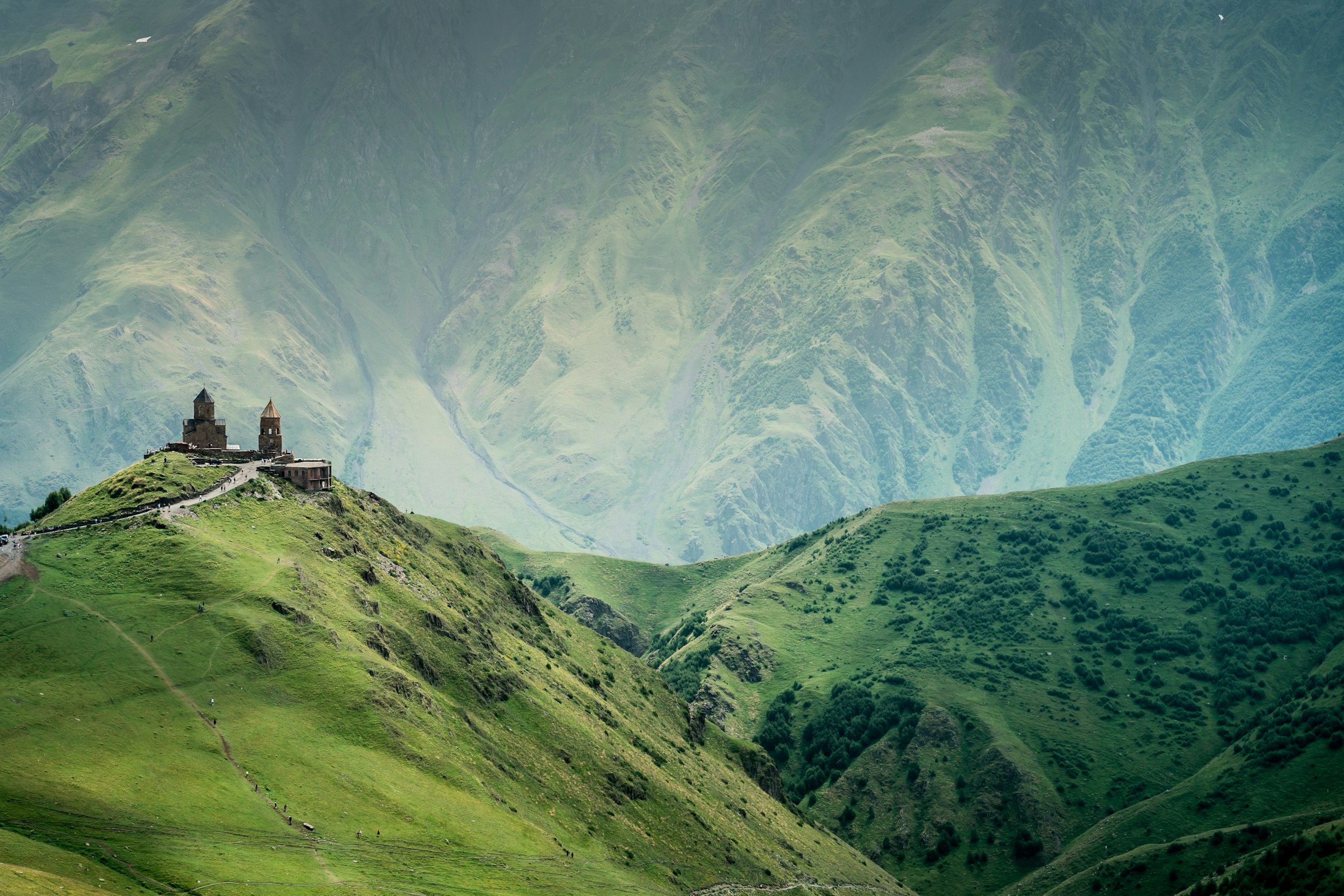
The High Caucasus is the reason many come. Upper Svaneti — a UNESCO World Heritage region reached via Zugdidi, with Mestia as its hub — preserves clusters of medieval stone defensive towers (koshki), and the Ushguli community is among the highest continuously inhabited settlements in Europe. To the north-east, Kazbegi (Stepantsminda) is crowned by the Gergeti Trinity Church, standing alone on its ridge beneath the 5,047 m Mount Kazbek — the postcard of Georgia. Remoter still is Tusheti, its tower-villages reachable only over the seasonal Abano Pass.
Beyond the peaks, Gudauri is the country’s main ski resort on the Military Highway; Batumi is the brash Black Sea resort city with a modern skyline and a summer beach scene; and Kutaisi, the western hub and former capital, sits near the UNESCO-listed Gelati Monastery and the Prometheus Cave. Georgia has four UNESCO World Heritage Sites in all — Mtskheta’s monuments, Gelati, Upper Svaneti and the Colchic rainforests.
| Place | What it’s for | Good to know |
|---|---|---|
| Svaneti (Mestia, Ushguli) | UNESCO tower villages, big treks | Reach via Zugdidi; Ushguli among Europe’s highest |
| Kazbegi (Stepantsminda) | Gergeti Trinity under Mt Kazbek | Via the Georgian Military Highway |
| Tusheti (Omalo) | Remote medieval tower villages | 4x4-only over the Abano Pass; seasonal |
| Gudauri | The main ski resort | Season early December to mid-April |
| Batumi | The Black Sea resort city | Modern skyline; a summer scene |
| Kutaisi | The western hub | Gelati Monastery and Prometheus Cave nearby |
Tbilisi
The warm city and its sulfur baths
The capital is a crooked-laned old town over hot springs — the city is literally named for its warm water.
“Tbili” = warm Tbilisi — the city named for its hot springs
Tbilisi is one of the more atmospheric capitals in the region: a tumble of crooked old-town lanes, carved wooden balconies and leaning churches below the Narikala Fortress, with sleek new footbridges and glass domes stitched in alongside. Its signature is the Abanotubani sulfur baths (see the figure), but the pleasure is as much the wandering — the flea market under the Dry Bridge, the wine bars, the long cafés of Rustaveli.
One practical note for the capital specifically: the sustained protests covered below are centred on Rustaveli Avenue outside Parliament, after dark — so plan evening walks and dinners away from that stretch when demonstrations are on, and you’ll barely notice them. By day the avenue and the old town are entirely normal.
Wine & food
The cradle of wine, and a feast
Georgia claims the oldest winemaking on earth — and a table culture built around the toast.
~8,000 years the cradle of wine
Georgia is the cradle of wine (see the figure), and the table is a reason to visit on its own. The headline dishes are khachapuri — cheese-filled bread, at its most extravagant in the Adjaruli boat of molten cheese crowned with butter and a raw egg — and khinkali, fat soup dumplings you grip by the knotted top (which you leave on the plate). Beyond them are hearty beans (lobio), walnut-stuffed aubergine (badrijani) and grilled meats.
The real experience is the supra, the Georgian feast, where a tamada (toastmaster) steers a long sequence of toasts over endless wine and the fierce grape spirit chacha. Accept that hospitality is taken seriously here: a guest is, in the proverb, a gift from God, and you will be fed and toasted well past the point you meant to stop.
| Dish / drink | What it is | Note |
|---|---|---|
| Khachapuri | Cheese bread | The Adjaruli is a boat with egg and butter |
| Khinkali | Juicy soup dumplings | Hold the knotted top — don’t eat it |
| Supra | The Georgian feast | Led by a tamada (toastmaster) |
| Qvevri wine | Amber wine from buried clay jars | The UNESCO-listed method |
| Chacha | Grape-pomace spirit | The local firewater |
| Lobio / badrijani | Bean stew / walnut-stuffed aubergine | The vegetarian staples |
Safety & politics
Very safe — with two real caveats
Low crime and legendary hospitality, around a firm no-go frontier and a live political situation in the capital.
For ordinary travel Georgia is very safe — crime is low, it sits at the lowest advisory tier (US Level 1 overall), and its hospitality is justly famous. The first hard caveat is geographic: the Russian-occupied regions of Abkhazia and South Ossetia are a firm no-go — advisories rate them Level 4 do not travel, there’s a landmine risk near the administrative boundary lines, and you must never attempt to enter from Russia, which can lead to arrest.
The second is political. Tbilisi has seen sustained nightly anti-government protests since late November 2024 — sparked by the "foreign agents" law and the suspension of EU-accession talks — continuing into late 2026, centred on Rustaveli Avenue outside Parliament and heaviest after dark, with mass administrative detentions during October 2026. There is no state of emergency, and they rarely threaten tourists who keep away, but avoid all demonstrations — taking part can lead to questioning on exit or refused re-entry — and they can snarl central-Tbilisi traffic. This is a live, evolving situation: re-check the advisories close to travel.
The protest impact is narrow and predictable: the Rustaveli Avenue stretch by Parliament, in the evenings. It is not a city-wide disturbance and has not changed Georgia’s overall Level 1 rating. Book accommodation a little off Rustaveli, keep evening plans elsewhere in the old town or Vake/Vera, and the demonstrations stay something you read about rather than something that touches your trip.
Good to know
Money, language, and the lari
The practical footnotes — a good-value, easy country with its own script and a cash-first countryside.
Money is straightforward and still good value: the currency is the lari (GEL), costs are low by Western-European standards (though up roughly 30–40% over three years, so no longer dirt-cheap), and cards work in Tbilisi and Batumi while cash rules in the regions, at markets and on marshrutkas. ATMs are plentiful in cities; draw cash before heading into the mountains.
On language, Georgian (kartuli) is a Kartvelian tongue unrelated to its neighbours, written in its own beautiful rounded Mkhedruli script (the living Georgian alphabet is itself UNESCO-listed) — so signage can be opaque. In practice you’ll manage: English is increasingly understood in Tbilisi and Batumi tourism and among younger people, and Russian is still widely understood. The country calls itself Sakartvelo; "Georgia" is the exonym.
A money tip for the mountains: Svaneti, Tusheti and Kazbegi village guesthouses are largely cash-only, and ATMs thin out fast once you leave Mestia or Stepantsminda. Draw enough lari in Tbilisi, Kutaisi or Batumi before you head up, keep small notes for marshrutkas and guesthouses, and you won’t be caught short where the card readers stop.
Compare Georgia (Caucasus)
If you like Georgia (Caucasus), also consider

France
Paris is only the opening act — wine country, the Alps, and two coastlines.
Italy
The benchmark for food, history, and beauty.

Greece
Ruins in the morning, a swim by noon, taverna until dark.
Japan
Extraordinary food, culture, and cities. Nothing quite prepares you for it.
Mexico
Mexico City is world-class. Add the coast, ruins, and food culture.
Thailand
The complete package for warm-climate travel.
Not sure where to go
Take the 5-minute quiz
Answer a few honest questions and get matched to destinations that actually fit how you travel.
Start the quiz