
Finland
The winter trip — aurora, huskies, and snow — with saunas the whole year round.
Finland is at its best when most countries are at their worst. The headline is a deep-winter run to Lapland: aurora overhead, husky and reindeer sleds, glass igloos, and the Santa industry around Rovaniemi. Helsinki adds design and harbour saunas, and in summer the Lakeland opens up under a sun that barely sets. It runs on the euro and works flawlessly.
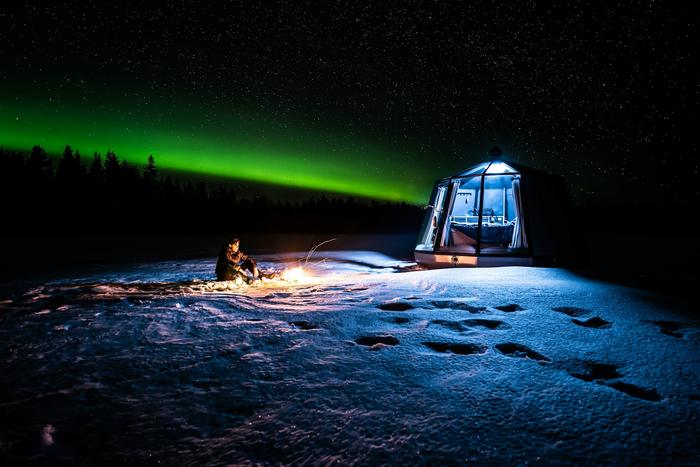
The signature trip flies into Helsinki for a day or two of design shops, market-hall food, and a public sauna by the sea, then continues north to Lapland. There the days are built around snow: a husky team through the forest, an evening out under the sky hoping the aurora shows, a night in a glass-roofed cabin. Summer is a different country — the Lakeland's thousands of lakes, cabins, and a sun that never quite sets, ideal for swimming, paddling, and the ritual sauna-then-lake plunge.
The honest part: this is an expensive trip, and the winter version compresses into very short, very cold days — in Lapland the sun barely clears the horizon, and the aurora is never guaranteed against a week of cloud. The culture is famously quiet and reserved; small talk is minimal and the silence can read as coolness if you expect otherwise. Outside Lapland and Helsinki there is genuinely little to do, and the off-shoulder months of October and April are dark, slushy, and worth skipping.
Highlights
-
Rovaniemi & Lapland
Aurora, husky sleds, glass igloos, and the Santa industry.
-
Helsinki
Nordic design, a market hall, and public saunas on the water.
-
The Lakeland
Thousands of lakes, lakeside cabins, and the sauna-and-swim ritual.
-
Sauna culture
Found everywhere — public, private, smoke, and floating on the harbour.
Practical info
- Visa
- Schengen — visa-free for most Western passports (90 days).
- Currency
- EUR (€).
- Language
- Finnish and Swedish. English near-universal.
- Safety
- Very safe. Winter cold is the main hazard.
- Getting around
- Reliable trains and buses; flights or the night train north to Lapland.
- Tap water
- Tap water excellent.
- Plug type
- Type C Type F 230V
- Money
- Effectively cashless. Cards accepted everywhere.
General guidance — visas, safety, and health change, so check your government's travel advisory and the official sources before you go.
Common questions
- Do you need a visa for Finland?
- No, for short visits. Finland is in the EU, Schengen and the eurozone, so US, UK, Canadian and Australian travellers get 90 days in any 180 visa-free, and EU/EEA citizens have full free movement. Your passport should be valid at least three months beyond your planned departure from the Schengen area. The EU’s biometric Entry/Exit System (EES) is now in operation, replacing passport stamps with fingerprints and a photo; the ETIAS authorisation is not yet required — it’s expected in 2027 (a €20, multi-year permit for visa-free visitors). So for a trip now, no ETIAS.
- What’s the best time to visit Finland — and can I see the northern lights?
- It depends which Finland you want. Winter (roughly December–March) is the snow-and-aurora season: Lapland for husky and reindeer safaris, snow hotels, Santa Claus Village and the northern lights, coldest in January–February, with polar “kaamos” darkness in the far north. Summer (June–August) is the midnight sun, the lakes and the archipelago, warmest and greenest — though Lapland’s mosquitoes are fierce. On the aurora: it needs three things at once — darkness, clear skies and solar activity — so the window is about September to March, Lapland is far better than Helsinki (Lapland sees up to ~200 displays a year to the south’s fewer than 20), and nothing is guaranteed on any single night; a stay of three nights or more meaningfully improves your odds.
- Is Finland expensive, and do I need cash?
- Yes and no, respectively. Finland is among Europe’s most expensive countries — dining and especially alcohol are notably pricey (drinks over 8% are sold only through the state Alko shops), with Lapland’s aurora cabins the steepest cost of all, and the standard VAT is 25.5% (raised in 2024). But you’ll rarely need cash: Finland is close to cashless, with contactless cards and phones accepted essentially everywhere (cash payments are now the exception). Tipping isn’t expected — service and VAT are already in the displayed price — so rounding up is a bonus, not an obligation.
- What should I know about driving in Finland?
- Two things, both about the north and the winter. Winter tyres are mandatory from roughly 1 November to 31 March when conditions require (studded tyres are allowed in the same window), and this applies to hire cars too — so winter driving means snow and ice as standard. And wildlife on the roads is a genuine hazard: Lapland’s free-roaming reindeer cause many collisions a year, and elk/moose strikes — most common at dawn, dusk and in the autumn rut — are dangerous given the animals’ size. Slow right down at crossing signs, especially up north, and avoid rural night driving where you can.
- Finland, Sweden or Norway for the northern lights?
- All three share the Arctic auroral band, so all three work — the honest differences are in the trip around the lights. Finnish Lapland leans into the full winter-wonderland package: husky and reindeer safaris, glass igloos, Santa, and a well-oiled aurora-tourism machine around Rovaniemi, Levi and Saariselkä. Norway pairs the aurora with fjord-and-coast drama (Tromsø); Sweden with Abisko’s famously clear-sky microclimate and the Icehotel. For the cosy, activity-packed Arctic-Christmas version, Finland is the pick.
- Can you still travel between Finland and Russia?
- No — not overland. Finland closed its entire eastern land border with Russia in December 2023 and has extended the closure (currently through 2028), so the crossings are shut, and the Allegro Helsinki–St Petersburg train has been suspended since 2022. There is no tourist rail or road route east. For leaving Finland by surface, the options run west and south instead: frequent ferries to Tallinn (about 2–2.5 hours) and overnight boats to Stockholm.
When to go
Winter aurora, or summer midnight sun
Finland is really two destinations in one — a dark, snowy, aurora-lit winter and a bright, green, lake-filled summer — and the season you pick changes everything.
Finland is two countries by season: the winter snow-and-aurora one (Dec–Mar, Lapland) and the summer midnight-sun one (Jun–Aug, lakes and archipelago). The crimson aurora bar (Sep–Mar, shown Sep–Dec) needs dark, clear, active skies and is never guaranteed — Lapland sees ~200 displays a year to the south’s under 20. The other crimson bar is Lapland’s fierce high-summer mosquitoes.
The most important planning decision for Finland is which season you’re coming for, because the winter and summer countries scarcely resemble each other. Winter (December–March) is the one most visitors picture: deep snow, husky and reindeer safaris, snow and ice hotels, Rovaniemi’s Santa Claus Village, and the northern lights — all under the short days (or, in the far north, the polar-night “kaamos”) and the deep cold of January and February.
Summer (June–August) flips it entirely: the midnight sun, when the far north sees weeks of continuous daylight, a landscape of lakes and forests and the Baltic archipelago, and the warmest weather — offset by heavy mosquitoes in Lapland. On the aurora specifically, set expectations honestly: it requires darkness, clear skies and solar activity together, so the window runs roughly September to March, Lapland is dramatically better than the south, and no operator can promise them — a multi-night stay is the way to improve the odds.
- you want the northern lightsSkipthe bright summer and the southGoLapland between September and March, for three nights or more
- you want the midnight sun and the lakesSkipthe dark, frozen winterGoJune–August — but pack mosquito repellent for Lapland
- you want to reach Lapland without a 12-hour driveSkipself-driving the length of the countryGothe Santa Claus Express night train (with a car-carrier if you want the car up there)
Entry & money
Schengen, euro, near-cashless — and a closed eastern border
Entry is standard Schengen and you’ll barely touch cash — but note the border east is shut.
Finland is in the EU, Schengen and the eurozone: visa-exempt visitors get 90 days in any 180, the biometric EES is now live (fingerprint and photo on arrival), and the ETIAS authorisation (€20) is expected in 2027, not required yet. The country is close to cashless — contactless cards and phones work essentially everywhere, and cash is now the exception — but it’s expensive, with a 25.5% standard VAT, pricey dining, and alcohol over 8% sold only through the state Alko shops. Tipping isn’t expected.
One piece of geography to know: since joining NATO in 2023, Finland has closed its entire land border with Russia (shut since December 2023 and extended through 2028), and the Allegro train east has been suspended since 2022 — so there is no overland route to Russia. Surface travel runs the other way, with frequent ferries to Tallinn and overnight boats to Stockholm.
The closed Russian border occasionally surprises travellers planning a Helsinki–St Petersburg add-on: it is not possible by train or road in 2026, full stop. Plan any Baltic or Nordic add-on westward (Tallinn, Stockholm, or a flight) instead. It doesn’t affect a normal Finland trip in any other way.
Getting around
Night trains north, ferries west, winter tyres on
Long distances to Lapland are bridged by a car-carrying night train; driving means winter tyres and watching for reindeer.
Lapland is a long way north, and the elegant way to cover it is the VR “Santa Claus Express” night train from Helsinki to Rovaniemi — about twelve hours, with sleeper cabins and a car-carrier wagon so you can take a vehicle up; sleeper reservations are compulsory and sell out in winter, so book ahead. Domestic flights also reach the Lapland hubs quickly.
If you drive, remember winter tyres are mandatory through the cold months (studded tyres permitted), and that reindeer and elk on the roads are a serious hazard — slow down at crossing signs and avoid driving the north at night. For getting out of the country, the Helsinki–Tallinn ferries cross to Estonia in a couple of hours with frequent sailings, and overnight boats run to Stockholm.
| Way | Use it for | Note |
|---|---|---|
| Santa Claus Express | Helsinki → Rovaniemi overnight | ~12h sleeper + car-carrier; book ahead in winter |
| Hire car (winter tyres) | Lapland and the lakes | Tyres mandatory Nov–Mar; watch for reindeer & elk |
| Helsinki–Tallinn ferry | A day-trip to Estonia | ~2.5h, many daily; overnight boats to Stockholm |
| Domestic flights | Fast to the Lapland hubs | Finnair to Rovaniemi, Ivalo, Kittilä |
Lapland is a long way north: the night train or a short flight beats a long winter drive. There is no overland route east — Finland’s border with Russia is closed. Checked October 2026.
Two northern-travel basics: the VR “Santa Claus Express” night train (Helsinki–Rovaniemi, about twelve hours, with a car-carrier wagon so you can take a vehicle up) is the elegant way north — but sleeper berths are compulsory to reserve and sell out well ahead in winter, so book early. And if you drive in the snow season, winter tyres are a legal requirement; hire cars come fitted, but confirm it when you collect the car.
Sights & culture
Santa, saunas and the right to roam
Beyond the aurora, Finland’s character shows in free-to-enter icons and deeply held customs — the sauna above all.
In Helsinki, the standout is the UNESCO-listed Suomenlinna sea fortress (inscribed 1991), reached year-round by a short public ferry on an ordinary HSL transit ticket, alongside the rock-hewn Temppeliaukio “Rock Church.” Up in Rovaniemi, the Santa Claus Village is free to enter — it straddles the marked Arctic Circle line eight kilometres from town, and meeting Santa, crossing the Circle and the post office cost nothing (you pay only for the official photo and the add-on attractions).
Two cultural institutions shape a Finnish trip. The sauna is near-universal and UNESCO-listed (2020): public saunas are usually gender-separated and bathed in nude, and you always shower before entering — it’s relaxation and social ritual, not a spa gimmick. And “Everyman’s Right” (jokamiehenoikeus) gives everyone the freedom to roam, forage berries and mushrooms, and wild-camp briefly on most land regardless of ownership, so long as you keep clear of homes and respect nature. Finland’s national parks are free to enter (Nuuksio near Helsinki; Urho Kekkonen and Pallas-Yllästunturi in Lapland).
Where to go
South cities, great lakes, Arctic north
From an island-fortress capital to the Sámi far north — Finland’s regions are a gradient into the Arctic.
Finland reads as a gradient from the southern cities — Helsinki with Suomenlinna and its design scene, and Turku, the oldest city, gateway to a 50,000-island archipelago and the Swedish-speaking Åland — up through the great Lakeland around Saimaa (summer-cottage country, home of the endangered Saimaa ringed seal and Savonlinna’s castle opera festival) to Lapland. There the hub is Rovaniemi on the Arctic Circle, with the deeper north — Inari’s Sámi heartland, the fells of Saariselkä, and the aurora-and-ski resorts of Levi and Ylläs — carrying the winter-wonderland trip.
| Region | What it’s for | Good to know |
|---|---|---|
| Helsinki & the south | Suomenlinna, design, the capital | The gateway; walkable and compact |
| Turku & the archipelago | The oldest city, ~50,000 islands, Åland | The southwest; summer island-hopping |
| Lakeland (Saimaa) | A vast lake district, Savonlinna’s castle opera | Summer cottages; the rare Saimaa seal |
| Rovaniemi & the Arctic Circle | Santa, aurora, the gateway to Lapland | The winter hub; night train from Helsinki |
| Northern Lapland (Inari, Saariselkä) | Sámi culture, fells, huskies, aurora | The deep north; Sámi Parliament at Inari |
| The fell resorts (Levi, Ylläs) | Winter sports and aurora cabins | Levi is the biggest ski resort |
Food & drink
Rye, reindeer, and a lot of coffee
Honest Nordic cooking off the forest and lake — wrapped around the world’s most caffeinated culture.
~12 kg a year the world’s highest coffee consumption, per person
Finnish food is honest and forest-and-lake-based: Karelian pies (rye crust, rice-porridge filling, egg butter), the Lapland classic of sautéed reindeer with mash and lingonberry, creamy salmon soup, dense sour rye bread, and foraged cloudberries and lingonberries. The sweet side runs to korvapuusti cinnamon buns and the divisive salty liquorice salmiakki. And then there’s the coffee — Finns drink more of it than anyone (see the figure) — plus a well-run craft-beer scene and the ubiquitous “lonkero” long drink.
| Dish / drink | What it is | Note |
|---|---|---|
| Karelian pies | Rye crust with rice-porridge filling | Eaten with egg butter (munavoi) |
| Sautéed reindeer | Poronkäristys with mash & lingonberry | The classic Lapland plate |
| Salmon soup | Creamy, dill-flecked lohikeitto | The comfort bowl |
| Korvapuusti | The cardamom cinnamon bun | The partner to all that coffee |
| Rye bread (ruisleipä) | Dense, sour, dark bread | The daily staple |
| Salmiakki | Salty liquorice | The love-it-or-hate-it sweet |
Finns drink more coffee per head than any nation on earth (~12 kg a year), so the korvapuusti-and-coffee break is a daily ritual. Forage cloudberries and lingonberries in season, and try a “lonkero” (gin long drink).
Culture
Sisu, saunas, and the happiest country
Quiet, self-reliant and nature-bound — and, by one famous measure, the happiest place on earth.
9 years running the world’s happiest country (2018–2026)
Finland is quiet, egalitarian and deeply tied to nature. Its language, Finnish, is a Uralic tongue unrelated to its Swedish and Russian neighbours (Swedish is co-official, and Sámi languages are spoken in the north), but English is near-universal, so visitors manage easily. The national self-image turns on “sisu” — a stoic, uncomplaining resilience — and on an unshowy closeness to forest, lake and sauna. It’s given the world the Moomins (Tove Jansson’s gentle trolls) and, by the UN’s measure, the title of world’s happiest country nine years running (see the figure) — less about cheer than trust, stability and a good life close to nature.
Good to know
Safe, pricey, and book the igloos early
The practical footnotes — a very safe, near-cashless, expensive country where the environment, not crime, is the risk.
Finland is one of the safest countries in the world, with very low crime — the real risks are environmental: cold and winter exposure, slips on ice and thin lake ice, snow-and-ice driving, and the roadside wildlife above. Tap water is excellent and safe to drink everywhere. English is very widely spoken (Finnish and Swedish are the official languages), and the US rates Finland Level 1. Carry little cash — cards and phones cover essentially everything.
Two planning notes: the famous glass-igloo and aurora cabins book six to twelve months ahead and are expensive (into the hundreds per night, more at the iconic resorts around Christmas), so lock them in early; and the daylight extremes affect sleep — pack an eye mask for the midnight-sun summer, and expect the long winter darkness (and, in the far north, the kaamos polar night) to be an adjustment.
Compare Finland
If you like Finland, also consider

France
Paris is only the opening act — wine country, the Alps, and two coastlines.

Italy
The benchmark for food, history, and beauty.

Greece
Ruins in the morning, a swim by noon, taverna until dark.
United States
A continent pretending to be a country — cities, deserts, and the best national parks anywhere.
Australia
Vast, varied, relaxed. Reef, Sydney, and proper wilderness in one.
Hawaii
A handful of islands where the landscapes and the ocean genuinely earn the flight.
Not sure where to go
Take the 5-minute quiz
Answer a few honest questions and get matched to destinations that actually fit how you travel.
Start the quiz