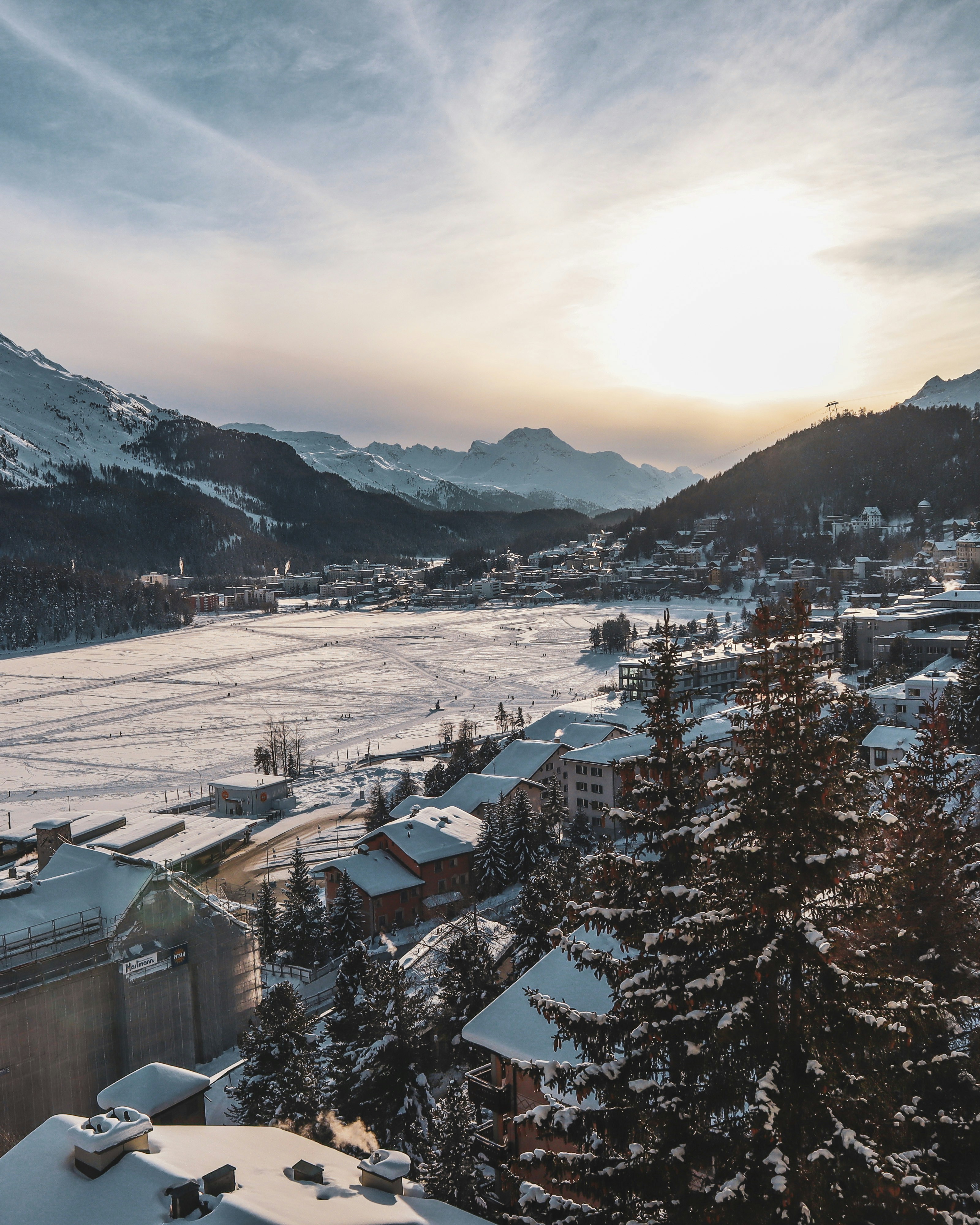
St. Moritz, Switzerland
The original winter resort — sun, snow and the Cresta Run.
St. Moritz invented the winter holiday in 1864, hosted two Winter Olympics, and still radiates the glamour and absurdity that come with being the place that put alpine tourism on the map. The Engadin valley gets 322 days of sunshine a year, the skiing covers two distinct areas (Corviglia and Corvatsch-Furtschellas), and the frozen lake hosts polo, cricket and horse racing on ice.
Corviglia (3,057 m) is the main ski mountain directly above St. Moritz — broad, sunny, cruising-focused — while Corvatsch (3,303 m) across the valley adds glacier height and more challenging terrain. Combined, the Upper Engadin ski pass covers 350 km of piste across St. Moritz, Celerina, Pontresina, Sils and Silvaplana.
The resort splits into St. Moritz Dorf (the old village, uphill, the luxury hotels) and St. Moritz Bad (lakeside, more affordable, the spa and sports facilities). It is expensive, though less extreme than Zermatt, and the Engadin sunshine is extraordinary — you ski in sunglasses more than goggles.
Highlights
-
Cresta Run
The world-famous natural ice toboggan run — open to public bookings.
-
Frozen lake events
Polo, horse racing and cricket on the frozen Lej da San Murezzan.
-
322 days of sun
The Engadin’s legendary sunshine record — the original "champagne climate".
-
Bernina Express
UNESCO-listed railway from Chur to Tirano, passing through St. Moritz.
Practical info
- Visa
- Switzerland is Schengen — visa-free for most Western passports (90 days).
- Currency
- CHF (Swiss franc).
- Language
- German (Romansh locally). English widely spoken.
- Safety
- Very safe; avalanche awareness needed off-piste.
- Getting around
- Rhaetian Railway from Chur (~2h); Zurich ~3.5h. No nearby major airport — Samedan has a small private airfield.
- Tap water
- Tap water safe.
- Plug type
- Type J 230V
- Money
- Cards everywhere.
General guidance — visas, safety, and health change, so check your government's travel advisory and the official sources before you go.
Common questions
- Is St. Moritz good for beginners?
- Corviglia has wide, well-groomed blue and red runs that suit progressing beginners, and the Salastrains area on Corviglia is a dedicated family and beginner zone. But St. Moritz is not cheap, the three ski sectors are not linked, and first-timers on a tight budget would find easier value elsewhere. See who it suits.
- Are the three ski areas connected?
- No. Corviglia/Piz Nair, Corvatsch/Furtschellas and Diavolezza/Lagalb are three separate mountains — you cannot ski between them. Free buses and the Rhaetian Railway link the valley bases. One regional pass covers all three. See the ski area.
- What is the Diavolezza glacier descent?
- The Morteratsch glacier descent from Diavolezza is a 10 km ungroomed run past the Piz Palü and Piz Bernina faces, ending at Morteratsch railway station — Switzerland's longest secured glacier run. It crosses crevassed terrain and must be done with a guide and glacier equipment. See the ski area.
- Can anyone ride the Cresta Run?
- Yes — public bookings are open to all (men and women since 2019). Beginners over 30 pay CHF 500 for their first five rides; subsequent rides are CHF 57 each. Under 30s pay CHF 41 per ride. Equipment is included. Speeds reach 140 km/h. See non-skiers.
- How do you get to St. Moritz?
- By train from Zurich in about 3–3½ hours via Chur and the Rhaetian Railway's UNESCO Albula line — one of the great scenic rail journeys in Europe. The nearest big airport is Zurich (ZRH). Samedan, 5 km away, is Europe's highest airport (1,707 m) for private/charter flights. See getting there.
- What happens on the frozen lake?
- In winter, Lake St. Moritz hosts the Snow Polo World Cup (late January), White Turf horse racing (three Sundays in February), Cricket on Ice and THE ICE classic-car concours d'élégance — all on the frozen surface. See non-skiers.
- What does a week in St. Moritz cost?
- Expect roughly CHF 220–500 per person per day all-in before flights — the low end is self-catering in Celerina or Pontresina with an early-booked Snow-Deal pass, the high end is a 5-star hotel in Dorf with private lessons and mountain lunches. St. Moritz is one of the most expensive ski destinations in Europe. See what it costs.
- Can you bring a dog to St. Moritz?
- To the valley, yes — the Engadin sells a season ticket for dogs on mountain railways and there are 41+ pet-friendly hotels. Dogs are not allowed on ski pistes or cross-country tracks but can use designated winter hiking trails on a lead. GB visitors need an Animal Health Certificate. See dogs.
The ski area
Three separate mountains, one valley pass
Like Chamonix, St. Moritz is not one linked ski area. Three distinct sectors sit around the Upper Engadin valley, connected only by bus and train.
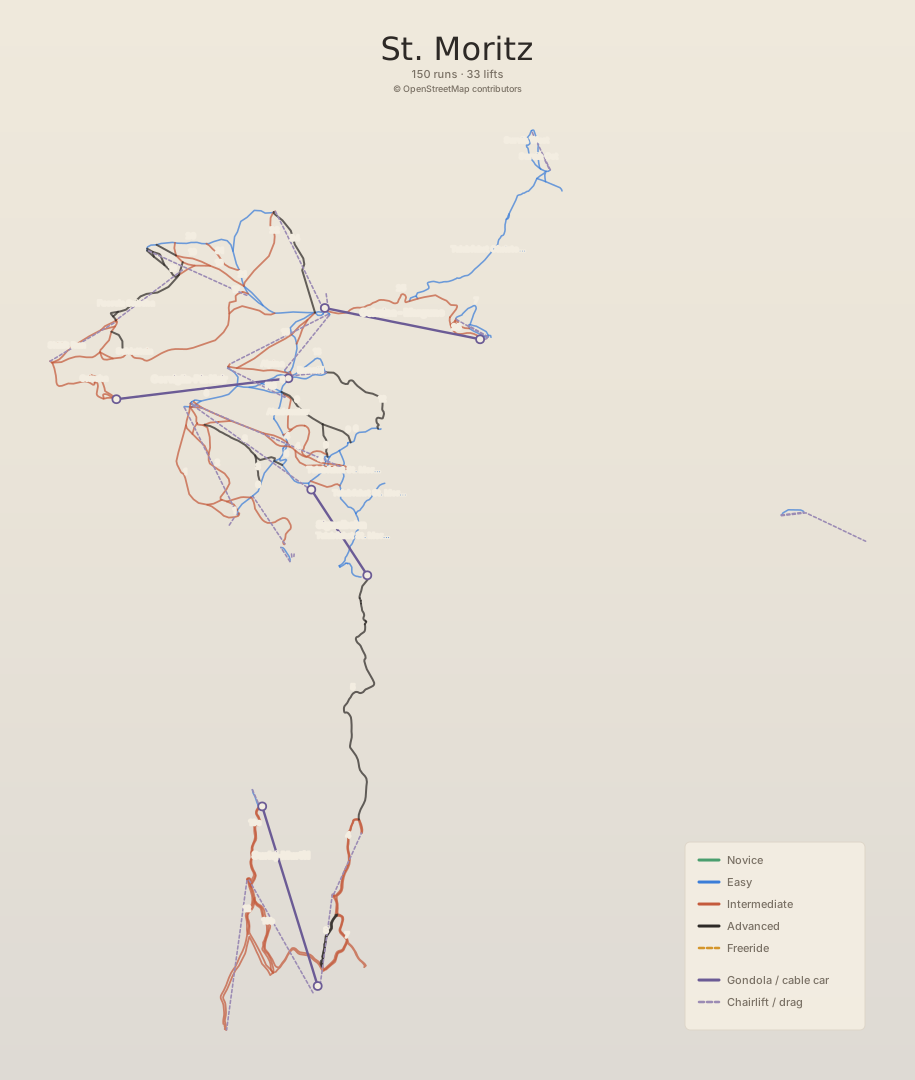
You cannot ski from one sector to the next. Corviglia/Piz Nair, Corvatsch/Furtschellas and Diavolezza/Lagalb are separate mountains; you move between them by bus or the Rhaetian Railway. A single Upper Engadin regional pass covers all three sectors, plus the smaller areas at Celerina, Sils and Zuoz.
The character of each sector is distinct: Corviglia is the groomed intermediate paradise, Corvatsch is the longer, steeper challenge with night skiing, and Diavolezza is the small but dramatic glacier gateway. Together they offer genuine variety — but the logistics of changing mountains cost you time each transition.
| Sector | Altitude | Best for | Notes |
|---|---|---|---|
| Corviglia / Piz Nair | 1,735 → 3,057 m | Intermediates, sun-cruising | St. Moritz's home mountain — 155 km piste, 23 lifts, wide groomed terrain, modern infrastructure. Accessed by funicular from Dorf or Signal cable car from Bad |
| Corvatsch / Furtschellas | 1,800 → 3,303 m | Advanced, long descents | 120 km piste, 14 lifts. Predominantly red, very few blue runs. Night skiing on illuminated 4.2 km piste. Accessed from Surlej/Silvaplana |
| Diavolezza / Lagalb | 2,093 → 2,978 m | Experts, glacier skiing | Small marked area with 5 lifts — but the gateway to the 10 km Morteratsch glacier descent past Piz Palü and Piz Bernina. Guide and glacier gear essential |
Approximate piste split across the region: 24–27% blue, 51–60% red, 16–20% black. Corviglia accounts for nearly half the total groomed piste. The Morteratsch glacier descent is not a marked piste — it is a secured but ungroomed glacier route for experienced skiers with a guide.
If you want huge linked mileage on one pass, St. Moritz is the wrong choice — its three unconnected sectors reward variety-seekers who enjoy changing terrain day by day, not skiers who want to clock up vertical without lifting a boot.
Who it suits
Who St. Moritz is — and isn't — for
St. Moritz serves cruising intermediates, lifestyle skiers and bucket-list adventurers superbly. It does not serve beginners on a budget.
The resort's character is as much about the scene as the skiing — the frozen-lake polo, the Cresta Run, the Michelin stars, the Badrutt's Palace bar. But the skiing itself is substantial if you pick the right sector:
- Cruising intermediatesSkipCorvatsch (predominantly challenging reds, almost no blue)GoCorviglia — wide, sunny, perfectly groomed reds and blues with mountain restaurants to match
- Advanced & expertsSkipsticking to Corviglia's cruisersGoCorvatsch for long, steep reds from 3,303 m; Diavolezza for the Morteratsch glacier descent with a guide
- FamiliesSkipthe Dorf luxury core (pricey, steep streets)GoSalastrains on Corviglia for dedicated beginner terrain and kids' school; base in Celerina for value and Corviglia access via Marguns gondola
- Cross-country skiersSkiptreating XC as an afterthoughtGothe Engadin's 230 km of prepared trails — one of Europe's premier XC networks, host of the Engadin Skimarathon
St. Moritz invented the winter holiday, and it shows — the social programme (polo, White Turf, bob, Cresta) is as big a draw as the pistes. If you want nothing but skiing and a quiet chalet, this is overpriced for what's on the hill; if you want skiing plus spectacle, nowhere else competes.
Snow & season
322 days of sunshine and inner-Alpine dry snow
St. Moritz sits south of the main Alpine ridge — less total snow than the northern Alps, but drier, colder powder and famously reliable sunshine.
Months on the axis (10 = October). Crimson bars mark the longest-running areas and the crowd peaks. Diavolezza opens earliest thanks to its glacier position; Corviglia carries the bulk of the groomed terrain.
The inner-Alpine position is a double-edged sword: St. Moritz gets less total precipitation than north-facing resorts, but what falls is dry, cold powder that preserves beautifully at altitude. The high sectors — Corvatsch at 3,303 m, Diavolezza at 2,978 m — hold snow deep into spring, while the valley floor at 1,820 m stays cold enough to keep base areas working.
Best value weeks are early-to-mid January (after New Year, before February half-terms) and late March (sunshine, good base, quieter). Avoid mid-February unless you enjoy lift queues, and note that the WEF in Davos (late January) can push accommodation prices up across the Engadin even in St. Moritz.
Lift passes
Dynamic pricing — the earlier you book, the less you pay
St. Moritz uses "Snow-Deal" dynamic pricing: the same day-pass fluctuates from CHF 47 to CHF 87 depending on when you buy and when you ski.
The Upper Engadin regional pass covers all three ski sectors plus the smaller areas. Pricing is dynamic — buy early online for the lowest rate. Ikon Pass holders get 7 days (full) or 5 days (base) included, no blackout dates.
| Pass | Duration | Adult (18+) | Youth (13–17) | Child (6–12) |
|---|---|---|---|---|
| Regional (Snow-Deal) | 1 day | CHF 31–58 | CHF 16–29 | |
| Regional | 6 days | ~CHF 251 | ~CHF 126 | |
| 3-of-5 flex | 3 days | — | — | |
| 5-of-7 flex | 5 days | — | — | |
| ENGADINcard 365 | season | CHF 857 | CHF 428 |
Under-6s ski free with a parent or instructor. The ENGADINcard 365 includes winter mountain railways and free Upper Engadin public transport (RhB 2nd class). Second child on ENGADINcard gets 30% off; additional children ride free. St. Moritz is an Ikon Pass partner — 7 days full, 5 days base. Figures read autumn 2026; Snow-Deal prices are dynamic — book early online for the lowest rates.
The Snow-Deal spread is enormous — a 1-day adult pass ranges from CHF 47 to CHF 87, nearly double. Book at least two weeks ahead online and save up to 45% versus the walk-up window price.
Lessons & guides
From children's snow camps to guided glacier descents
St. Moritz's ski schools lean upmarket — private lessons and small groups, with guided glacier excursions for the Diavolezza descent.
The Suvretta Snowsports School is the prestige school — attached to the Suvretta House hotel, with its own beginner lifts and a teen snow camp (CHF 590/week). The Swiss Ski School St. Moritz is the traditional ESF-equivalent with group lessons from about CHF 250 for 5 half-days and privates from about CHF 130/hour.
For the Morteratsch glacier descent from Diavolezza, you need a qualified mountain guide and glacier equipment — the run crosses crevassed terrain. Local mountain guide offices and the ski schools arrange guided excursions; do not attempt the glacier descent unguided.
The Diavolezza glacier run is not a piste — it is a secured but ungroomed route across a working glacier. A guide, harness, transceiver and crampons are non-negotiable. Book guided groups well ahead for peak weeks.
Families & kids
Dedicated family terrain — and a valley full of off-slope activities
Corviglia has a real family zone, the neighbouring towns offer cheaper bases, and the Engadin's flat valley floor is full of things for children.
Salastrains on Corviglia is the dedicated family area with beginner slopes, a children's ski school (Red Legends) and a kid-friendly restaurant. The Snowli Kids' Village has carousels and dedicated children's lifts. Additional beginner slopes at Surlej, Celerina and Pontresina keep the options flexible.
Off the slopes, the Engadin's flat valley floor makes family activities easy: the Muottas Muragl sledge run (4.2 km, 718 m vertical — challenging, not for young children), gentler alternatives at Preda-Bergün and Madulain, ice skating on Lake Staz, the Ovaverva indoor waterpark, horse-drawn carriage rides to the Fex Valley, and a summer botanical garden at Schatzalp.
| Option | Ages | What it is |
|---|---|---|
| Snowli Kids' Village | ~3+ | Carousels and dedicated children's lifts for first-timers on Corviglia |
| Red Legends (Salastrains) | ~4+ | Children's ski school on Corviglia's dedicated family area |
| Suvretta children's group | ~4–12 | Mon–Fri group ski lessons (CHF 540–590/week), lunch supervision available |
| Suvretta Teen Camp | 13–18 | Intensive snow camp (CHF 590/week) — skiing, freeride intro, social |
Under-6s ski free. Celerina (one RhB stop, Corviglia access via Marguns gondola) and Pontresina (10 min by bus/train, Diavolezza access, youth hostel) are the family-friendly budget bases. The Preda-Bergün sledge run (6 km) is the best family toboggan — purpose-built, gentler than Muottas Muragl, and reached by a scenic RhB ride.
The Muottas Muragl sledge run is fast and challenging — not suitable for beginners or young children. Families with small children should use the Preda-Bergün or Madulain runs instead.
Getting there
One of the great scenic rail journeys — and no easy way around it
Getting to St. Moritz is part of the experience. The UNESCO Albula railway is spectacular — but it takes 3½ hours from Zurich, and there is no shortcut.
The default route is Zurich to St. Moritz by train — about 3–3½ hours via Chur, changing to the Rhaetian Railway for the Albula line through its UNESCO-listed viaducts and tunnels. The Bernina Express from Tirano (Italy) and the Glacier Express from Zermatt are the scenic alternatives but are day-trip-length journeys, not commutes.
By car, Zurich is about 3 hours via the A3/A13 to Chur and then the Julier Pass (2,284 m — open year-round, no tunnel needed). Milan is about 4 hours via Chiavenna and the Maloja Pass. Samedan Engadin Airport, 5 km from St. Moritz, is Europe's highest airport (1,707 m) and handles private/charter flights.
| From | To St. Moritz | Notes |
|---|---|---|
| Zurich airport (ZRH) | ~3–3½ hours by train | SBB to Chur (~1h15), change to RhB Albula line (~2h). The UNESCO route |
| Zurich by car | ~3 hours | A3/A13 to Chur, then Julier Pass (2,284 m, open year-round) |
| Milan Malpensa (MXP) | ~4 hours by car | Via Chiavenna and the Maloja Pass |
| Samedan airport | ~10 min | Europe's highest airport — private/charter flights only |
The Rhaetian Railway Albula/Bernina lines are UNESCO World Heritage — the journey is worth taking for itself. The Engadin Premium Card (guest card, free from your accommodation) gives free RhB 2nd-class travel between Klosters Dorf and Filisur, plus free local buses.
Unlike Chamonix (an hour from Geneva), St. Moritz does not have a quick airport transfer — 3+ hours from any major airport is the minimum. Factor this into a short trip; for a long week, the rail journey through the Alps is a feature, not a flaw.
Where to stay
Dorf for glamour, Bad for value — or base outside for half the price
St. Moritz splits into Dorf (upper, luxury) and Bad (lower, calmer). The real budget move is basing in Celerina or Pontresina, one stop away.
St. Moritz Dorf perches on a sunny terrace above the lake — boutiques, galleries, the Palace Hotel, the funicular to Corviglia. This is the glamorous heart and the most expensive base. St. Moritz Bad sits on the valley floor by the lake — more modern, quieter, less showy, with the Signal cable car giving direct Corviglia access (avoids the funicular queues).
Celerina, one stop on the RhB, shares Corviglia access via the Marguns gondola and offers 3-star hotels from about CHF 180–250/night. Pontresina, 10 minutes by bus, gives access to Diavolezza and has the area's youth hostel. Silvaplana and Sils are the Corvatsch/Furtschellas bases.
| Where | Character | From (double, per night) |
|---|---|---|
| Badrutt's Palace (Dorf) | The 5-star icon since 1896 | CHF 900–1,400+ |
| Kulm Hotel (Dorf) | Where the winter holiday was "invented" in 1864 | CHF 800–2,000+ |
| Suvretta House (above Dorf) | Grand, isolated — own ski school and lifts | CHF 600–1,300+ |
| Hotel Monopol (Dorf) | Mid-range 3-star in the village core | ~CHF 350 |
| Hotel Bernina (Dorf) | Budget option in Dorf | ~CHF 180 |
| Celerina / Pontresina | One stop away — genuine savings | CHF 150–250 |
WEF week in Davos (late January) inflates prices across the Engadin — book early or avoid. Accommodation comes with the free Premium Card (guest card) for local transport and discounts.
Dorf is where the money goes; Celerina is where the value is. A CHF 180/night hotel in Celerina with the Marguns gondola to Corviglia gives you the same skiing as a CHF 900/night Palace room — you just have a different bar at the end of the day.
Après & dining
Mountain restaurants that rival the town — and a bar scene that doesn't pretend to be modest
St. Moritz's mountain dining is among the best in the Alps. The town après is quieter than St. Anton but considerably more expensive.
On the mountain, La Marmite on Corviglia is widely considered one of the best mountain restaurants in the world — caviar, truffles, Bellinis at 2,486 m. El Paradiso (2,174 m) is the glamorous terrace with sheepskin sunbeds and lobster rolls. White Marmot at the Corviglia summit, Trutz and Chasellas round out a mountain-dining scene that in most resorts would be the headline.
In town, Roo Bar (Hotel Hauser) is the legendary après — boozy hot chocolate and live music at weekends. Bobby's Pub (Schweizerhof) draws a younger crowd. The Renaissance Bar and King's Social House at Badrutt's Palace are where the serious money drinks. Devil's Place at Waldhaus am See has one of the world's finest whisky collections (over 2,500 bottles). For dinner, two Michelin stars each at Da Vittorio (Italian, Carlton Hotel) and Ecco (Champfèr), with La Coupole-Matsuhisa (Nobu, at the Palace) for Japanese-Peruvian.
A mountain lunch at La Marmite or El Paradiso is as much a St. Moritz experience as the skiing — but budget CHF 60–100+ per head. For a standard main course on the mountain, expect CHF 29–35.
Non-skiers
Polo on a frozen lake, a skeleton run from 1887, and a bobsled for hire
St. Moritz may have the strongest non-ski programme of any resort in the Alps — and most of it happens on or around the frozen lake.
CHF 500 your first five rides on the Cresta Run
The frozen Lake St. Moritz hosts an extraordinary winter calendar: the Snow Polo World Cup (late January, the world's most prestigious snow polo since 1985, free entry), White Turf horse racing (three Sundays in February — flat racing, trotting and skijoring), Cricket on Ice (since 1988, eight teams on two pitches), and THE ICE classic-car concours d'élégance.
The Olympia Bob Run is the world's only remaining natural-ice bobsled track — taxi rides (you ride as a passenger with a professional pilot) cost about CHF 230–280. Muottas Muragl (funicular to 2,456 m) gives the panoramic view of the Upper Engadin lakes and the Bernina massif.
For walkers: 150 km of marked winter hiking trails. For culture: the Segantini Museum (Giovanni Segantini's Alpine paintings), the Kirchner paintings at the Forum Paracelsus, and Hotel Schatzalp — the Art Nouveau sanatorium at 1,861 m (reached by funicular) that inspired Thomas Mann's The Magic Mountain, though Mann set his novel in Davos. And the Engadin Skimarathon (42 km, Maloja to S-chanf, second Sunday of March) is the largest mass-sport event in Switzerland and the second-largest cross-country race in the world.
Most frozen-lake events are free to watch from the shore. White Turf's grandstand and hospitality packages cost more — but the spectacle of horses galloping across a frozen lake at 1,820 m is free.
Dogs
Dogs in the valley but not on the pistes — and a season ticket for the railway
The Engadin is dog-friendly in the valley, with a season pass for dogs on the mountain railways — but the pistes and XC trails are off limits.
Dogs are not allowed on ski pistes or cross-country tracks in the Engadin — a Switzerland-wide rule more consistently enforced than in some French resorts. Dogs can use designated winter hiking trails on a lead and ride mountain railways (the Engadin sells a dedicated dog season ticket). In Graubünden, dogs must be leashed in built-up areas.
Pet-friendly hotels are plentiful — 41+ in the St. Moritz area, including Kulm Hotel (CHF 45–85/night depending on size), Carlton Hotel (CHF 60/night), and Badrutt's Palace and Suvretta House. Several allow dogs in dining rooms.
GB → Switzerland paperwork: the old EU pet passport no longer works for British dogs. You need an Animal Health Certificate issued by an Official Vet no more than 10 days before travel, a microchip, and a rabies vaccination given at least 21 full days before travel. A new AHC is needed for every trip. Switzerland applies EU pet travel rules as a Schengen state. Cost: typically GBP 150–250 per AHC.
Accessibility
A flat valley helps — but contact the mountains office before you come
The Engadin valley floor is notably flat for an Alpine destination, making it one of the more wheelchair-friendly resorts — but mountain-station access varies.
The Corviglia funicular and Signal cable car are accessible for wheelchair users with assistance — contact mountains.ch (+41 81 830 00 00) at least 2 hours before arrival. Free electric buses connect the valley with ski access points, and the Rhaetian Railway provides accessibility assistance.
The valley floor is flat and manageable for wheelchair users between St. Moritz, Celerina and Pontresina. Several barrier-free hotels exist in each town. No dedicated adaptive ski school is prominently advertised for St. Moritz specifically — visitors requiring adaptive skiing should contact the resort directly to arrange instructors and equipment.
Full accessibility cannot be guaranteed at all mountain stations due to older infrastructure. Contact the mountains.ch office in advance with your specific needs rather than hoping for the best on arrival.
Safety
Glacier terrain, helicopter rescue, and the insurance gap
St. Moritz's glacier skiing is serious — and Switzerland is the country where the gap between what you think insurance covers and what it actually covers bites hardest.
The Diavolezza glacier terrain is real glaciated mountaineering: crevasses, avalanche risk, no piste marking. A qualified guide and glacier equipment are non-negotiable for the Morteratsch descent. Even on the marked pistes, the high altitude (up to 3,303 m) and the distance from major hospitals make rescue expensive.
EHIC/GHIC does not cover Switzerland. Switzerland is not in the EU and there is no reciprocal healthcare agreement with the UK — so the card that gives you state emergency care in France does nothing here. Private travel and ski insurance is essential, covering at minimum CHF 30,000 mountain rescue and CHF 1,000,000 medical. Standard policies often exclude off-piste; glacier skiing requires explicit cover.
Rega (Swiss Air-Rescue) operates helicopter rescue across Switzerland. A Rega patron membership (CHF 30/year) means Rega waives rescue costs not covered by your insurance — it is not an insurance policy, but it closes the gap between your cover and the bill. The Rega app transmits GPS coordinates for faster rescue.
Do not assume your European ski insurance works in Switzerland — check the small print. And do not assume "off-piste cover" includes glacier terrain: many policies cover guided off-piste adjacent to marked runs but exclude glacier skiing. If you are doing the Diavolezza descent, you need explicit glacier cover.
What it costs
What a day in St. Moritz actually costs
St. Moritz is among the most expensive ski destinations in Europe — but the Snow-Deal pass pricing and the budget bases in Celerina and Pontresina keep a non-luxury week within reach.
Here is the day-rate breakdown, so you can build your own number rather than trust a brochure headline. Everything is per person per day unless noted.
| What | Typical day-rate | Notes |
|---|---|---|
| Lift pass — regional (Snow-Deal) | ~CHF 63 (6-day avg) | Buy early online — walk-up can be nearly double |
| Lift pass — walk-up peak day | CHF 87 | The Snow-Deal maximum; book 2+ weeks ahead for CHF 47–60 |
| Ski / board hire | CHF 35–55 | Full setup; online pre-booking saves ~10% |
| Group lesson (per day equiv.) | ~CHF 50 (5 half-days / day) | Swiss Ski School group; Suvretta from CHF 108/day (Mon–Fri week) |
| Private lesson | CHF 130/hour · CHF 370–510/day | Suvretta 1–3 people; PassionSki from CHF 120/hour |
| Mountain lunch | CHF 25–35 standard · CHF 60–100+ La Marmite | A main course on the mountain; the glamorous spots cost far more |
| Dinner out | CHF 30–40 casual · CHF 60–80 mid-range · CHF 175+ Michelin | Per head in town; Da Vittorio and Ecco at the top end |
| Bed for the night | CHF 75–125 Pontresina · CHF 175–350 mid-range · CHF 450+ 5-star | Per person; Dorf 5-star hotels from CHF 900+/room |
| Kurtaxe (visitor tax) | CHF 5 per adult per night | Typically included in the accommodation price; provides the Premium Card |
| Transfer (Zurich airport) | ~CHF 70–90 (train, 2nd class) · CHF 500–700 (private) | One-way; 3–3½ hours by train is the reality |
Rates read autumn 2026 for the 2025/26 season. Snow-Deal pass pricing is dynamic — buy early online, not at the window. WEF week (late January) inflates everything across the Engadin. Peak-week lodging (Christmas, mid-February, WEF) can double or triple off-peak prices. The Premium Card (free from your accommodation) gives free local RhB travel and access to ~70 activities.
The levers that move the number most: base in Celerina or Pontresina instead of Dorf (saves CHF 100+/night); book the Snow-Deal pass early (saves up to 45%); eat a mountain lunch at a self-service spot (CHF 20) instead of La Marmite (CHF 80+); and go in January rather than WEF week or February half-term.
Compare St. Moritz, Switzerland
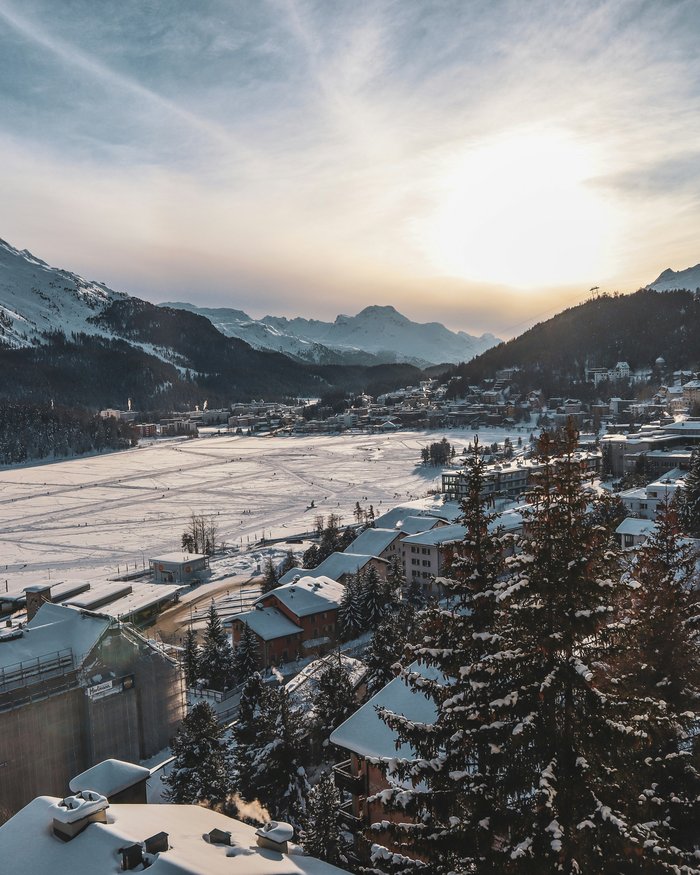
If you like St. Moritz, Switzerland, also consider
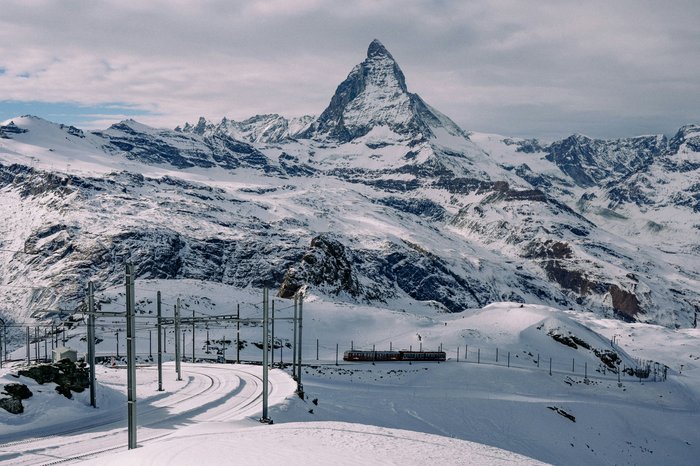
Zermatt, Switzerland
Car-free village under the Matterhorn, with year-round glacier skiing.
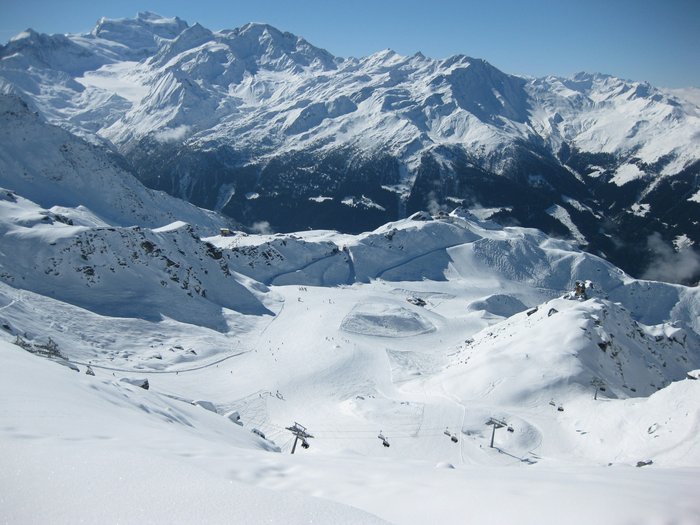
Verbier, Switzerland
Switzerland’s off-piste capital — steep, sunny and expensive.
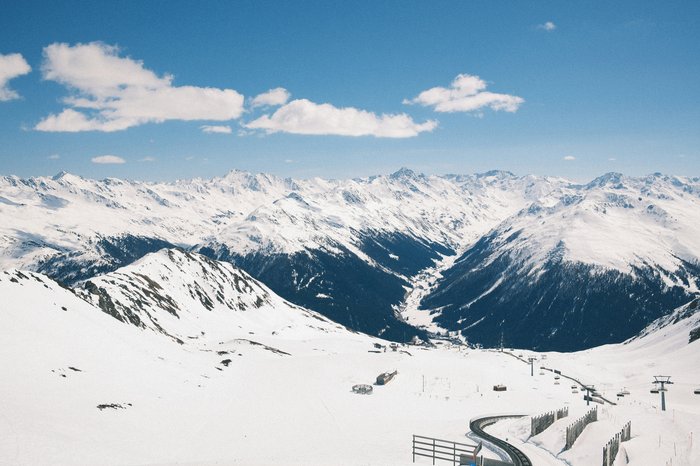
Davos, Switzerland
A real Swiss town with six ski mountains and Europe’s largest natural ice rink.
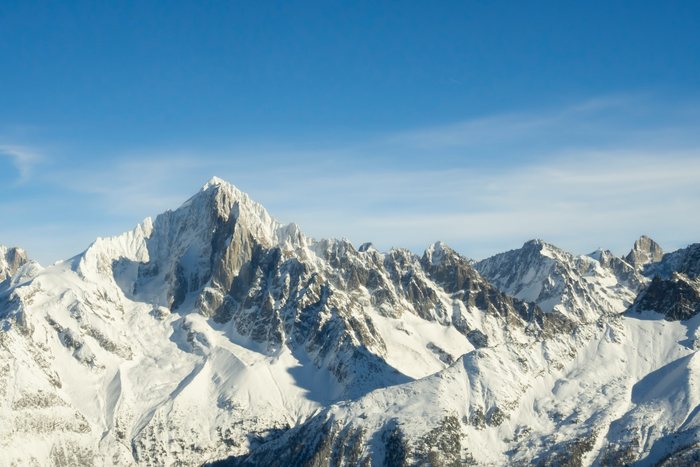
Chamonix, France
The birthplace of alpinism, under Mont Blanc.
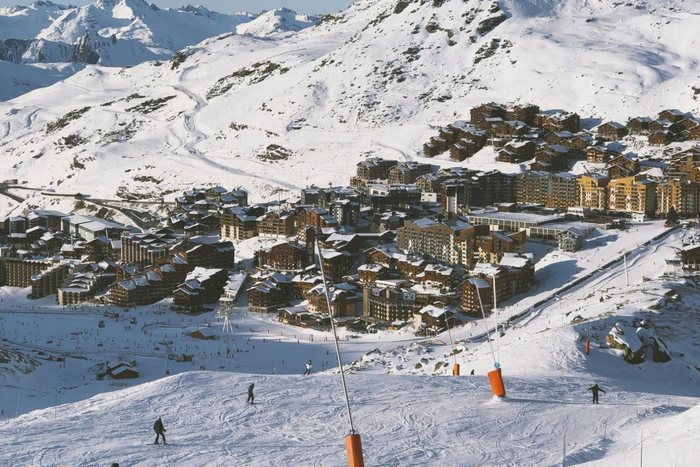
Val Thorens, France
Europe’s highest resort — snow-sure, and the gateway to the world’s largest linked ski area.
Val d’Isère, France
High-altitude, serious skiing with a village that actually feels like one.