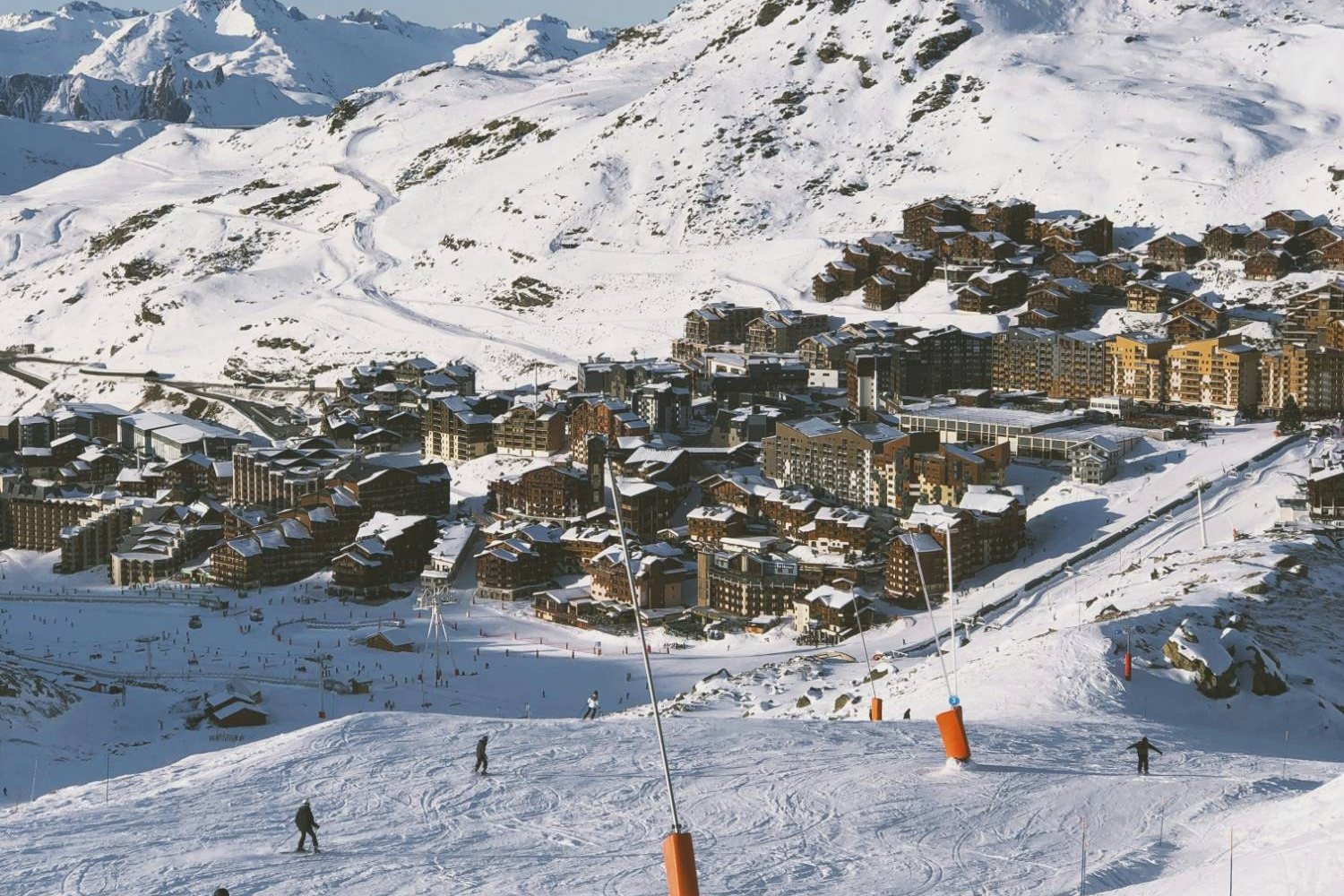
Val Thorens, France
Europe’s highest resort — snow-sure, and the gateway to the world’s largest linked ski area.
Val Thorens sits at 2,300 m at the top of the Belleville valley, the highest resort in Europe and the surest bet in the Alps for snow from late November into May. It is unashamedly purpose-built — a car-light, ski-in/ski-out village of apartments and hotels rather than an old town — and it is the back door to Les Trois Vallées, the largest interconnected ski area on earth.
The pitch is simple: height and scale. From the door you can ski onto a 600 km linked network taking in Méribel, Courchevel and the rest of the Trois Vallées on a single pass, with a glacier and north-facing slopes that hold their snow when lower resorts turn to slush. The resort runs hard après and late — La Folie Douce started here — so the evenings are as much a draw as the pistes for a certain crowd.
The trade-offs are the flip side of the strengths. At altitude there are almost no trees, so a storm or a flat-light day leaves you with little shelter or definition, and the modern village has limited charm next to a Chamonix or a Zermatt. It is also dead outside the ski season — this is a winter machine, not a year-round town.
Highlights
-
Les Trois Vallées
Ski straight onto the largest linked area in the world — 600 km of piste on one pass.
-
Cime Caron
A cable car to 3,200 m with a huge north-facing descent and a panorama to match.
-
Glacier de Péclet
The high, snow-sure terrain that underwrites the long season.
-
La Folie Douce
The original mountain après-ski — mid-afternoon, mid-mountain.
Practical info
- Visa
- Schengen — visa-free for most Western passports (90 days).
- Currency
- EUR (€)
- Language
- French. English widely spoken in the resort.
- Safety
- Very safe; standard on-mountain and altitude precautions apply.
- Getting around
- About 2h30–3h by road from Geneva, Lyon or Chambéry airports; largely car-free once there.
- Tap water
- Tap water safe.
- Plug type
- Type C Type E 230V
- Money
- Cards everywhere.
General guidance — visas, safety, and health change, so check your government's travel advisory and the official sources before you go.
Common questions
- Is Val Thorens really the highest resort in Europe?
- Yes — the village sits at 2,300 m, the highest of any resort in Europe, with skiing up to 3,230 m. That altitude is the reason for its exceptionally long season (late November to early May) and its near-guaranteed snow, but it also means the terrain is entirely above the tree line. See the ski area.
- How big is the ski area from Val Thorens?
- From your door you can ski onto Les Trois Vallées — the largest interconnected ski domain on earth, roughly 600 km of linked piste taking in Les Menuires, Méribel and Courchevel on a single pass. The local domain is about 150 km with 83 runs. See the ski area.
- Is Val Thorens good for beginners and families?
- Very — it carries the official French Famille Plus label. There are gentle, wide, snow-sure nursery slopes with magic carpets right by the village, and the vast Trois Vallées to grow into. The catch is the treeless terrain: in flat light or a storm, visibility is poor and there is no shelter. See families & kids and who it suits.
- Is Val Thorens snow-sure for a late-season trip?
- About as snow-sure as the Alps get. 99% of the terrain sits above 2,000 m, the average annual snowfall is over 6 metres, and 2,400 snow cannons back up the Trois Vallées. The lifts stay open into May — long after lower resorts have closed. See snow & season.
- What is the Family Flex lift-pass deal?
- Families of three or more (at least one child 5–17) where everyone pays the child rate — both adults and children — on passes of 6 days or longer. It applies to both the Val Thorens–Orelle and the full Trois Vallées pass. See lift passes.
- How do you get to Val Thorens?
- The closest airports are Chambéry (~1h30), Geneva (~2h35) and Lyon (~2h20). The last 37 km from Moûtiers is a winding mountain road with 20-odd hairpin turns that takes 45–50 minutes in clear conditions — and much longer on a peak Saturday. By train, a TGV runs from Paris to Moûtiers in about four hours. See getting there.
- Can you bring a dog to Val Thorens?
- To the resort, yes; onto the pistes or the lifts in winter, no. Dogs are banned from groomed runs in France and the lifts do not carry dogs in winter (unlike some other French resorts). Dogs ride the lifts in summer only. Leashed dogs are welcome on the village paths, and dog sitters are available from the tourist office. See dogs.
The ski area
The highest resort in Europe — and the back door to 600 km
Val Thorens sits at 2,300 m at the head of the Belleville valley. From here you ski straight onto Les Trois Vallées, the largest linked ski area on earth — no bus, no transfer, just lifts and pistes.

Everything is linked. Unlike Chamonix, where you bus between separate mountains, Val Thorens connects to every corner of the Trois Vallées by lift and piste. Ski over the ridge to Les Menuires, on to Méribel, across to Courchevel and back in a single day — the circuit never breaks. The "fourth valley" of Orelle drops from the Cime de Caron via the steep Combe de Rosael black run into the quieter Maurienne, with two gondolas connecting back up.
The local domain has 83 runs over 150 km — 12 green, 35 blue, 28 red and 8 black — served by 31 lifts including the Cime de Caron cable car (to 3,195 m with a 360-degree panorama), the Péclet funitel (to ~3,000 m) and an efficient web of high-speed chairs and funitels. The terrain is big, open and above the tree line throughout, which is both the appeal and the caveat: huge uninterrupted descents in good visibility, a featureless whiteout in bad.
| Sector | Altitude | Best for | Notes |
|---|---|---|---|
| Cime de Caron | 2,300 → 3,195 m | Advanced, panorama | Cable car to the summit; steep blacks and the drop to Orelle via the Combe de Rosael |
| Péclet | 2,300 → ~3,000 m | Intermediates, snow-sure | Funitel to glacier-adjacent terrain; high and north-facing |
| Plein Sud | 2,300 → 2,600 m | Beginners, families | Sunny, gentle slopes right from the village; magic carpets at the base |
| Orelle / 4th Valley | 881 → 3,230 m | Quiet, north-facing | Accessed from Cime de Caron or from Orelle village via the 3 Vallées Express gondola; fewer crowds |
| Les Menuires (linked) | 1,815 → 2,850 m | Cruising intermediates | Directly connected down-valley; good-value alternative base |
The Trois Vallées in total: roughly 347 runs (53 green, 141 blue, 117 red, 36 black) across 183 lifts and about 600 km of marked piste — independently measured at ~493 km, but "600 km" is the marketed figure and the one you will see on every pass.
Because Val Thorens is the highest station, it is the last to close and the first to be snow-sure. That altitude advantage is real — but so is the treelessness. If flat light and whiteouts bother you, know that there is not a single tree on any piste.
Who it suits
Who Val Thorens is — and isn’t — for
The paradox of Val Thorens: it is one of the best resorts in the Alps for beginners and for experts, but the wrong pick for anyone who hates purpose-built architecture or needs trees for comfort.
The huge, gentle, snow-sure nursery slopes make it excellent for first-timers, and the Trois Vallées gives intermediates more linked mileage than they could ski in a month. Experts have the Cime de Caron steeps, the Orelle black run, and accessible off-piste and touring. But the village is a 1970s purpose-built complex — functional, car-light, efficient, and honestly not pretty — and the terrain is entirely above the tree line, so a storm day or flat light leaves you with nowhere to hide.
- First-timers & familiesSkipCime de Caron blacks and off-pisteGoPlein Sud nursery slopes and the gentle blues around the village; from there, grow into Les Menuires and Méribel on the same pass
- Cruising intermediatesSkipstaying on the local domain all weekGoUse Val Thorens as a snow-sure base and explore the entire Trois Vallées — a different valley each day, never repeated
- Advanced & expertsSkipthe gentle Plein Sud sectorGoCime de Caron for steep piste and the Combe de Rosael to Orelle; off-piste and touring with a guide from the Péclet sector
- Charm-seekers & tree-line skiersSkipVal Thorens itselfGoBase in Méribel (traditional chalet village, tree-lined runs) or Les Menuires/Saint-Martin-de-Belleville (old Savoyard hamlet) and ski up to Val Thorens for the altitude
If the purpose-built village puts you off, Saint-Martin-de-Belleville — a genuine old Savoyard hamlet on the same lift system, a few kilometres down the Belleville valley — gives you the charm and the same pass. The snow and the altitude are up here; the looks are down there.
Snow & season
The longest season in the Alps, underwritten by altitude
2,300 m at the base, 3,230 m at the top, and an average of 6.4 metres of snowfall a year. Val Thorens opens before anyone else and closes after almost everyone.
Months on the axis (12 = December). Crimson bars are the season extremes and the crowd peaks. The French February break is staggered across three school zones, so the crush runs for about four weeks — the worst overlap is late February. January and late March–April are the value windows.
The altitude does the heavy lifting. With 99% of the terrain above 2,000 m and north-facing slopes off the Péclet and Caron sectors, Val Thorens holds its snow when lower resorts are already patchy. The glacier-adjacent terrain near Péclet adds late-season insurance, and the 2,400 snow cannons across the Trois Vallées (440+ in Val Thorens alone) cover the gaps.
The trade-off for all that altitude: the season starts high and cold, but the first weeks (late November to mid-December) open with a limited lift network — the full Trois Vallées typically isn’t linked until around Christmas. The busiest period is the French February holidays, when three school zones overlap across four weeks. January and late March are the sweet spot: full coverage, cheaper lodging, shorter lift queues.
Lift passes
Two passes — and a family deal that changes the arithmetic
The choice is between the Val Thorens–Orelle local pass and the full Les Trois Vallées pass. For most visitors, the Trois Vallées is the one — but the Family Flex makes it cheaper than you expect.
The local Val Thorens–Orelle pass covers the 150 km domain — 83 runs, including the Cime de Caron and the Orelle fourth valley. The Les 3 Vallées pass opens the full 600 km — Val Thorens, Les Menuires, Méribel and Courchevel — and is worth it for anyone staying more than two or three days. Both have two fixed seasonal tiers (early/low and main/peak), not dynamic pricing.
| Pass | Covers | 6-day adult | Per day |
|---|---|---|---|
| Val Thorens–Orelle (main) | Local 150 km + Orelle 4th valley | €355 | |
| Val Thorens–Orelle (early) | Same — before 20 Dec | €319.50 | |
| Les 3 Vallées (peak) | Full 600 km linked domain | €409 | |
| Les 3 Vallées (low) | Same — early Dec & mid-Apr | €368 |
Adult 18–74; child 5–17 pays about 18% less; over-75s pay roughly a quarter of the adult rate; under-5s ski free (collect at the ticket office with proof of date of birth). Family Flex: families of 3+ (min 1 child 5–17, max 2 adults) where everyone pays the child rate — a 3V 6-day family of four pays €335 per person instead of €409. All passes must be the same area, same duration, one transaction. Carré Neige rescue add-on: €3.50/day. Figures are 2025/26 season.
A 6-day pass automatically includes a 7th day free. If you are skiing the full Trois Vallées for a week, the Family Flex is transformative — two adults and two children save over €300 between them.
Lessons & guides
The big school and three English-first alternatives
ESF is the largest operation, but Prosneige, Oxygène and New Generation all guarantee English-speaking instruction with smaller groups — and New Generation is fully British-run.
The ESF Val Thorens is the traditional French school — big, multilingual, with morning and afternoon group sessions and a children’s lunch-and-care add-on for €150 a week. Group sizes run from 3 to 12, sessions are 2.5 hours, and prices start at about €45 per adult half-day and €41 for children.
For guaranteed English instruction and smaller groups: Prosneige (adult group from €50/2h, max 10; private from €74/h), Oxygène (private from €65/h for two people — the 3rd and 4th join free; off-piste guiding available), and New Generation (British-run, all English, private from €165/session). Off-piste guiding is available through all the independents and the local Bureau des Guides — the Cime de Caron and Péclet sectors have genuine freeride terrain that rewards a guide.
Oxygène’s "3rd and 4th person free" on private lessons is a real saving for a family of four: two hours of private instruction for the whole family for about €130, cheaper than four individual group slots.
Families & kids
Famille Plus — the government stamp, and childcare from three months
Val Thorens holds the official French Famille Plus quality mark: certified childcare, adapted pricing, family activities and a purpose-built village that was designed for prams and pushchairs, not cobblestones.
The childcare starts younger here than at most resorts. The Montana Nursery takes babies from 3 months, the Montana Day Care takes toddlers from 18 months (nappies accepted — no toilet-training requirement at this stage), and the ESF’s Piou-Piou snow garden introduces skiing from age 3. Ski-school group lessons start from age 5.
| Option | Ages | What it is |
|---|---|---|
| Montana Nursery | 3–17 months | Baby care — certified early-childhood staff, dedicated baby area |
| Montana Day Care | 18 months – 3 yrs | Childcare with snow outings (snowmen, sledging); nappies accepted; full or half days |
| Mini Piou-Piou (ESF) | from 2.5 yrs | Introduction to skiing — first taste of snow |
| Piou-Piou / ESF snow garden | from 3 yrs | Snow garden with magic carpet and ski roundabout — the real start of progression |
| ESF / Prosneige group lessons | 5–12 yrs | Half-day group skiing from ~€41; ESF offers a lunch-and-care add-on (€150/week) |
The ESF snow garden and lessons require children to be toilet-trained (standard French rule). Below that age, the Montana nurseries accept nappies. Under-5s ski free; the Family Flex pass deal means both parents pay the child rate too.
The purpose-built, car-light, pedestrianised village is genuinely easier with young children than a steep old mountain town — flat walkways, everything within pushchair distance, a free shuttle bus, and a free playground on Place Caron with two slides and a cable-car climbing frame.
Getting there
Multiple airports — and a 37 km mountain road that tests your nerves
Four airports serve Val Thorens, but every route ends the same way: a winding 37 km climb from Moûtiers with 20-odd hairpins and nearly 1,800 m of vertical gain.
Unlike Chamonix (an hour from Geneva) or Morzine (closer still), the altitude makes the final transfer the bottleneck, not the flight. From Moûtiers the climb takes 45–50 minutes on a clear day but can stretch to two or three hours on a peak changeover Saturday, especially in heavy snow. Time your travel to avoid Saturday if you possibly can.
By train, the TGV runs from Paris to Moûtiers-Salins-Brides-les-Bains in about four hours, with Eurostar connections from London via Paris or Lille. From Moûtiers the Altibus shuttle takes about 90 minutes; a pre-booked private transfer is faster (~50 min). The resort itself is semi-pedestrianised — street parking is banned, cars go into Valthoparc, and free Navette shuttle buses run from 08:00 to 20:00.
| From | To Val Thorens | Notes |
|---|---|---|
| Chambéry airport | ~1h30 | Closest airport; limited routes but the shortest transfer |
| Lyon airport | ~2h20 | More flight choice; the most popular gateway from the UK |
| Geneva airport | ~2h35 | Large international hub; crosses the Swiss–French border |
| Grenoble airport | ~2h10 | Seasonal; mostly UK charter flights |
| Moûtiers, by TGV | ~50 min (final leg) | Train from Paris ~4h; Altibus or taxi from the station |
All times assume dry-road, midweek conditions. Peak Saturdays (especially February half-term) can double the road time from Moûtiers. Shared shuttle from Geneva: from ~€43 pp; private transfer: from ~€244 midweek. France’s Loi Montagne requires 3PMSF winter tyres or snow chains, 1 Nov–31 Mar (fine €135).
Where to stay
Purpose-built, ski-in/ski-out — and honestly not pretty
Almost every bed in Val Thorens is true ski-in, ski-out. That is the point of a purpose-built resort, and the honest trade-off is the architecture.
Val Thorens was built from scratch in the early 1970s for one purpose: to put skiers on the snow with the minimum of fuss. The village is a compact cluster of apartment blocks, hotels and a pedestrianised centre where you click into your bindings outside the door and ski to the lifts. There are no cobbled streets, no church bells, no Savoyard slate roofs — just efficient access to 600 km of linked terrain.
Accommodation is overwhelmingly self-catering apartments (the majority of beds), ranging from basic studios at €50–80 a night to refurbished résidences at €120–200. Hotels run from the 3-star Le Sherpa (from ~€120) through the 4-star Fahrenheit Seven (from ~€175 in low season) to the 5-star Le Fitz Roy and Altapura (from ~€450–680). For budget travellers, the Lac du Lou hostel has dorm beds from about €35 a night — possibly the cheapest bed at 2,300 m in the Alps.
For charm without losing the pass: Saint-Martin-de-Belleville, 10 minutes down the valley, is a genuine old Savoyard hamlet with stone chalets, a Baroque church and a Michelin-starred restaurant — all on the same Trois Vallées lift system. It is the "stay for the looks, ski for the altitude" option.
Après & dining
The original Folie Douce, 40 bars, and Europe’s highest two-star
Val Thorens invented the La Folie Douce format and exports it to other resorts. It also has 40-plus bars, a nightclub in a former car park, and a two-Michelin-star restaurant at 2,300 m.
Après starts on the mountain. La Folie Douce — the original, at 2,600 m under the Plein Sud chair — runs DJs, live performers and cabaret from 14:00 to 17:00 daily, with three restaurants attached (La Fruitière for gourmet, La Petite Cuisine for Savoyard standards, The Butcher Shop for terrace burgers). Bar 360 at 2,368 m calls itself "Europe’s highest party" and backs the claim with a terrace, DJs from 14:00, and a crowd that doesn’t leave when the lifts close.
In the village: The Frog & Roast Beef is the self-proclaimed "highest pub in Europe" (British pub grub, live bands); the Saloon Bar is notorious for Joss shots and happy hours; and Malaysia — in a converted underground car park, capacity 1,200 — has been the Alps’ largest nightclub for 25 years running, with international DJs and a closing time that you probably won’t remember.
On the plate, the headline is Jean Sulpice at the Hotel Pashmina — two Michelin stars at 2,300 m, making it Europe’s highest starred restaurant. The Chalet de la Marine at 2,500 m is the beloved mountain-restaurant institution (Gorini brothers, open fire, honest Savoyard cooking since 2005). In the village, a fondue Savoyarde at La Fondue runs about €27 a head, a plat du jour on the mountain is €15–25, and a three-course mountain lunch runs €35–50.
Non-skiers
A 6 km toboggan run, a 105 km/h zip line, and ice driving
Val Thorens is a ski resort first, but the non-ski activities trade on the same altitude: the highest, longest or fastest of their kind in Europe.
6 km / 700 m drop the Cosmojet toboggan run
La Tyrolienne is a 1,300 m zip line from the Pointe du Bouchet at 3,230 m — speeds up to 105 km/h, 250 m above the piste at the highest point, and at €56 possibly the most expensive two minutes you will spend in the Alps (ages 8–88, 40–120 kg). Ice driving on the Alain Prost circuit (from €200 for 1.5 hours) puts you behind the wheel on sheet ice. Snowshoeing, dog sledding, bowling and a sports centre round out the list.
The one gap: Val Thorens has no standalone thermal spa — unlike Brides-les-Bains down in the valley, which has proper thermal baths. The hotel spas at the Altapura, Le Fitz Roy and Pashmina are available to guests, but non-residents wanting a soak are out of luck unless they book a day-spa treatment. A pedestrian lift pass (1-day €29.50, 6-day €89.50) lets a non-skiing partner ride the gondolas and funitels for altitude walks and mountain-restaurant lunches.
The Cosmojet luge has become one of the most popular non-ski draws in the Alps. It books out on good-weather days — pre-book online if you can, especially during February half-term.
Dogs
Dogs welcome in the resort — not on the pistes or the lifts
Val Thorens is dog-friendly on the ground but stricter than some French resorts in the air: winter lifts are off-limits to dogs, unlike Chamonix where leashed dogs ride most cable cars.
The rules, from valthorens.com directly: dogs are not allowed on the groomed pistes (France-wide) and not allowed on Val Thorens lifts in winter. In summer the lifts accept calm, leashed dogs. On the village paths, leashed dogs are welcome, with 21 free poop-bag dispensers around the resort. Dog sitters can be booked through the tourist office.
Neighbouring Les Menuires and Saint-Martin-de-Belleville — on the same Trois Vallées pass — do allow dogs on their lifts even in winter. So if you want to take the dog up the mountain for a walk, base or day-trip down-valley rather than trying to do it from Val Thorens itself.
GB → France paperwork: the old pet passport no longer works for British dogs. You need an Animal Health Certificate, a microchip, and a rabies vaccination given at least 21 full days before travel. Tapeworm treatment is not required for France. Many Val Thorens résidences accept pets (~€70/week supplement, vaccination proof required — book in advance).
Accessibility
Purpose-built works in your favour: flat paths, adapted lifts, 50% off the pass
A purpose-built resort has one genuine advantage over a picturesque old town: it was designed for access. Val Thorens has flat pedestrianised walkways, ramps, and wheelchair-accessible lifts that a Chamonix or a Zermatt cannot match.
Adaptive skiing is well supported across the Trois Vallées. ESF-trained instructors offer sit-ski, dualski, Uni Ski, Bi Ski, kartski and tandemski with specialist adapted equipment. The Cairn and Caron lift stations have elevators, ramps and wheelchair access; wheelchairs are available at the Cairn/Caron, Moraine and Péclet lift bases, plus accessible picnic halls and toilets. In Courchevel, 70% of lifts are equipped for easy access, and the Orelle 3 Vallées Express station has ramps.
Disabled skiers (orange disability card / CMI mobility, 80%+ disability) and a named companion both receive a 50% reduction on the lift pass — available at ticket offices only. All car parks have PRM spaces. In summer, all-terrain wheelchairs (FTT) and Joëlette outings are available.
Safety
Altitude matters — and standard travel insurance won’t cover you
At 2,300 m to 3,230 m, Val Thorens sits in the band where mild altitude effects are common for the first day or two. And the treeless terrain adds disorientation risk in storms.
The altitude is a real factor: headaches, breathlessness and fatigue in the first 24–48 hours are common and usually mild, but susceptible visitors should take the first half-day gently. Above the tree line, whiteout conditions in a storm leave no visual reference at all — you can lose all sense of direction on the wide, open slopes.
Off-piste is serious: avalanche terrain, crevasse risk near the glacier-adjacent areas, and no trees to catch you. A guide and a transceiver-probe-shovel kit are non-negotiable off the marked runs. On insurance, the standard warning applies: a UK GHIC covers state emergency care but not mountain rescue, helicopter evacuation or repatriation. Helicopter rescue alone runs €72 per minute. Carré Neige (about €3.50 a day, added when you buy the pass — not after) covers on-piste and lift-accessible off-piste rescue and medical costs up to €50,000, but it is not a substitute for full ski-specific travel insurance.
Carré Neige must be added when you buy the lift pass — you cannot add it afterwards. It covers rescue and medical costs but not personal liability or belongings. For off-piste with a guide, check your own policy covers guided glacier and avalanche terrain.
What it costs
What a day in Val Thorens actually costs
Val Thorens is mid-to-upper-range — cheaper than Courchevel, dearer than Les Menuires, and the Family Flex deal shifts the economics for families.
Here is the day-rate breakdown, so you can build your own number. Everything is per person per day unless noted.
| What | Typical day-rate | Notes |
|---|---|---|
| Lift pass — Val Thorens–Orelle | ~€53–€59 | From a 6-day pass; early vs main season |
| Lift pass — Les 3 Vallées | ~€61–€68 | Full 600 km linked domain; 6-day = 7 days free |
| Lift pass — Family Flex (3V) | ~€56 | Everyone pays child rate — a family of 4 saves €300+ |
| Ski / board hire | ~€12 (basic) – €23 (gold) | From a 6-day pre-booked rental; "Red" performance pack ~€16/day |
| Group lesson (ESF, adult) | ~€45 per half-day | Child from ~€41; Prosneige from ~€50 for a 2h session |
| Private lesson | €65–75/hr (ESF) · €130/2h (Oxygène, up to 4) | Oxygène’s 3rd and 4th person free — a family deal |
| Mountain lunch | €15–25 plat du jour · €35–50 three-course | Per head, on the mountain |
| Dinner out | €25–30 pizza/simple · €40–50 Savoyard · €65+ fine dining | Per head in the village |
| Bed for the night | €35 hostel · €50–80 budget studio · €120–200 3–4★ · €450+ 5★ | Per person or per room; February doubles the price |
| Tourist tax | ~€1.50–€5.30 per night | By accommodation class; varies by star rating |
| Airport transfer (Geneva) | ~€43 pp (shared) · €244+ (private vehicle) | One-way; the mountain is 2h35 from the airport |
Rates read autumn 2026 (2025/26 season). They are set each season — buy passes and transfers online in advance, and re-check before you travel. Peak-week lodging (Christmas, February half-term) can roughly double the off-peak price. The Family Flex deal is the single biggest lever for a family budget.
The levers that move the number most: use the Family Flex if you qualify; stay in a self-catering apartment and shop at the valley supermarket rather than the resort mini-mart; ski on the Val Thorens–Orelle local pass if you won’t leave the valley; and go in January rather than February half-term.
Compare Val Thorens, France
If you like Val Thorens, France, also consider
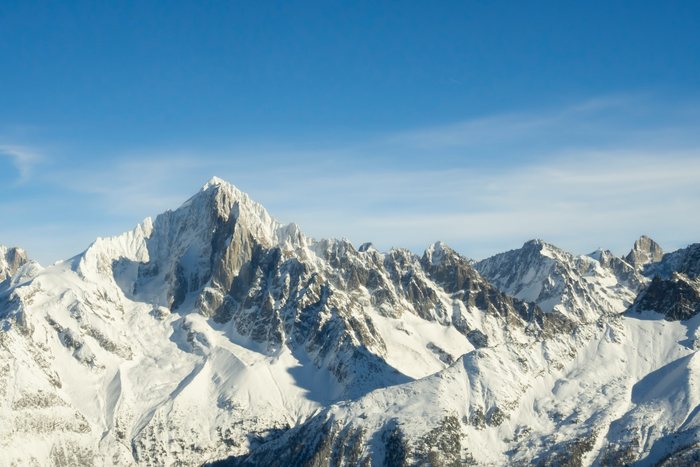
Chamonix, France
The birthplace of alpinism, under Mont Blanc.
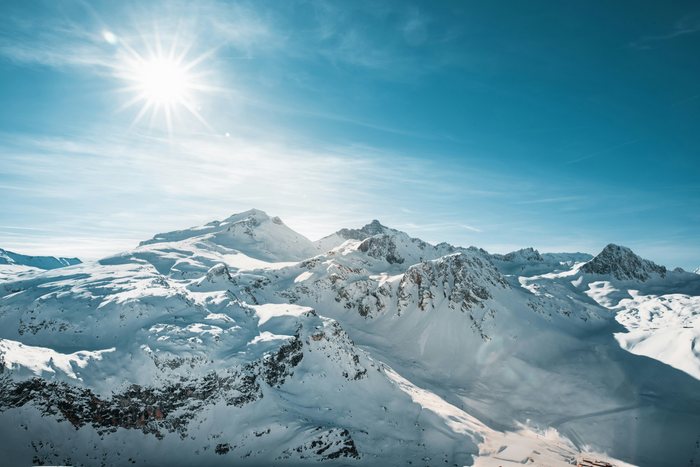
Val d’Isère, France
High-altitude, serious skiing with a village that actually feels like one.
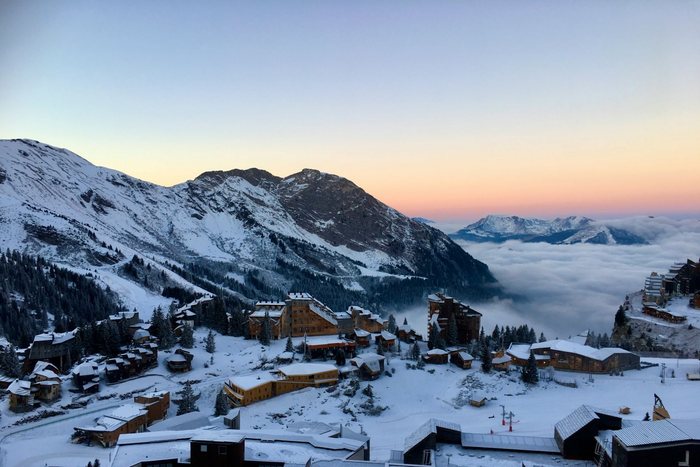
Morzine, France
A real Savoyard town and the gateway to the vast Portes du Soleil.
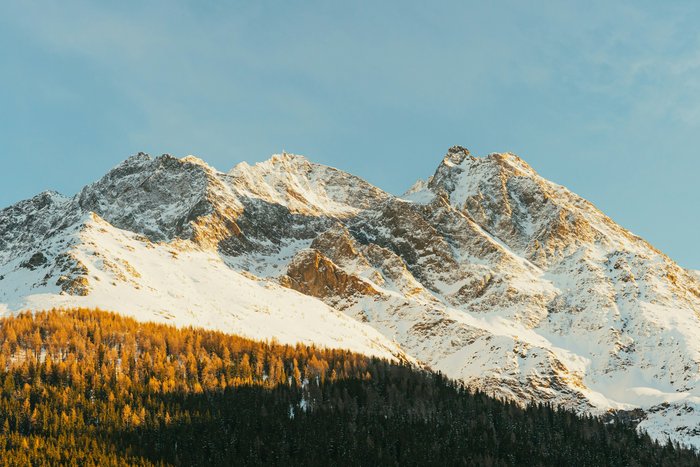
St. Anton am Arlberg, Austria
The birthplace of ski instruction and Austria’s most legendary off-piste.
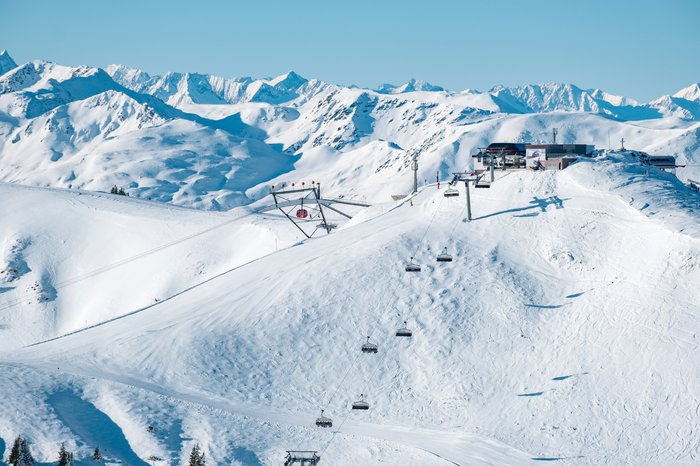
Kitzbühel, Austria
A medieval town with a World Cup downhill and 800 years of alpine charm.
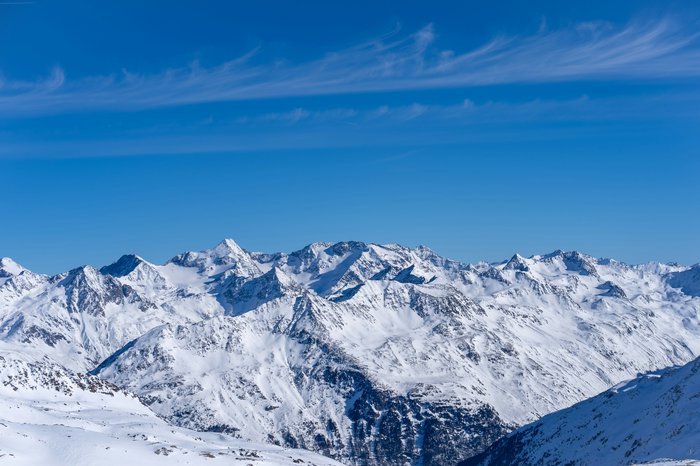
Sölden, Austria
Two glaciers, three 3,000 m peaks, a James Bond villain’s lair and the World Cup opener.