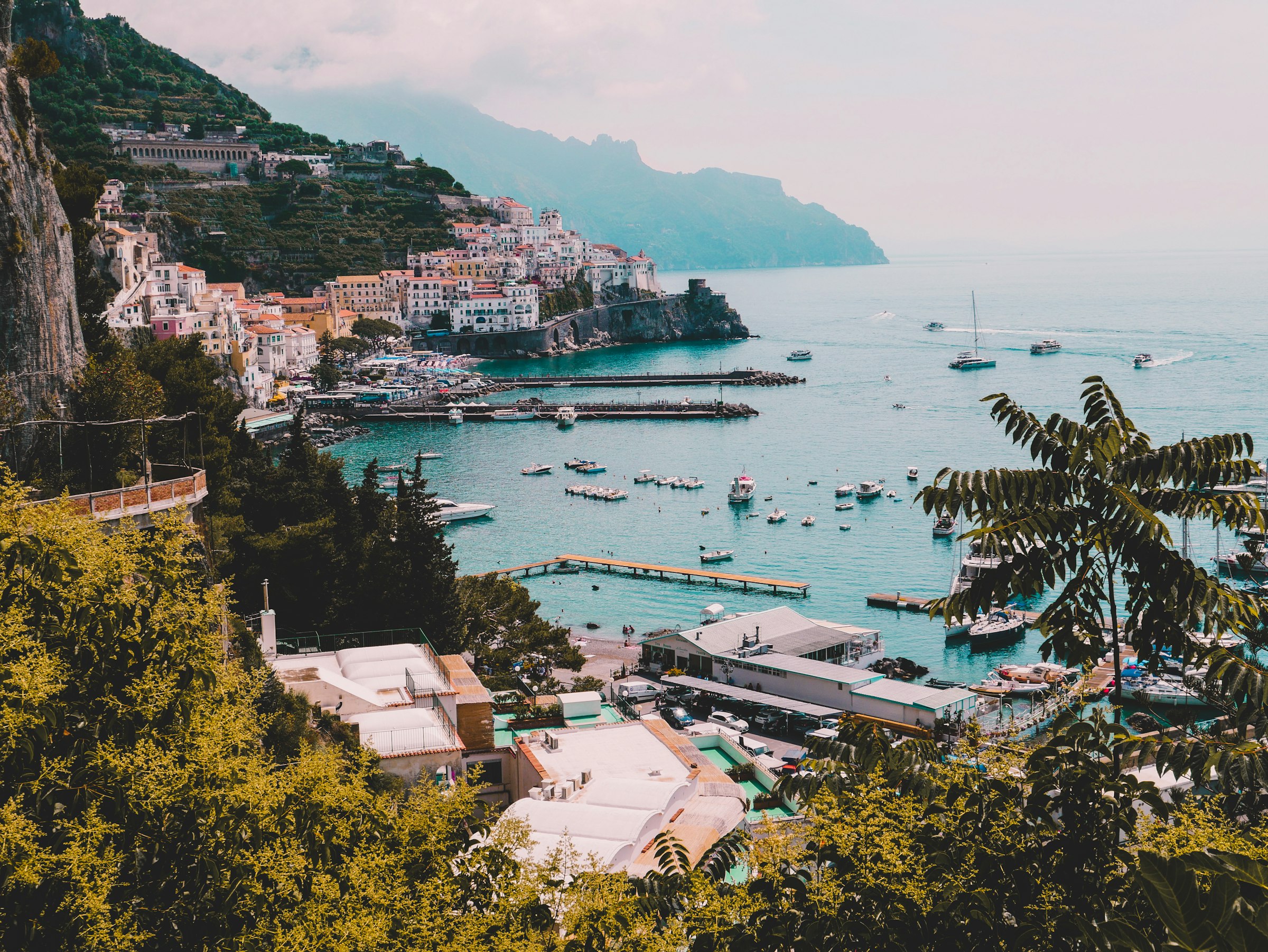
Amalfi Coast
Italy’s most glamorous stretch of coast — pastel villages stacked above the sea, lemons, and long lunches.
The Amalfi Coast is a 50-kilometre run of near-vertical cliff south of Naples where pastel villages cling to the rock above a blue sea, connected by a famously white-knuckle corniche road. It's the postcard of Italian coastal glamour — Positano tumbling down to the water, Ravello's clifftop gardens, lemons the size of fists — and for all the hype it genuinely delivers, provided you get the timing right.
The three names to know: Positano, the vertiginous pastel village that everyone photographs and pays a premium to stay in; Amalfi, the old maritime republic with a striped cathedral at the heart of the coast; and Ravello, set high above the sea with the most beautiful garden-terrace views in Italy. You move between them by ferry (far nicer than the clogged road) or by nerve-testing bus, and the best days are simple: a boat out to a swimming cove, a long seafood-and-lemon lunch, a walk on the Path of the Gods high above the coast, a day trip by fast ferry to Capri. It's about the setting and the table more than any list of sights.
The honest part: this is one of the most expensive and most crowded stretches of coast in Europe, and in July and August it can be genuinely miserable — the single road jams solid, ferries and beaches overflow, and hotel prices are eye-watering. The 'beaches' are mostly small, pebbly, and paid. And it's vertical: everything is steps, which is punishing in the heat and hard going if stairs are an issue. Come in May, June, or September, travel by ferry not car, and consider basing somewhere calmer to day-trip in — do that and it earns every bit of its reputation.
Highlights
-
Positano
The vertiginous pastel village spilling down to the sea — the coast’s defining, and priciest, view.
-
Ravello
High above the water, with the garden terraces of Villa Cimbrone and Villa Rufolo and the best views on the coast.
-
Amalfi
The historic heart: a striped Arab-Norman cathedral and a tangle of lanes behind the harbour.
-
Path of the Gods
A high cliff-top trail between Bomerano and Positano with the coast laid out far below.
-
Capri
A fast-ferry day trip to the glamorous island — the Blue Grotto, the Faraglioni, and the chairlift up Monte Solaro.
-
Lemons & seafood
Limoncello, lemon groves terraced into the cliffs, and long seafood lunches — the coast’s real ritual.
Practical info
- Visa
- Schengen — visa-free for most Western passports (90 days).
- Currency
- EUR (€)
- Language
- Italian; English widely spoken in tourism.
- Safety
- Very safe; the real hazards are the road, the steps, and summer crowds.
- Getting around
- Ferries are the smart way along the coast in season; buses are scenic but jammed. A car is more hindrance than help.
- Tap water
- Tap water safe and good.
- Plug type
- Type C Type F Type L 230V
- Money
- Cards widely accepted; carry cash for small cafés and beach clubs.
General guidance — visas, safety, and health change, so check your government's travel advisory and the official sources before you go.
Common questions
- When is the best time to visit the Amalfi Coast?
- May–June and September to early October are the sweet spot — warm sea, long days, the coast fully open, but without the July–August crush. High summer is spectacular and impossible in equal measure: peak heat, peak prices and gridlock on a single cliff road. And the coast genuinely shuts in winter — from around November to Easter many Positano and Amalfi hotels, restaurants and beach clubs close for the season and the ferries largely stop, so a winter visit means a much quieter, half-shuttered place (Sorrento and Salerno stay livelier year-round).
- Should I rent a car on the Amalfi Coast?
- In peak season, no. The SS163 coast road is narrow, cliff-hugging and gridlocked in summer, parking is scarce and expensive, and from roughly June to October an alternate-number-plate restriction ("targhe alterne") bans odd- or even-plated cars on given days during the daytime — and standard rental cars are not exempt (hotels with a confirmed booking, taxis and licensed NCC private drivers are). Base yourself where ferries and buses reach and skip the car. Outside the season a car is more manageable, but you still won’t need one for the main towns.
- How do you get around without a car?
- Three ways. Ferries are the smart choice in season — fast, scenic and free of the road traffic, linking Positano, Amalfi, Sorrento, Salerno and Capri from about 1 April to early November (they largely stop in winter and can be cancelled in rough seas). SITA SUD buses are the cheap coastal link but are slow and so crowded in summer that they sometimes leave you unable to board at Positano. And private drivers (NCC) are the premium door-to-door option — notably, they’re exempt from the plate restriction. The Circumvesuviana train (and the smarter Campania Express) only reaches Sorrento, not the coast itself.
- Is Capri worth a day trip, and what does it cost?
- Yes, but go early and expect crowds and cost. Capri runs a landing tax on day visitors (€5 in peak months, now folded into the ferry or hydrofoil ticket rather than paid separately), and 2026 brought caps on large organised groups (40 people per disembarkation, headsets required for groups over 20). The Blue Grotto (Grotta Azzurra) is a weather-dependent, fee-stacked experience — a short rowboat visit on top of the boat transfer, around €43 all in, and closed entirely when the swell is up. Going early beats both the day-tripper wave and the midday queues.
- What should I know about the beaches and terrain?
- Two things people underestimate. The beaches are mostly pebble or rock, not sand, and the best spots are largely paid beach clubs (loungers and umbrellas for a daily fee), with only small free strips (spiaggia libera) that fill fast — bring water shoes and don’t expect wide sandy beaches. And the terrain is vertical: Positano and Ravello are built up cliffsides on endless staircases (it’s some 300 steps down to Positano’s Arienzo beach), so there’s a lot of climbing and it’s a poor fit for limited mobility or heavy luggage. Pack light and wear real shoes.
- What’s special to eat on the Amalfi Coast?
- The coast runs on its lemons — the giant, sweet sfusato amalfitano — made into limoncello and the cream-filled delizia al limone. The signature pasta is scialatielli, often with seafood; from the fishing village of Cetara comes colatura di alici, a prized anchovy sauce descended from Roman garum; and the Campania plains behind the coast give mozzarella di bufala DOP. Naples, the gateway, adds its sfogliatella pastries and pizza. Eat seafood, drink a cold local white or a Furore wine, and finish with limoncello.
When to go
Shoulder season — and the winter shutdown
A short list of good months: the May–June and September–October shoulders, either side of an impossible peak and a genuine off-season close.
The two shoulders — May–June and September into early October — are the sweet spot: warm sea, coast fully open, none of the crimson July–August peak’s heat, prices and single-road gridlock. The ferries run roughly 1 April to early November; outside that, from November to Easter, much of Positano and Amalfi shuts for the winter (Sorrento and Salerno stay open).
The Amalfi Coast has a narrow window of grace: May–June and September into early October, when the sea is warm, the towns are fully open and the crush has not arrived or has just eased. July and August are the coast at full tilt — breathtaking, but with peak heat, peak prices and a single cliff road jammed solid.
The less-known fact is the winter shutdown. From roughly November to Easter, many Positano and Amalfi hotels, restaurants and beach clubs close for the season and the ferries largely stop running, so an off-season visit means a beautiful but half-shuttered coast. If you want winter, base in Sorrento or Salerno, which stay livelier year-round and keep their transport links.
- you’re visiting in peak summerSkiprenting a carGoferries plus the odd bus or private driver — the plate ban and gridlock make driving a trap
- you want the coast fully aliveSkipNovember–EasterGoMay–June or September–early October (winter half-shuts Positano & Amalfi)
- you’re day-tripping to CapriSkiparriving at middayGogoing early — before the day-tripper wave and the Blue Grotto queue
The driving trap
One cliff road, and a plate ban
The defining practical fact: in season, driving yourself is the wrong choice, and the rules actively discourage it.
The SS163 coast road is narrow, cliff-hugging, and gridlocked through the summer — and the authorities ration it. From roughly June to October an alternate-number-plate restriction ("targhe alterne") bans odd- or even-plated vehicles on alternating days during the daytime (about 10:00–18:00) on the Vietri-to-Positano stretch: weekends and holidays in June, July and October, then every day through August and September. The exact dates are reissued each year by ANAS, so check before you drive — but the key point is that standard rental cars are not exempt (hotels with a confirmed booking, taxis and licensed NCC drivers are).
Add scarce, expensive parking to the traffic and the plate ban, and the conclusion is simple: in season, don’t drive yourself. Base where ferries and buses reach, and move by boat. Outside the summer the road is more manageable, but you still won’t want a car for the main towns.
The plate ban catches self-drivers out because rental cars get no exemption: whether your plate is “allowed” that day is pure luck, and being caught on the wrong day risks a fine. Private NCC drivers and taxis are exempt, and a confirmed hotel booking covers your arrival and departure transfer — so if you must have a car on the coast, it’s a driver you want, not a rental.
Getting around
Move by boat
With the car ruled out, the coast runs on ferries first, buses as backup, and a train that only gets you to the edge.
Ferries are the smart way to travel in season — fast, scenic and free of the road snarl, linking Positano, Amalfi, Sorrento, Salerno and Capri from about 1 April to early November (operators include Travelmar, Alilauro and NLG). They largely stop in winter and can be cancelled in rough seas, so treat them as seasonal and weather-dependent. The SITA SUD buses are the cheap coastal option but are slow and so crowded in summer that they sometimes leave Amalfi full, making it impossible to board at Positano at peak times.
The Circumvesuviana train from Naples reaches only Sorrento — the gateway, not the coast itself — cheap and basic; the Campania Express is its comfier, reserved-seat tourist version on the same line. For door-to-door comfort, private drivers (NCC) are the premium answer, and they’re exempt from the plate restriction. Most visitors end up combining ferries with the odd bus or driver, and a base chosen for its boat links.
| Way | Use it for | Note |
|---|---|---|
| Ferry (Travelmar, Alilauro, NLG…) | Town to town in season | Fast, scenic; ~Apr–early Nov; cancellable in swell |
| SITA SUD bus | The cheap coastal link | Slow; so full in summer it can’t board at Positano |
| Circumvesuviana / Campania Express | Naples to Sorrento | Reaches only Sorrento, not the coast itself |
| Private driver (NCC) | Door-to-door comfort | Premium; exempt from the plate ban |
| Your own rental car | Avoid in season | Plate ban + gridlock + scarce, costly parking |
Most visitors combine ferries with the odd bus or private driver, and choose a base for its boat links. The Campania Express is the air-conditioned, reserved-seat version of the Circumvesuviana from Naples. Checked October 2026.
Ferries are the coast’s real artery, not the road: the seasonal network runs roughly 1 April to early November, so an off-season visit throws you onto the SITA buses and the clogged SS163. Capri adds a €5 landing tax (April–October) bundled into the fare, and from 2026 caps tour groups at 40 per disembarkation with headsets required above 20 — so arriving independently and early beats the midday group crush.
The towns
Positano, Amalfi, Ravello — and the gateways
Six places do the work: the photogenic cliff towns, the historic hub, the garden terrace above, and the year-round gateways.
The coast is really six places. Positano is the vertical, pastel-stacked icon — the most glamorous and priciest base, and a workout of staircases. Amalfi, the medieval maritime republic that gave the coast its name, is the historic hub, its striped Cathedral of Sant’Andrea rising over a grand staircase; and high on the ridge above sits Ravello, a quieter world of garden villas and summer concerts (see the next section). Praiano, between Positano and Amalfi, is the calmer, better-value base with a celebrated sunset terrace.
The two gateways anchor the ends. Sorrento, on the Bay of Naples side of the peninsula (administratively part of Naples, not the Amalfi side), is the year-round hub where the train meets the ferries. Salerno, the workaday city at the eastern end, is the cheapest base, stays open all winter, and has fast ferries west along the coast. Choose a base for its boat links, not its postcard looks, and you travel the whole coast easily.
| Town | What it’s for | Good to know |
|---|---|---|
| Positano | The vertical, photogenic icon | The priciest base; endless stairs |
| Amalfi | The historic hub and cathedral | A medieval maritime republic; central ferry port |
| Ravello | High above — gardens and music | Villa Rufolo & Cimbrone; summer festival |
| Praiano | A quieter base between the two | Better value; famous sunset church terrace |
| Sorrento | The gateway on the Bay of Naples | Year-round; the train + ferry hub |
| Salerno | The workaday eastern gateway | Year-round; the cheapest base; ferries west |
Capri
The Blue Grotto and the Faraglioni
The famous island day trip — glorious, crowded and fee-stacked — rewards an early start and a weather eye.
~€43 all-in Capri’s Blue Grotto — if the sea allows
Capri is the classic day trip from the coast or Sorrento — and a crowded, costly one. A landing tax (€5 in peak months, now built into the ferry ticket) applies to day visitors, and 2026 added caps on large organised groups: no more than 40 people disembarking together, and headsets required for groups over 20, part of the island’s push against over-tourism. The headline sight, the Blue Grotto, is covered in the figure — go early, as it closes in swell and queues build fast.
Beyond the grotto, Capri rewards wandering: the Faraglioni sea stacks, the Gardens of Augustus and the hairpin Via Krupp, the smart piazzetta, and, from quieter Anacapri, a single-seat chairlift up Monte Solaro for the island’s best view. Do it as an early start to beat both the day-tripper wave off the ferries and the midday heat.
Sights & walks
The Path of the Gods, villas, and Roman ruins
Beyond the towns: a free clifftop walk, two garden villas, and the great Roman excursions a train ride away.
The standout walk is the Path of the Gods (Sentiero degli Dei) — a free, unticketed clifftop trail from Bomerano (Agerola) to Nocelle, high above the sea, finished with a knee-testing descent of some 1,500 steps down to Positano. Up in Ravello, the gardens of Villa Rufolo (€8; the inspiration for Wagner’s Parsifal, and the open-air stage of the summer Ravello Festival) and Villa Cimbrone (~€10; its marble Terrace of Infinity the coast’s most famous view) are both unmissable and need no advance booking.
The region is also the base for Italy’s great Roman excursions: Pompeii and Herculaneum and the climb up Vesuvius, all reached via Sorrento and the Circumvesuviana, and the superbly preserved Greek temples of Paestum, about an hour south of Salerno by regional train. None of the coast’s own sights need pre-booking — but all reward an early start.
| Sight / walk | What it is | Good to know |
|---|---|---|
| Path of the Gods | The free clifftop trail | Bomerano/Agerola to Nocelle; ~1,500 steps down to Positano |
| Villa Rufolo (Ravello) | Gardens that inspired Wagner | €8; the Ravello Festival stage |
| Villa Cimbrone (Ravello) | The Terrace of Infinity | ~€10; the coast’s best garden view |
| Pompeii & Vesuvius | Roman ruins and the volcano | Via Sorrento / the Circumvesuviana |
| Paestum | Greek temples | South of Salerno, ~1 hr by train |
Food
Lemons, seafood and Campania’s larder
The coast eats off its lemon terraces and its fishing boats, backed by the rich larder of Campania.
The sfusato lemon the Amalfi lemon, and what’s made from it
Amalfi cooking is coastal and citrus-bright. The lemons (see the figure) are everywhere — in limoncello, in desserts, over fish — and the sea supplies the rest: scialatielli ai frutti di mare, grilled catch, and the prized colatura di alici from the little fishing village of Cetara. From the plains behind the coast comes DOP mozzarella di bufala, and from Naples, the gateway, the city’s pizza and flaky sfogliatella pastries.
Drink local: a cold white from the hillside Furore and Tramonti vineyards, or a Campania Falanghina, and finish — always — with a shot of limoncello straight from the freezer. Eat a little inland or in the gateway towns for better value; the Positano waterfront charges for its view.
Good to know
Pebble beaches, stairs, live EU borders
The practical footnotes — what the beaches are really like, the terrain, and the Italy-wide entry picture.
The beaches are mostly pebble or rock, not sand, and the prime spots are paid beach clubs (sunbed-and-umbrella hire) with only small free strips (spiaggia libera) that fill early — bring water shoes. The terrain is steep and stair-heavy: Positano and Ravello climb their cliffs on long staircases (it’s around 300 steps down to Positano’s Arienzo beach), so expect a lot of steps and pack light. This is the Amalfi Coast’s real character — vertical, scenic, not step-free.
Entry is standard Italy: Schengen and the eurozone, no visa for short stays for US, UK and most Western visitors. The EU’s biometric Entry/Exit System (EES) is now fully deployed, so expect fingerprint-and-photo registration on arrival into Italy; the separate ETIAS authorisation is not yet required and is expected in 2027 (a €20 online step). For the fuller Italy picture, see the Italy guide.
A base-choosing tip that saves money and stairs: the postcard towns (Positano above all) charge a heavy premium and demand a lot of climbing. Praiano is the quieter, better-value spot mid-coast; Salerno and Sorrento are the cheapest, flattest, best-connected bases and stay open all winter. Pick your base for its ferry links and your knees, then day-trip to the icons by boat.
Compare Amalfi Coast
If you like Amalfi Coast, also consider

France
Paris is only the opening act — wine country, the Alps, and two coastlines.
Japan
Extraordinary food, culture, and cities. Nothing quite prepares you for it.
Mexico
Mexico City is world-class. Add the coast, ruins, and food culture.
Thailand
The complete package for warm-climate travel.
Not sure where to go
Take the 5-minute quiz
Answer a few honest questions and get matched to destinations that actually fit how you travel.
Start the quiz