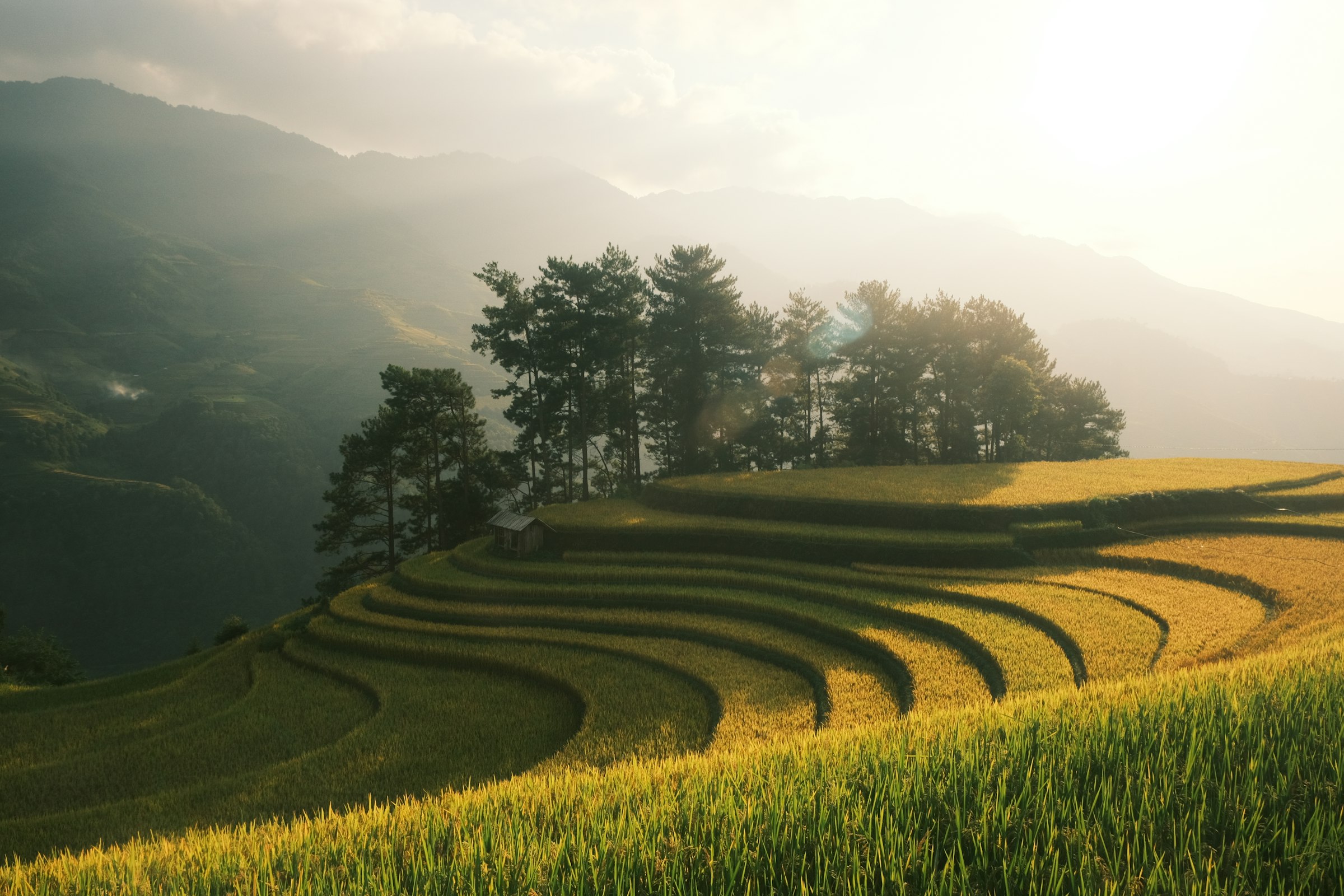
Vietnam
The best food in Southeast Asia, remarkable scenery, a long coastline.
Vietnam packs an extraordinary amount into one country: the chaos of Saigon, the elegance of Hanoi, the karst seascape of Ha Long, the ancient lanterns of Hoi An, and beach towns scattered down a 3,400 km coast. The food is the strongest argument for going — and it's hard to overstate how good it is.
The classic run goes north to south: Hanoi's old quarter, a night on a boat off Cat Ba or the Ha Giang loop by motorbike, then Hue, Hoi An, and finally Saigon's roar. Sleeper trains and cheap domestic flights stitch it together. Street food sets the daily rhythm — pho at dawn, banh mi on travel days, bia hoi on plastic stools — and it costs so little that splurging on a good hotel still leaves the budget intact.
Vietnam asks for patience. Three climate zones mean somewhere is always raining, so a full-length trip rarely catches perfect weather throughout. Crossing the street is an act of faith, overcharging in tourist zones is routine, and Ha Long Bay's beauty comes with a fleet of near-identical cruise boats. English runs out fast beyond the trail. If you want polish, pay for it in Hoi An. The food and the prices forgive everything else.
Highlights
-
Hanoi
Old quarter chaos, lakes, and the best pho on earth.
-
Ha Long & Cat Ba
Limestone islands rising from emerald water.
-
Hoi An
Lantern-lit old town, tailors, and quiet beaches nearby.
-
Ho Chi Minh City
Coffee culture, war history, and electric energy.
Practical info
- Visa
- E-visa available for most nationalities (90 days). Verify before travel.
- Currency
- VND (Dong). Roughly 25,000 VND ≈ 1 USD.
- Language
- Vietnamese. Limited English outside major cities and tourist spots.
- Safety
- Safe. Traffic and pickpocketing are the main concerns.
- Getting around
- Trains run the coast (slow, scenic). Domestic flights cheap. Grab in cities.
- Tap water
- Tap water not safe.
- Plug type
- Type A Type C Type D 220V
- Money
- Cash dominant; cards limited to nicer hotels and restaurants.
General guidance — visas, safety, and health change, so check your government's travel advisory and the official sources before you go.
Common questions
- Do you need a visa for Vietnam?
- It depends on your passport — there’s no single rule. Twenty-four countries are visa-free for 45 days (the UK, Germany, France, Italy, Spain, the Nordics, Japan and South Korea among them, plus a second group including the Netherlands, Poland, Czechia and Switzerland), under schemes running to 2028. But US, Canadian, Australian and New Zealand travellers are not visa-exempt — they need the e-visa, open to all nationalities since 2023, valid up to 90 days, single or multiple entry, costing about US$25 (single) or US$50 (multiple) and taking roughly three to five working days. Apply only on the official government portal (the domain ends .gov.vn) — the lookalike agencies charge several times the real fee. Carry a passport valid six months beyond entry.
- When is the best time to visit Vietnam?
- There isn’t one month that’s good everywhere, because Vietnam has three distinct climate zones. The north (Hanoi, Sapa, Ha Long) has a cool, drizzly winter (Dec–Feb) and hot, stormy summers — best in spring and autumn. The centre (Hue, Da Nang, Hoi An) is dry roughly February–August and wet with typhoons September–December, when Hoi An’s old town regularly floods. The south (Ho Chi Minh City, the Mekong) is warm year-round, dry November–April. For a full-country trip, March–April (or November) is the best compromise. Also plan around Tet, the lunar new year (6 February in 2027), when much closes and transport fills.
- Can I rent and ride a motorbike in Vietnam?
- You can rent one anywhere — but for most Western tourists, riding it is illegal and uninsured, and the rental shop won’t tell you. To ride legally you need a home licence with a motorcycle category plus a 1968 Vienna Convention International Driving Permit. The catch: the US and Canada (and, by most accounts, the UK, Australia and Ireland) issue the 1949 Geneva IDP, which Vietnam does not recognise — so those riders are unlicensed in law and most travel insurance is void in a crash. Enforcement tightened sharply under Decree 168 (in force since January 2025). Given traffic is the single biggest danger to visitors, think hard before riding — Grab and Xanh SM motorbike-taxis do the same job legally.
- Is Vietnam safe, and what should I watch for?
- Vietnam is generally very safe — violent crime against foreigners is rare, and the real danger is the traffic, not crime. The most common theft is drive-by bag- and phone-snatching by motorbike: carry bags on the side away from the road and don’t use your phone at the kerb. The usual scams are rigged taxi meters (use a ride app, or stick to Mai Linh and Vinasun) and overcharging. Dengue is present year-round, worse in the wet season, so use repellent; street food is a highlight — pick busy, high-turnover stalls. Crossing the road, move slowly and steadily and let the motorbike swarm flow around you.
- Is Vietnam cheaper than Thailand?
- Yes — Vietnam is among the very cheapest countries in Asia, with a bowl of pho for a dollar or two and budget rooms from a few dollars; it undercuts Thailand on food and lodging, though Thailand’s islands and transport are more polished. Both are superb value. See our full comparison.
- Do I need to book the caves and Ha Long cruises ahead?
- For Son Doong, far ahead — the world’s largest cave is capped at about 1,000 permits a year through one operator and is sold out into 2028. Ha Long Bay cruises are bought as one- or two-night packages (not arranged on the spot), and booking ahead gets you a better boat and the quieter alternative bays. Hoi An and Hue you can simply turn up for.
Entry & visa
The visa rule depends on your passport
Vietnam has no one-size entry rule — 24 countries walk in for 45 days, while others need the 90-day e-visa.
The one thing to get right first is your own entry category, because it varies by nationality. Twenty-four countries — the UK and much of the EU (in two tranches), plus Japan, South Korea and others — are visa-free for 45 days under schemes running to 2028. Everyone else, notably US, Canadian, Australian and New Zealand passport holders, needs the e-visa: open to all nationalities since 2023, valid up to 90 days, single or multiple entry.
Apply for the e-visa only on the official government portal (a .gov.vn address), where it costs roughly US$25 (single) or US$50 (multiple) and processes in about three to five working days. The web is thick with agency lookalike sites charging two to five times as much for the identical document — avoid them. Carry a passport valid six months beyond arrival whichever route applies.
Sort your Vietnam entry category first, because it varies by passport. Twenty-four countries — the UK and much of the EU, plus Japan, South Korea and others — are visa-free for 45 days; everyone else needs the 90-day e-visa, applied for on the official government e-visa portal a few days ahead (not one of the many paid copycat sites). Check which bucket you’re in before you book flights.
When to go
Three climates, so no single best month
Vietnam runs 1,650 km north to south, so it’s really three trips in three climate zones — and the weather decides your route.
Crimson are the ones to plan around. March–April (or November) is the best all-round compromise for a full north-to-south trip; the south’s dry season also wraps the new year (Nov–Apr).
The north (Hanoi, Ha Long, Sapa) has a genuine cool, grey winter December–February and hot, stormy summers, so spring and autumn are best. The centre (Hue, Da Nang, Hoi An, the Phong Nha caves) is dry February–August but turns wet September–December, with typhoons peaking September–October and Hoi An’s old town flooding in October–November. The south (Ho Chi Minh City, the Mekong) is warm all year, dry November–April.
Because the zones peak at different times, you plan the route around the season rather than the other way round:
- September–December (central typhoon & flood season)SkipHue, Da Nang and Hoi An — the old town floods in Oct–NovGothe south (HCMC, the Mekong, Phu Quoc), dry and warm then
- The northern winter (Dec–Feb), cool and greySkipexpecting beach weather in Hanoi or Ha LongGothe far south, warm year-round — or come north in spring/autumn
- Tet week (around 6 February in 2027)Skipintercity travel — transport and hotels fill and prices jumpGostaying put in one city to witness it, or shifting your dates
Where to go
North, centre and south — three different trips
The country is for range along its length; pick regions by what you want and when you’re going.
A first trip usually strings together one or two zones rather than all three: Hanoi with Ha Long Bay and Sapa in the north; the trio of Hue, Da Nang and Hoi An in the centre, with the Phong Nha caves a detour inland; and Ho Chi Minh City with the Mekong Delta and the beach island of Phu Quoc in the south. The classic full run is Hanoi to Saigon (or the reverse), flying the long legs and lingering in the centre.
| Region | The draw | Best season |
|---|---|---|
| North | Hanoi, Ha Long Bay, Sapa’s rice terraces, Ninh Binh | Spring & autumn (Mar–Apr, Sep–Nov) |
| Centre | Hoi An, Hue, Da Nang beaches, the Phong Nha caves | Feb–Aug (floods Oct–Nov) |
| South | Ho Chi Minh City, the Mekong Delta, Phu Quoc island | Dry Nov–Apr |
No single month suits the whole country — March–April (or November) is the best compromise for a full north-to-south trip, and the sea and weather differ sharply by zone.
Getting around
Fly the long hops, app the short ones
A thin country where domestic flights cover the distance, the train is the scenic option, and apps beat the taxi touts.
| Route | Mode | Fare · time |
|---|---|---|
| Hanoi – Ho Chi Minh City | Flight | ~$19–120 · 2 h |
| Hanoi – Ho Chi Minh City | Reunification Express | ~$70–96 sleeper · 32–36 h |
| Hue – Da Nang | Train (Hai Van Pass) | The scenic highlight · ~3 h |
Indicative 2026 fares at about 25,900 dong to the dollar. VietJet and Vietnam Airlines fly the big legs — Bamboo Airways no longer sells scheduled tickets. A 350 km/h high-speed railway is approved but not expected until the 2030s.
On riding yourself: for most Western tourists a rented motorbike means riding unlicensed and uninsured (see the FAQ), and the traffic is the real danger of a Vietnam trip. Decree 168 (2025) raised fines sharply — a motorbike red-light offence is now 4–6 million dong (~US$160–240), no helmet 400,000–600,000 dong. A Grab or Xanh SM motorbike-taxi does the same job legally.
Sights & tickets
Bays, old towns and a sold-out cave
The headline sights are mostly cheap to enter — the one that needs real planning is the world’s biggest cave.
Booked to 2028 Son Doong, the world’s largest cave — sold out years ahead
Ha Long Bay is the icon and is heavily overtouristed — millions of visitors and hundreds of boats a year — so many travellers now choose the quieter karst alternatives of Lan Ha Bay / Cat Ba or Bai Tu Long; cruises are booked as one- or two-night packages. Inland, Hoi An’s lantern-lit old town uses a heritage ticket (now two tiers) covering a set of monuments including the restored Japanese Covered Bridge, and Hue’s Imperial Citadel anchors a scatter of ticketed royal tombs. The beaches of Da Nang and the island of Phu Quoc round out the coast.
| Sight | Ticket | Note |
|---|---|---|
| Hoi An old town | 80,000 or 120,000 VND (~$3–5) | Two tiers; covers a set of monuments, valid 3 days |
| Hue Imperial Citadel | 200,000 VND (~$8) | Royal tombs 150,000 VND each; combos from 420,000 |
| Ha Long Bay cruise | ~$110–320 (1 night) | Overtouristed — try Lan Ha or Bai Tu Long |
| Son Doong expedition | ~US$3,000 (6D/5N) | Oxalis only, ~1,000/yr, booked to 2028 |
Prices read off 2026 listings. The no-permit caves at Phong Nha — Paradise Cave (~250,000 VND) and Phong Nha Cave (~150,000 VND) — are the accessible alternative to Son Doong.
Ha Long cruises vary enormously in quality for the price — book a reputable one- or two-night package ahead rather than arranging on the spot, and consider Lan Ha Bay or Bai Tu Long, which carry a fraction of the boats.
Safety
The traffic is the danger, not crime
Vietnam is very safe from crime — the risk that actually hurts visitors is the road.
17.7 / 100k road deaths — the real hazard of a Vietnam trip
Beyond the traffic, the hazards are small and avoidable: rigged taxi meters (use a ride app, or Mai Linh and Vinasun), street-vendor overcharging, and the odd photo-prop scam in Ho Chi Minh City. Dengue is present year-round (worse in the wet season), so use repellent; malaria is a rural-only, low risk and absent from the cities. And when you cross a road, the trick is to walk slowly and steadily at a predictable pace — the motorbike swarm flows around you; sudden stops or sprints are what cause accidents.
Money
Lots of zeros, and a cash habit
A cheap, cash-leaning economy with a confusing currency and fast-growing QR payments.
The currency is the Vietnamese dong, which runs to a lot of zeros (around 25,900 to the US dollar) — watch the 100,000 and 500,000 notes, which look alike and are an easy mix-up. Vietnam is still a heavily cash economy outside the big cities, though QR payments are spreading fast; ATMs often cap withdrawals low (around 3 million dong a time) and charge a per-transaction fee, with VPBank and ACB the friendliest. It remains exceptional value — among the cheapest countries in Asia: a bowl of pho runs 35,000–60,000 dong (US$1.40–2.40), a budget room a few dollars. Tipping isn’t traditional but is appreciated in tourism, and not expected in ordinary local eateries.
Good to know
Water, temples and the practical basics
The small things that make a Vietnam trip go smoothly.
Vietnamese is the language, with English common in the tourist areas and thinner in the rural north. Plugs are Type A/C at 220V (US flat pins fit the sockets, but 110V-only devices need a converter). Don’t drink the tap water — bottled or boiled only, and skip ice at the cheapest places. At temples and pagodas, cover shoulders and knees and remove your shoes at the sanctuary threshold.
The street food is a headline in itself — pho, banh mi, bun cha, the egg coffee of Hanoi — and the safest bet is a busy, high-turnover stall where the food is cooked in front of you. Weighing Vietnam against its obvious neighbour-rival? See Thailand vs Vietnam, measured.
Compare Vietnam

If you like Vietnam, also consider

France
Paris is only the opening act — wine country, the Alps, and two coastlines.
Italy
The benchmark for food, history, and beauty.

Japan
Extraordinary food, culture, and cities. Nothing quite prepares you for it.
Not sure where to go
Take the 5-minute quiz
Answer a few honest questions and get matched to destinations that actually fit how you travel.
Start the quiz