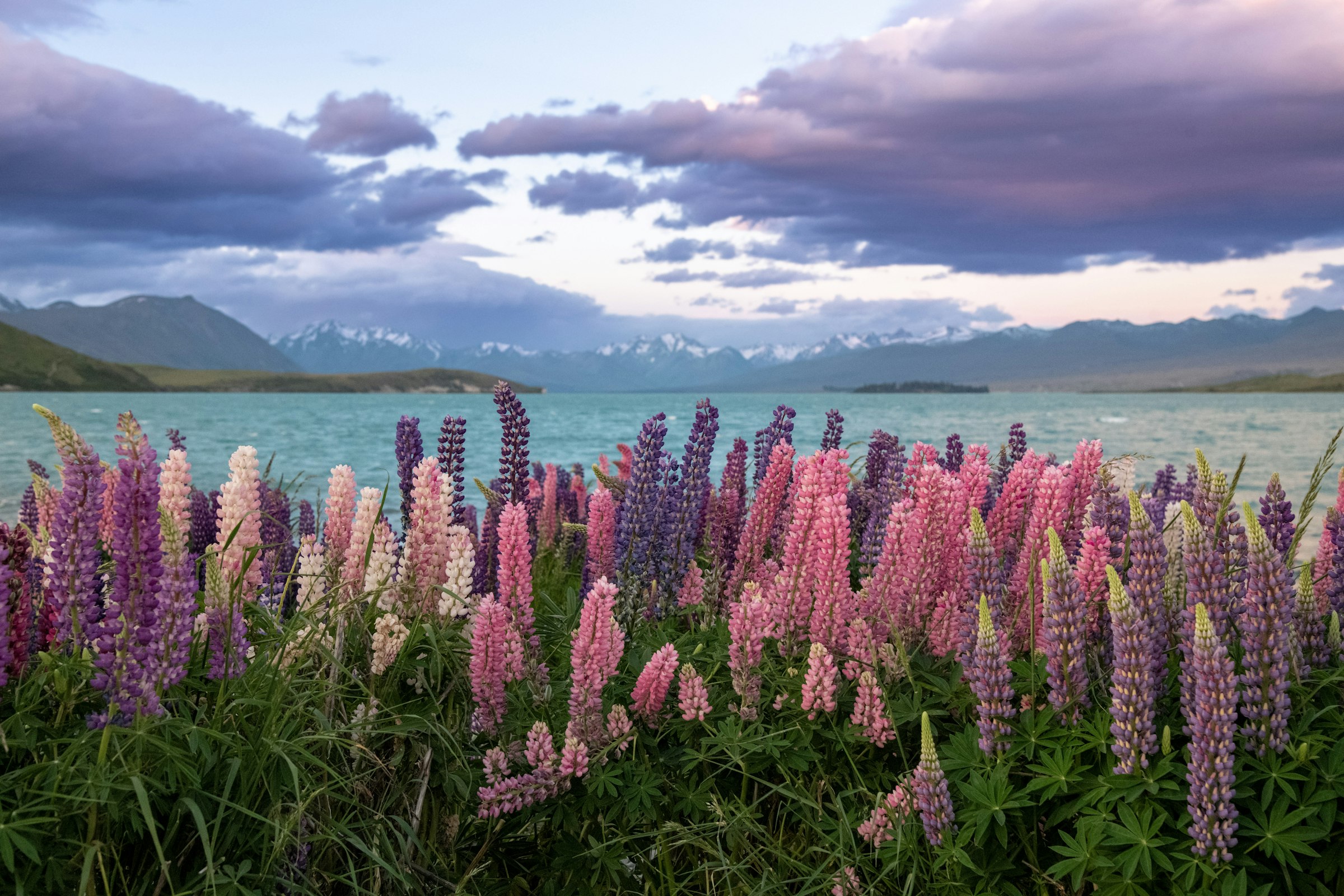
New Zealand
Fjords, volcanoes, glaciers, beaches — in one country.
New Zealand earns the long flight. The variety of landscapes per kilometer is unlike anywhere else: Fiordland's sounds, the Southern Alps and glaciers, Tongariro's volcanic crossing, the Bay of Islands' beach country. Plan three weeks minimum if you want both islands; six is better.
This is a road trip, full stop. Most people take a campervan or rental car and string together the South Island — Queenstown, Wanaka, Mount Cook, the West Coast glaciers, Fiordland — with days that run hike, scenic drive, petrol-station meat pie, repeat. The Great Walks and Milford-area beds book out months ahead in summer. Your money disappears into the vehicle, fuel, and activities: bungy jumps, heli-hikes, and Milford cruises add up brutally fast.
The honest part: it's expensive, it's far away, and the weather answers to no itinerary — Milford Sound gets rained out regularly and the Tongariro Crossing closes in high wind. Towns are small and shut early; if you want nightlife, museums, or a serious food scene, you're in the wrong country. Fiordland's sandflies are a plague with wings. But for three weeks of landscapes that change completely every two hours of driving, nowhere else delivers.
Highlights
-
Queenstown & Fiordland
Adventure capital. Milford Sound is non-negotiable.
-
Wanaka & Mount Cook
Quieter alternative to Queenstown with the most striking peaks.
-
Tongariro Crossing
One-day volcanic crater hike on the North Island.
-
Bay of Islands
Subtropical north — sailing, beaches, slower pace.
Practical info
- Visa
- NZeTA required for visa-waiver travelers; apply online before travel.
- Currency
- NZD (Dollar). Roughly 1.7 NZD ≈ 1 USD.
- Language
- English (and Maori).
- Safety
- Very safe. Weather and outdoor activities are the real risks.
- Getting around
- Self-drive — campervan or rental car. Domestic flights between islands.
- Tap water
- Tap water safe.
- Plug type
- Type I 230V
- Money
- Cards everywhere. Cashless culture.
General guidance — visas, safety, and health change, so check your government's travel advisory and the official sources before you go.
Common questions
- When is the best time to visit New Zealand?
- Remember the seasons are flipped: summer is December–February (warm, the busiest and priciest stretch, with school holidays late Dec–Jan the peak), autumn (March–May) is a settled, quieter sweet spot, winter (June–August) is South Island ski season when many alpine tracks close, and spring is September–November. The South Island is cooler and more alpine, the North warmer and more temperate; weather is highly changeable, especially on the wet West Coast and in the mountains.
- Do you need a car in New Zealand, and how do the two islands connect?
- A car or campervan is essentially required — inter-regional public transport is limited, and the country is long and slow, with winding roads that make drive times far exceed what a map suggests. The two main islands are joined by the Cook Strait ferry (Wellington–Picton, about 3–3.5 hours); you can take a vehicle across, but book vehicle space ahead in peak season, and note the ageing fleet has had breakdowns.
- How do you book the Great Walks?
- The Great Walks are New Zealand’s premier multi-day tracks, and their huts and campsites must be booked in advance for the Great Walks season (1 November–30 April), through the Department of Conservation (DOC). Demand is intense — the Milford Track sells out within about half an hour of release — and international visitors pay higher hut fees than residents (a Milford hut night was NZD $152 for overseas visitors in 2026/27, versus $106 for residents). Bookings for a season open the preceding May.
- Is New Zealand expensive?
- Mid-to-high — it’s a developed Western country where fuel, adventure activities and remote-area food add up, and overseas visitors pay higher park fees than locals. But unlike some comparable destinations it has a genuine budget tier: campervans, hostels, holiday parks, DOC campsites and self-catering keep it accessible if you plan that way.
- What do you need to enter New Zealand?
- Visa-waiver visitors (and everyone arriving by air) need an NZeTA — about NZD $17 via the official app or $23 on the website, valid two years — plus the International Visitor Conservation & Tourism Levy (IVL) of NZD $100, paid at the same time. The IVL nearly tripled from $35 to $100 on 1 October 2024. Australian citizens need neither. Apply a few days ahead via immigration.govt.nz only.
- Which island should you choose if you only have time for one?
- The South Island for raw landscape — Fiordland, the Southern Alps, Queenstown, the glaciers and the dark skies — and the North Island for geothermal wonders, Māori culture, the volcanoes and the warmer, more populated feel. Many first trips try to do both and under-budget the driving and the Cook Strait crossing between them; with limited time, one island done well beats a rushed loop of both.
When to go
Flipped seasons, two very different islands
Get the hemisphere right first: summer is December–February, and winter shuts the high country.
The seasons are flipped — summer is December–February. The two crimson bars are the ones that catch people out: the Dec–Feb peak (shown Jan–Feb, it runs through December) is the hottest, busiest, most expensive stretch; and the Great Walks season (1 Nov–30 Apr, shown Jan–Apr) is when the famous tracks’ huts must be booked months ahead. Autumn (Mar–May) is the sweet spot.
Peak is summer, December–February — warm and busy, with the late-December-to-January school holidays the most crowded and expensive stretch. Autumn (March–May) is the quieter sweet spot: settled weather, thinner crowds. Winter (June–August) is South Island ski season, but it turns the alpine Great Walks and some passes into serious backcountry undertakings, so don’t plan a summer-style tramping trip then. The South Island is cooler and more dramatic (Fiordland, the Southern Alps, Queenstown); the North is warmer and more temperate (Bay of Islands, Rotorua’s geothermal field, Tongariro). Expect fast-changing weather, and pack for rain on the West Coast and in Fiordland whatever the forecast.
- a Great Walk is the centrepiece of your tripSkipassuming first-come huts or booking flights firstGobooking the day DOC releases the season (the preceding May) — Milford goes in ~30 minutes
- you’re planning short hops between sightsSkiptrusting straight-line map distancesGoroughly doubling your drive-time estimates — the roads are long and winding
- you want settled weather and fewer crowdsSkipthe December–January school-holiday peakGothe March–May autumn, the quiet sweet spot
Entry & money
The NZeTA and the conservation levy
Two things to buy before you fly — and they’re paid together.
Entry is paperwork you sort online before departure, not at the airport: the NZeTA (about NZD $17 via the official app, $23 on the website, valid two years) covers visa-waiver visitors and everyone arriving by air, and it’s bundled with the International Visitor Conservation & Tourism Levy — NZD $100, which nearly tripled from $35 in October 2024 and funds conservation and tourism infrastructure. Apply a few days ahead via immigration.govt.nz only (the clone sites overcharge). Australian citizens are exempt from both. The currency is the New Zealand dollar, and cards are accepted almost everywhere.
Biosecurity is taken very seriously: declare all food, and clean any hiking boots, tent or outdoor gear before you arrive, because an isolated island ecosystem is fiercely protected and fines for undeclared items are real. It’s the one arrival formality that genuinely surprises visitors.
Getting around
Long, slow, and a ferry in the middle
The single biggest planning mistake is time: drives take far longer than the map suggests, and the two islands are a sea crossing apart.
New Zealand is a long, mountainous country, and winding, hilly roads mean you average well under 100 km/h on many routes — single destinations like Milford Sound can be multiple hours each way from the nearest town. Plan realistic daily driving and don’t trust straight-line distances. The two main islands are joined by the Cook Strait ferry (Interislander and Bluebridge, Wellington–Picton, about 3–3.5 hours); vehicles cross too, but reserve the vehicle space ahead in summer. Watch for one-lane bridges, unsealed roads, and alpine passes that close or demand chains in winter — the Homer Tunnel on the Milford Road is single-lane and light-controlled.
| Way | Use it for | Note |
|---|---|---|
| Hire car / campervan | Touring either island | The default; drive on the left, roads are slow |
| Cook Strait ferry | Wellington ↔ Picton | ~3–3.5h; ageing fleet, book vehicle space ahead |
| Domestic flights | Long hops (Auckland–Queenstown) | Saves a multi-day drive; Air NZ, Jetstar |
| Alpine roads | Milford, Crown Range, the passes | Carry chains in winter — a $750 fine applies on QLDC roads |
Winding, hilly roads mean you average well under 100 km/h on many routes, and single destinations like Milford Sound are hours from the nearest town. The Cook Strait ferry fleet is ageing (replacements due ~2029) and had breakdowns in early 2026. Checked October 2026.
The big sights
Fiordland, volcanoes, and Middle-earth
The headline experiences are spread across both islands — and the distances between them are the real planning cost.
1990 the year the south-west wilderness became UNESCO heritage
In the south, Milford Sound is the set piece, reached on the scenic Milford Road (SH94) from Te Anau through the Homer Tunnel — there’s no fuel past Te Anau, and the avalanche-prone road can close in winter, so carry chains and fill up. Aoraki/Mount Cook (3,724m, the highest peak), the dark skies of Lake Tekapo, Queenstown’s adventure scene and the Franz Josef and Fox glaciers — now reached by guided heli-hike as the ice has retreated from the valley floors — anchor the South Island.
On the North Island, the Tongariro volcanoes (New Zealand’s first national park), Rotorua’s geysers and Māori culture, the Waitomo glowworm caves, and the Hobbiton Movie Set near Matamata (guided tours only, booked ahead — the standard adult tour rose to NZD $130 on 1 April 2026) are the draws. Budget generously for the driving between them.
The Great Walks
The best hikes are booked months ahead
New Zealand’s marquee multi-day tracks run on a booking system, not first-come — and the famous ones vanish in minutes.
All Great Walk huts and campsites are booked through the Department of Conservation, and the premier tracks — the Milford and Routeburn above all — are effectively fixed within minutes of the season’s release. International visitors pay noticeably more than residents (the Milford hut was NZD $152 a night for overseas walkers in 2026/27). If a Great Walk is the centrepiece of your trip, plan the dates around the booking opening, not the other way round.
The day-hike equivalent is the Tongariro Alpine Crossing on the North Island: wildly popular, with a 4-hour parking limit at the Mangatepopo trailhead from late October to 30 April (not bookable; overstayers are towed), so DOC steers walkers onto shuttle services from the surrounding towns. Book a shuttle rather than gamble on the car park.
A Great Walk is a book-the-minute-it-opens event. The Department of Conservation releases hut and campsite bookings for the premier tracks (the Milford and Routeburn above all) on a set date each year, and the good dates vanish within minutes. Decide your track and dates early, be online the moment the season’s bookings open, and keep a backup track in mind. International visitors also pay noticeably more than residents.
Where to go
Two islands, six landscapes
Each region is a distinct world — and you can’t do them all in one short trip.
The South Island is the landscape half: Fiordland’s sounds, Queenstown and Central Otago for adventure and wine, the alpine Mackenzie around Aoraki/Mount Cook with its dark-sky reserve, and the glacier-and-rainforest West Coast. The North Island brings the geothermal drama of Rotorua and Taupō, the volcanoes of Tongariro, Māori cultural centres, and the warm, subtropical Bay of Islands up north. A good first trip picks one island and two or three of its regions rather than sprinting through all six.
| Region | What it’s for | Base / note |
|---|---|---|
| Fiordland (SW) | Milford & Doubtful Sounds, the Routeburn | UNESCO wilderness; base at Te Anau/Queenstown |
| Queenstown & Central Otago | Adventure, bungy, Pinot Noir, Wānaka | The South Island hub |
| Aoraki & the Mackenzie | NZ’s highest peak, dark-sky stargazing | Mount Cook, Lake Tekapo |
| West Coast | Franz Josef & Fox glaciers, rainforest | Wet; heli-hike onto the ice; sandflies |
| Rotorua & Taupō | Geysers, Māori culture, the great lake | The North Island geothermal core |
| Tongariro & the far north | Volcanoes, and the subtropical Bay of Islands | The North Island spread |
Food & culture
Hāngī, green-lipped mussels, and a flat white
A clean-green larder and a living Māori culture — more than the “lamb and sauvignon” cliché.
6 Feb 1840 the Treaty of Waitangi — the nation’s founding document
New Zealand eats well off a clean-green larder: the Māori hāngī (an earth-oven feast), superb green-lipped mussels and seasonal Bluff oysters, the signature lamb, and sweet classics — pavlova (whose origin it cheerfully disputes with Australia) and hokey-pokey ice cream. The coffee culture is strong (the flat white is a shared NZ/Australian claim) and the wine is genuinely world-class. Woven through it all is a living Māori culture — see the figure — which is central to how the country sees itself.
| Food | What it is | Note |
|---|---|---|
| Hāngī | Meat and veg steamed in an earth oven | The traditional Māori feast |
| Green-lipped mussels | Large mussels endemic to NZ | Cheap, excellent, everywhere |
| Bluff oysters | Wild Foveaux Strait oysters | A prized seasonal treat (Mar–Aug) |
| Lamb | The signature roast | NZ is a top lamb exporter |
| Pavlova | Meringue dessert with cream and fruit | Origin good-naturedly disputed with Australia |
| Hokey pokey | Vanilla ice cream with honeycomb toffee | The national ice-cream flavour |
The coffee is serious (the flat white, whose origin NZ and Australia both claim), the wine world-class — Marlborough makes most of the country’s famous Sauvignon Blanc, Central Otago its Pinot Noir — and L&P is the kitsch local soft drink.
Good to know
The levy, the UV, and the sandflies
The practical footnotes — one is a charge, one is the sun, one will drive you mad in Fiordland.
Entry is an NZeTA (about NZD $17 app / $23 web, valid two years) plus the NZD $100 IVL, paid together — Australians are exempt from both. Plugs are Type I at 230V (same as Australia), and you drive on the left. The sun is fierce — low ozone means very high UV, so sunblock matters even on cool days, and NZ has one of the world’s highest skin-cancer rates. The main hazards are the driving, the weather and the outdoors (hypothermia, river crossings), plus the notorious sandflies on the West Coast and in Fiordland — bring repellent.
New Zealand is very safe — the US rates it Level 1 (normal precautions) and the UK gives only routine guidance. The real risks are environmental rather than criminal: changeable alpine weather, cold rivers, long remote drives, and earthquakes/volcanic activity (it’s seismically active). Tap water is safe in towns; treat or boil backcountry water for giardia.
Compare New Zealand
If you like New Zealand, also consider
Not sure where to go
Take the 5-minute quiz
Answer a few honest questions and get matched to destinations that actually fit how you travel.
Start the quiz