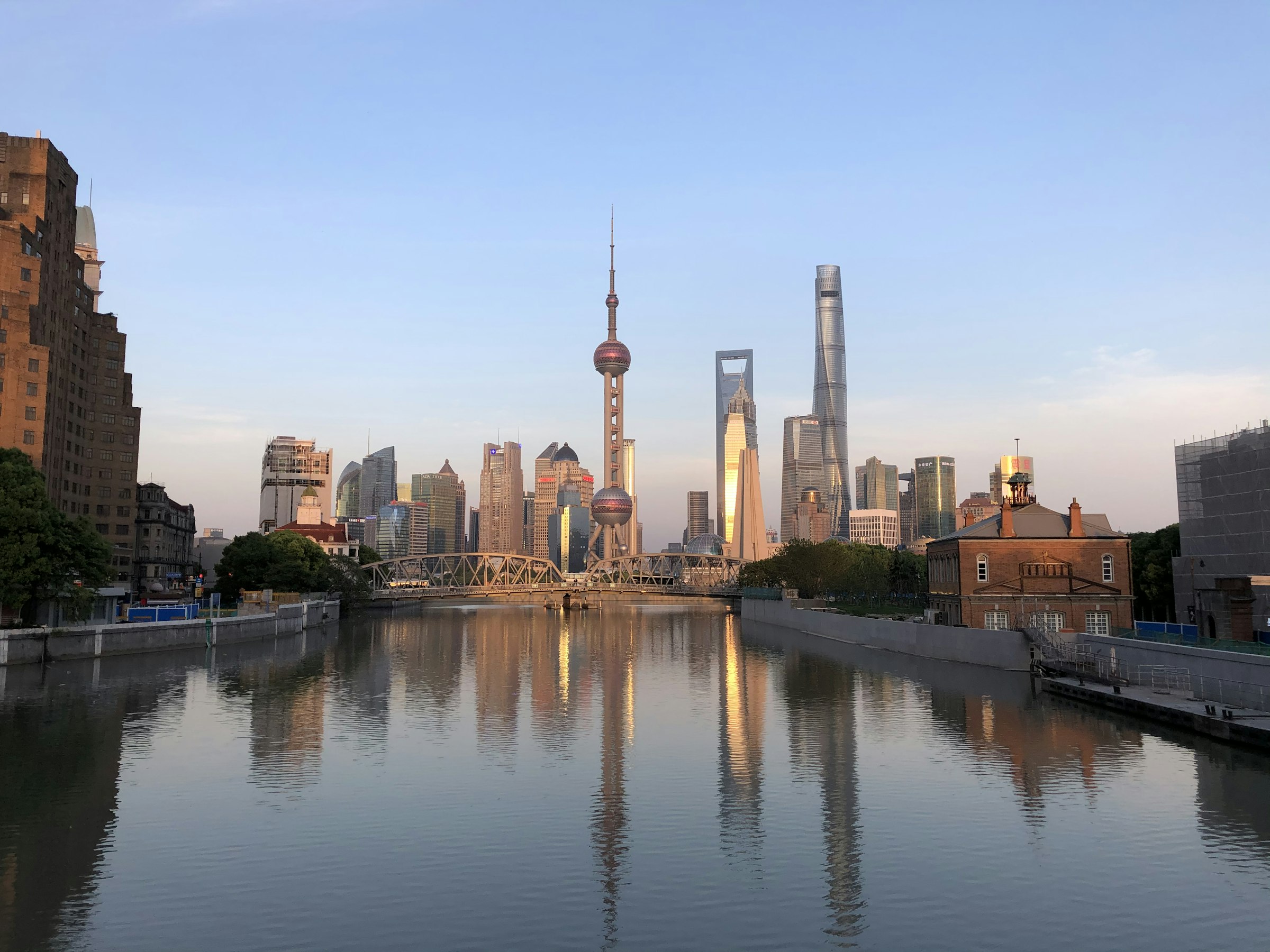
China
Ancient history and hypermodern cities at a scale that's hard to grasp until you're there.
China rewards travelers who commit. The headline sights — the Great Wall, the Terracotta Army, the Forbidden City — earn their fame, but the country's real depth is in the contrast: Shanghai's skyline against Yunnan's rice terraces, Beijing's hutongs against Sichuan's mountains. The language barrier is real and logistics take planning, but few trips pay back the effort like this one. Spring and autumn dodge the worst heat and crowds.
A workable first route runs Beijing to Xi'an to Chengdu by high-speed rail, then a flight to Yunnan or back east to Shanghai — two weeks, four very different Chinas. Days fill fast: dawn at the Wall before the tour buses, hand-pulled noodles for a couple of dollars, trains at 350 km/h that leave on the minute. Your money goes further than you expect; food and transport are cheap, and the spend is mostly hotels and the long flight in.
The friction is real. The internet is walled — set up a VPN and Alipay before you land or you'll struggle to pay for lunch. English is scarce, your passport gets scanned constantly, and major sights need advance booking. Avoid the early-October Golden Week and the May holiday, when domestic crowds overwhelm everything. If you want spontaneous, easygoing travel, look elsewhere. Commit to the admin, though, and you get one of the world's great civilizations at street-food prices.
Highlights
-
Beijing
The Great Wall, the Forbidden City, and the old hutong lanes between them.
-
Shanghai
China's most cosmopolitan city — the Bund, food, and serious energy.
-
Xi'an
The Terracotta Army and the eastern end of the old Silk Road.
-
Yunnan
Rice terraces, Tibetan foothills, and the country's best regional travel.
-
Chengdu & Sichuan
Pandas, mountains, and food worth coming for on its own.
Practical info
- Visa
- Tourist visa required for most Western passports; some cities offer visa-free transit. Verify before travel.
- Currency
- CNY (Yuan). Roughly 7 CNY ≈ 1 USD.
- Language
- Mandarin. English limited outside major hotels and sights.
- Safety
- Very safe for travelers; petty theft is rare.
- Getting around
- World-class high-speed rail. Use a VPN and a local payment app (Alipay/WeChat).
- Tap water
- Tap water not safe to drink. Boiled or bottled only.
- Plug type
- Type A Type C Type I 220V
- Money
- Mobile payment dominates; set up Alipay/WeChat Pay before arrival. Cash and cards are second-class.
General guidance — visas, safety, and health change, so check your government's travel advisory and the official sources before you go.
Common questions
- Do you need a visa for China in 2026?
- It depends on your passport, and the key rule is temporary. China’s unilateral visa-free policy lets ordinary passport-holders from around 50 countries — most of the EU, the UK, Canada, Australia, New Zealand, Japan and South Korea among them — enter for up to 30 days without a visa, but this is currently set to expire on 31 December 2026, so re-verify (it has been renewed each year via a November announcement). The United States is not on that list; US citizens still need a tourist visa, though they qualify for the 240-hour visa-free transit (see below). Check your nationality before booking.
- What is China’s 240-hour visa-free transit?
- Travellers from 55 eligible countries (including the US, UK, Canada and most of the EU) can transit China visa-free for up to 240 hours (10 days) if they hold an onward ticket to a third country or region and stay within the designated areas — 65 ports across 24 provincial-level regions. The catch: you must be heading onward to a different third country, so a simple round trip from home doesn’t qualify. Unlike the 30-day policy, this one is a standing arrangement with no announced expiry.
- Does Google, WhatsApp and Instagram work in China?
- No — the Great Firewall blocks Google (Search, Gmail, Maps, YouTube), WhatsApp, Facebook, Instagram, X, Telegram, Signal, Reddit and ChatGPT, and Netflix doesn’t operate there. The most reliable workaround for a visitor is a travel eSIM whose data genuinely routes outside China (not every eSIM does), so blocked apps just work; many pair it with a VPN installed before arrival. Set connectivity up before you land.
- How do payments and trains work for foreigners now?
- Much easier than a few years ago. You can link an international Visa/Mastercard to Alipay or WeChat Pay without a Chinese bank account — set it up before you go, as QR mobile pay is near-universal and cash is awkward (payments under ¥200 are fee-free; a ~3% service fee applies above that). High-speed rail uses passport-based e-tickets (scan your passport at the gate), booked on the official 12306 English app or via Trip.com; your passport number must match the booking exactly.
- When is the best time to visit China?
- Spring (April–May) and autumn (September–October) — mild and dry. Summers are hot and humid with a typhoon-prone south-east coast; northern winters are cold. Avoid the two domestic-travel crushes, when trains and hotels sell out and sights are jammed: National Day “Golden Week” (1–7 October) and Spring Festival / Lunar New Year (6 February in 2027), with its roughly 40-day travel migration.
- Is China safe to travel in?
- Street crime against tourists is rare and the cities feel very safe day and night — the real caveats are legal, not criminal. The US rates China Level 2, and both the US and UK warn of exit bans and the risk of arbitrary detention tied to business, civil or security matters (an exit ban can be discovered only when you try to leave). For an ordinary sightseeing trip this is background, not a deterrent — but it’s the thing worth knowing.
Entry & visas
A visa-free window that may close at year-end
China has opened up dramatically — but the 30-day route is temporary, set to expire 31 December 2026, so check before you book.
Two separate routes in. The unilateral visa-free policy admits ordinary passport-holders from around 50 countries for up to 30 days (expanded from 15 in late 2024; the UK and Canada were added in February 2026) — most of Europe, Australia, New Zealand, Japan and South Korea — but not the United States, whose citizens still need a tourist visa. Americans and others instead use the 240-hour (10-day) visa-free transit, which requires an onward ticket to a third country and staying within the designated areas. Since late 2025 a digital arrival card can be filed online before you land.
The thing to watch: the 30-day unilateral policy is set to expire on 31 December 2026. China has renewed it each year so far, each time via a November announcement, so a 2027 extension is widely expected but not yet confirmed — so check your nationality’s status close to travel. The 240-hour transit policy is separate and standing, with no expiry, so it isn’t affected by that deadline.
Visa and transit rules here move faster than almost anything else on the site — the country lists, the day-counts and the expiry have all changed within the last two years. Treat every figure in this section as a prompt to check the current official rule for your passport before booking, not a fixed fact.
The firewall & apps
The internet is walled — plan connectivity first
The single most important practical prep: your usual apps don’t work, and the fix is bought before you arrive.
The Great Firewall blocks Google, WhatsApp, Instagram, Facebook, X and much else, so sort connectivity before you fly: a travel eSIM that routes data outside China is the reliable way to keep your normal apps working (check that the provider actually routes internationally — not all do), with a VPN installed before arrival as a pairing or fallback. For payments, link a foreign card to Alipay or WeChat Pay (now possible without a Chinese bank account) — QR pay is everywhere and cash is clumsy. For trains, the world-leading high-speed rail uses passport e-tickets booked on the official 12306 app or Trip.com; book 10–15 days ahead for popular routes.
Getting around
High-speed rail does almost everything
The bullet-train network is so complete that it replaces short-haul flights between most big cities.
China’s high-speed rail is the default way to move between the headline cities — roughly 45,000km of track, the world’s largest network, and on the core corridors it beats flying once you count airport time. City metros are excellent, cheap and take mobile pay or a transit QR. Keep flights for the long diagonals — Beijing to the far south-west, or out to Xinjiang and Tibet (which carry their own permit rules). Everything runs on your passport, so carry it: it’s your train ticket, your hotel check-in and your sightseeing pass.
| Route | How | Note |
|---|---|---|
| Beijing – Shanghai | High-speed rail ~4½h | The flagship line; beats flying door-to-door |
| Beijing – Xi’an | High-speed rail ~4½–6h | For the Terracotta Army |
| Xi’an – Chengdu | High-speed rail ~3–4h | Through the mountains to panda country |
| Within cities | World-class metros, QR / mobile pay | Cheap, fast, English signage in the big cities |
High-speed rail uses passport e-tickets — scan your passport at the automatic gate, no paper ticket. Book on the official 12306 English app or Trip.com; your passport number must match exactly. For the far west or the deep south-west, flights still save a day. Checked October 2026.
The big sights
The Wall, the Forbidden City, the Terracotta Army
Epic in scale — and most of the headliners now need passport-linked timed booking.
61 sites China’s UNESCO World Heritage total — 2nd in the world
The set pieces are extraordinary. For the Great Wall near Beijing, Mutianyu is the best all-rounder (long restored section, cable car, far less chaos than Badaling), Badaling the most famous and most crowded, and Jinshanling the wild, photogenic hiking choice. The Forbidden City must be booked online in advance — a daily cap of 40,000 means tickets release about 7 days out and sell out, you enter with the passport used to book, and it’s closed Mondays.
Xi’an’s Terracotta Army (UNESCO-listed, discovered 1974) and the karst rivers of Guilin/Yangshuo and the Avatar-like sandstone pillars of Zhangjiajie round out a classic route, with Shanghai and the Bund for the modern face and Chengdu’s panda base to the west. Most major sights use passport-linked timed entry, so book ahead.
Where to go
North, east, karst south, panda west
The country is continental — you choose a region and a theme, not a grand tour.
Think in regions. Beijing and the north are the imperial heart; Xi’an the ancient centre; Shanghai and the east the modern, easy-entry face, with Hangzhou’s West Lake nearby. The scenic south is the karst country around Guilin and Yangshuo and the sandstone towers of Zhangjiajie; the west is Chengdu, pandas and the gateway to Tibet and the mountains (which carry their own permits). A first trip usually strings Beijing–Xi’an–Shanghai by rail, adding one scenic region.
| Region / hub | What it’s for | Good to know |
|---|---|---|
| Beijing & the north | The Wall, Forbidden City, imperial sights | Most trips start here; timed-entry booking |
| Xi’an (centre) | The Terracotta Army, the old Silk Road capital | A high-speed-rail hop from Beijing |
| Shanghai & the east | The modern megacity; the Bund, Hangzhou’s West Lake | Slick, international, easy first stop |
| Guilin & Yangshuo (south) | Li River karst peaks, cycling, villages | The classic Chinese-painting landscape |
| Zhangjiajie (Hunan) | The Avatar sandstone pillars, glass bridge | Dramatic, crowd-heavy in peak months |
| Chengdu & Sichuan (west) | Pandas, mountains, the spiciest food | Gateway to the south-west and Tibet routes |
Food & drink
Eight great cuisines, one country
There is no single "Chinese food" — the regional gap is as wide as between European countries.
A ritual, not a drink Chinese tea culture — UNESCO heritage since 2022
Treat "Chinese food" as a dozen cuisines, not one. The Eight Great Cuisines split the country: numbing-hot Sichuan and hotpot in the west, Cantonese dim sum and roast meats in the south, Peking duck and wheat dumplings in the north, and the sweeter Jiangnan cooking of the Shanghai region, home of xiaolongbao soup dumplings. The rule is simple: eat the local style wherever you are, and lean on photo menus and translation apps (Google Translate is blocked — use Pleco or Baidu).
| Style | Where | Signature |
|---|---|---|
| Sichuan | Chengdu, the west | Numbing-hot “mala” and hotpot |
| Cantonese | Guangdong, the south | Dim sum, roast meats, seafood |
| Beijing / northern | Beijing and the north | Peking duck; wheat noodles and dumplings |
| Jiangnan / Shanghai | The lower Yangtze, east | Xiaolongbao soup dumplings, sweeter braises |
| Hunan | Zhangjiajie, central-south | Fresh, fiery chilli heat |
China’s "Eight Great Cuisines" (Sichuan, Cantonese, Shandong, Jiangsu, Zhejiang, Fujian, Hunan, Anhui) mark out genuinely different food cultures. Eat regionally — the local style where you are will beat the generic restaurant anywhere.
When to go
Spring and autumn — and dodge the two crushes
Get the weather and the domestic-holiday calendar right, or you’ll fight hundreds of millions for a train seat.
The crimson bars are the two travel crushes to avoid: National Day "Golden Week" (1–7 October) and the Spring Festival migration (around 6 February in 2027), whose roughly 40-day "chunyun" is the largest annual human movement on earth — trains and hotels sell out and prices surge. Aim for the shoulders either side.
Aim for spring (April–May) or autumn (September–October) — mild and dry, the best all-round weather. Summers are hot and humid, with typhoons on the south-east coast; northern winters are cold. Above all, avoid the two national travel crushes, when flights and trains sell out and hotels double or triple: National Day “Golden Week” (1–7 October) and Spring Festival / Lunar New Year (6 February in 2027), whose roughly 40-day migration is the largest annual human movement on earth.
- you want the Great Wall without the scrumSkipBadaling during Golden Week (1–7 Oct)GoMutianyu or Jinshanling on a weekday outside the holiday
- you’re moving between citiesSkiptravelling anywhere around Spring Festival (6 Feb 2027)Gospring or autumn, when rail isn’t a national scrum
- you expect your usual apps to workSkiparriving unprepared and relying on local networksGoan internationally-routed eSIM (and a VPN) set up before you fly
Dodge the two national travel crushes at all costs. During National Day “Golden Week” (1–7 October) and the Chinese New Year period, hundreds of millions of people travel at once: trains and flights sell out weeks ahead, the headline sights are overwhelmed, and hotel rates double or triple. If your dates are flexible, avoid both windows entirely; if they aren’t, book intercity transport and timed-entry tickets (the Forbidden City above all) the moment the booking window opens.
Good to know
Translation apps, bottled water, cash as backup
The practical footnotes — one shaped by the firewall you’ve already planned around.
English is modest outside tourist and hotel settings, so a translation app is essential — but Google Translate is blocked, so use an offline-capable or Chinese app (Pleco, Baidu) or lean on your eSIM. Tap water is not potable — drink bottled or boiled. Plugs are 220V, mainly Type A (flat two-pin) and Type I (three-pin), so US/Japan 110V devices need a dual-voltage check. Carry a little cash as backup even though mobile pay rules — a few situations still want it.
A legal rather than criminal caveat: street crime against tourists is rare and the cities feel very safe, but the US rates China Level 2 and both the US and UK warn of exit bans and the risk of arbitrary detention tied to business, civil or security disputes — an exit ban can surface only when you try to leave. For ordinary sightseeing this is background, but keep documentation clean and your affairs uncomplicated.
Compare China



If you like China, also consider

France
Paris is only the opening act — wine country, the Alps, and two coastlines.

Italy
The benchmark for food, history, and beauty.

Greece
Ruins in the morning, a swim by noon, taverna until dark.
Not sure where to go
Take the 5-minute quiz
Answer a few honest questions and get matched to destinations that actually fit how you travel.
Start the quiz