Bhutan vs India

Neighbours at opposite extremes of scale and intensity. Bhutan is tiny, curated and controlled — a guided loop through a Buddhist kingdom that deliberately limits visitors with a per-night fee, calm, clean and serene. India is the vast, chaotic subcontinent — overwhelming, infinitely varied and dirt cheap, a sensory overload of cities, temples, deserts and mountains that could absorb a lifetime of trips.

South Asia

Bhutan

The last intact Himalayan Buddhist kingdom, on its own terms.

Best time to visit
  1. January: fine
  2. February: fine
  3. March: peak
  4. April: peak
  5. May: peak
  6. June: fine
  7. July: avoid
  8. August: avoid
  9. September: peak
  10. October: peak
  11. November: peak
  12. December: fine
Peak Fine Avoid
South Asia

India

Overwhelming, beautiful, and utterly unlike anywhere else.

Best time to visit
  1. January: peak
  2. February: peak
  3. March: fine
  4. April: avoid
  5. May: avoid
  6. June: avoid
  7. July: avoid
  8. August: avoid
  9. September: fine
  10. October: peak
  11. November: peak
  12. December: peak
Peak Fine Avoid

Read our full guides about Bhutan and India.

Side by side

Emphasised where they differ. Muted rows are much the same either way.

Bhutan India
Best time March–May, September–November October–February
Climate mild warm
Budget Expensive by design — the US$100-per-adult-per-night SDF sits on top of everything Very cheap — one of the best-value countries anywhere, at almost any budget
Trip length 1–2 wks 2–8 wks
Visa All visitors except India, Bangladesh, and Maldives need a visa arranged in advance, plus the Sustainable Development Fee (~US$100/night). E-visa required for most nationalities. Apply 4 days+ before travel.
Currency BTN (Ngultrum), pegged to and interchangeable with the Indian Rupee, which is also accepted. INR (Rupee). Roughly 84 INR ≈ 1 USD.
Language Dzongkha (official); English is widely used and the medium of instruction. Hindi, English, plus dozens of regional languages. English widespread.
Tap water Drink bottled or boiled water. Tap water not safe. Bottled or filtered only.
Safety Extremely safe with very low crime. Generally safe but solo female travel needs care. Watch food/water hygiene.

General guidance — visas, safety, and health change, so check your government's travel advisory and the official sources before you go.

The split

A curated kingdom, or a vast subcontinent

Neighbours at opposite extremes — one is tiny, serene and controlled, the other vast, cheap and overwhelming.

Tiny vs vastthe scaleOne cultural loop, or a whole subcontinent
Serene vs intensethe characterControlled calm, or sensory overload
Premium vs cheapthe moneyThe US$100/night SDF, or best-value anywhere

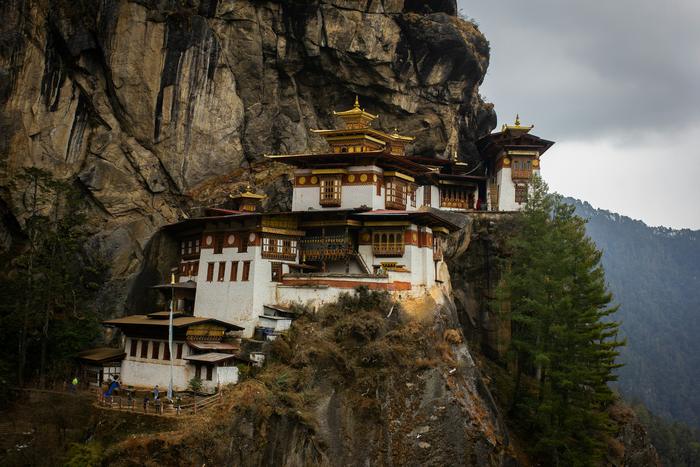
Bhutan is tiny, curated and controlled: a guided loop through a Buddhist kingdom that deliberately limits visitors with a per-night fee — calm, clean and serene, building to the Tiger’s Nest. India is the vast, chaotic subcontinent: overwhelming, infinitely varied and dirt cheap, a sensory overload of cities, temples, deserts and mountains that could absorb a lifetime of trips. Serene control, or boundless intensity.

The operational detail — Bhutan’s SDF, guide rule and Paro flights, India’s e-Visa and site ticketing — lives on the two guides: Bhutan, know before you go and India, know before you go. This page is the head-to-head.

Who suits which

Who each actually suits

Serene-and-curated or vast-and-intense — so these never invert.

If you want…BhutanIndia
A calm, crowd-free cultural loopWins clearly. Controlled and sereneCrowded and chaotic
Vast variety and intensityTiny and focusedWins clearly. A subcontinent
The lower billThe SDF makes it priceyWins. Best-value anywhere
Guided ease and orderWins. Clean and curatedDIY, overwhelming
A lifetime of return tripsOne loop, soon seenWins. Endless regions
Buddhist mountain serenityWins. Dzongs, the Tiger’s NestHas it, among much else

Doing both

Bhutan as a serene India add-on

Reached via India — a natural pairing.

Because Bhutan is usually reached via India — flights to Paro from Delhi, Kolkata or Bagdogra, or the overland border at Phuentsholing — a calm Bhutan loop slots naturally onto a bigger India trip: the subcontinent’s vast, cheap intensity, then Bhutan’s controlled serenity as the counterpoint. Budget Bhutan’s US$100-a-night SDF on top, and remember the ngultrum is pegged 1:1 to the Indian rupee.

What we leave out

What we deliberately leave out

Exact prices and the moving pieces — Bhutan’s SDF (reduced rate confirmed only to Aug 2027), India’s site and transport costs and seasonal air quality — change within a season, so the figures here are the shape of the gap, not a quote; the country guides carry the live detail.

Bhutan or India, month by month

Which of the two is the better bet for each month of the year, scored on how well the season suits each place.

Which to choose

Choose Bhutan if:

  • You want a serene, curated, crowd-free kingdom — dzongs, the Tiger’s Nest, calm.
  • Guided ease and a controlled experience are worth the per-night fee.
  • A short, peaceful Himalayan cultural loop is the draw.

Choose India if:

  • You want vast variety and intensity — cities, temples, deserts, mountains, food.
  • A cheap, overwhelming, endlessly deep subcontinent appeals.
  • You can take the chaos, and want a lifetime’s worth of trips in one country.

Common questions

Should I combine Bhutan and India?
Very commonly — Bhutan is usually reached via India (flights to Paro run from Delhi, Kolkata and Bagdogra, and there’s an overland border at Phuentsholing), so a serene Bhutan loop makes a natural add-on to an India trip. India supplies the vast, cheap intensity; Bhutan the calm, curated counterpoint. Budget Bhutan’s US$100-a-night SDF on top, and note the currencies are linked (the ngultrum is pegged 1:1 to the rupee). See the Bhutan and India guides.
Which is more intense versus more serene?
Opposite poles. India is sensory overload — crowds, noise, colour, chaos and infinite variety, exhilarating and exhausting. Bhutan is deliberately serene — controlled visitor numbers, clean ordered towns, a guided loop at a gentle pace. If you want to be swept up and overwhelmed, India; if you want calm and curation, Bhutan.
Which is cheaper?
India, overwhelmingly — it’s one of the best-value countries anywhere, comfortable at almost any budget. Bhutan is expensive by design: the US$100-per-adult-per-night SDF, on top of all other costs, exists specifically to keep numbers low. India rewards any budget; Bhutan charges a premium for exclusivity.
Which is more varied?
India, by a vast margin — a subcontinent of Himalayan north, desert Rajasthan, Mughal monuments, southern temples and backwaters, Goa’s beaches and more, enough for a lifetime of trips. Bhutan is a focused, small country — a single cultural loop through its western valleys. Infinite variety, or a curated sliver of the Himalaya.

Still undecided

Take the quiz

Three matches. Often answers comparison questions for you.

Start the quiz