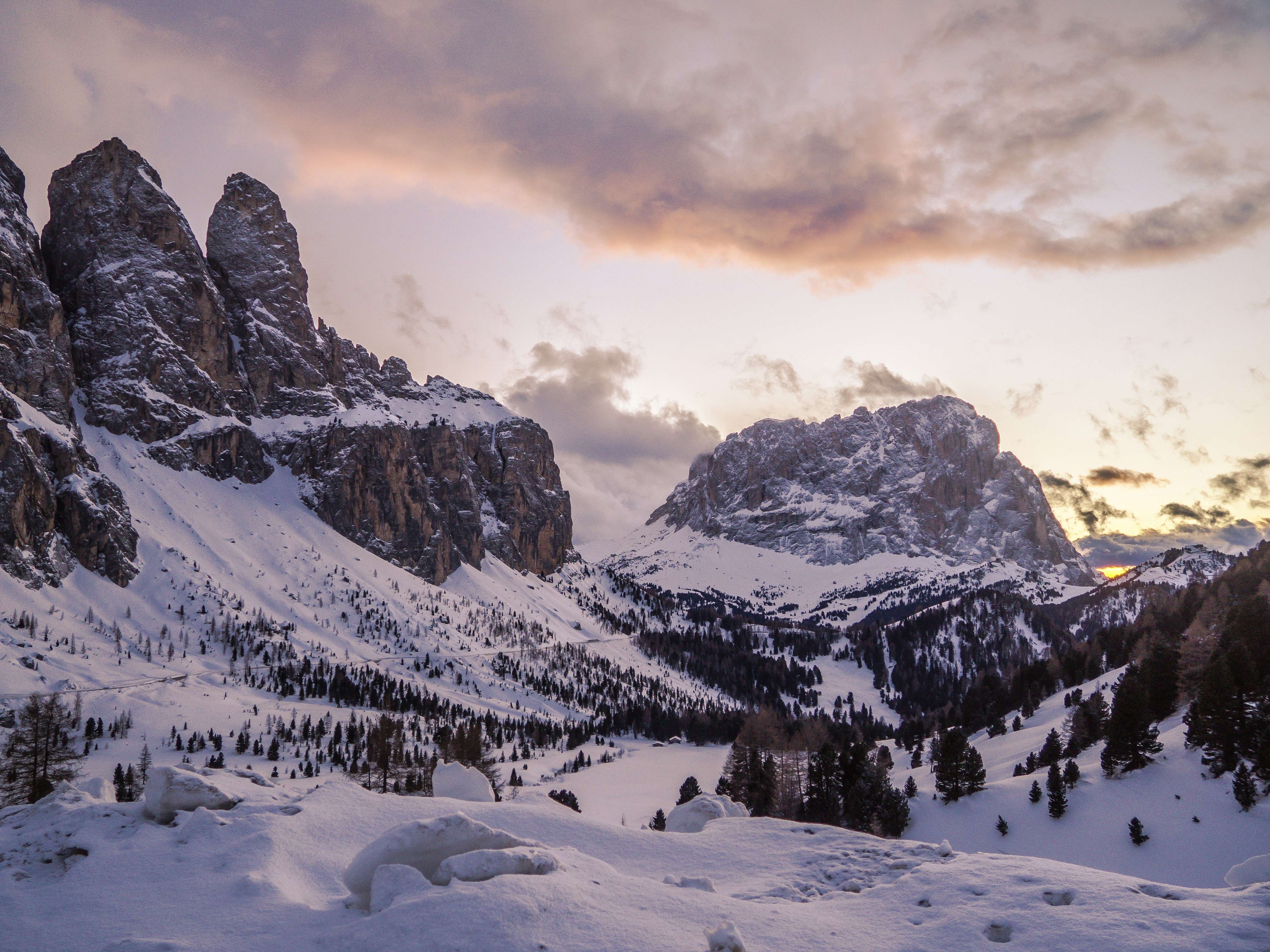
Val Gardena, Italy
The Sella Ronda, the Saslong World Cup and the best rifugio food in the Dolomites.
Val Gardena is a Ladin-speaking valley in South Tyrol whose three villages — Selva (Wolkenstein), Santa Cristina (St. Christina) and Ortisei (St. Ulrich) — sit beneath the Dolomite spires at the heart of the Sella Ronda circuit. A single pass unlocks 175 km of local piste or, with the Dolomiti Superski upgrade, 1,200+ km across 12 valleys — the largest linked ski-pass area on earth.
The skiing runs from the gentle, sunny plateau of Alpe di Siusi (Europe’s largest high-altitude meadow) through the fast, rolling intermediate terrain of the Sella Ronda to the steep, icy Saslong World Cup downhill above Santa Cristina. The circuit — a 26 km loop around the Sella massif, skiable clockwise or anti-clockwise in a day — is one of the great bucket-list ski experiences.
What sets Val Gardena apart from other Dolomite valleys is the food. Ladin cooking — canederli, cajincì, strudel — is served in wood-panelled rifugi that feel like starred restaurants at mountain-hut prices. The valley also has a centuries-old wood-carving tradition, visible in every shop window in Ortisei.
Highlights
-
Sella Ronda
A 26 km circuit around the Sella massif — one of the great intermediate ski days.
-
Saslong downhill
The World Cup course — steep, technical and open to the public between races.
-
Dolomiti Superski
1,200+ km on one pass — the world’s largest linked lift-pass area.
-
Rifugio cooking
Ladin canederli, polenta and strudel in century-old mountain huts.
Practical info
- Visa
- Schengen — visa-free for most Western passports (90 days).
- Currency
- EUR (€)
- Language
- Ladin, Italian and German (trilingual South Tyrol). English in tourist services.
- Safety
- Safe; standard avalanche precautions off-piste.
- Getting around
- Innsbruck ~1.5h, Verona ~2.5h by car. Bus from Bolzano.
- Tap water
- Tap water safe.
- Plug type
- Type C Type F Type L 230V
- Money
- Cards accepted; cash useful at smaller huts.
General guidance — visas, safety, and health change, so check your government's travel advisory and the official sources before you go.
Common questions
- How big is Val Gardena’s ski area?
- The valley has 181 km of local piste across three linked sectors, plus direct access to the Sella Ronda circuit and the full Dolomiti Superski network of 1,200+ km across 12 valleys.
- What is the Sella Ronda?
- A 44 km circuit around the Sella massif linking four Dolomite valleys — Val Gardena, Alta Badia, Arabba and Val di Fassa. You ski it clockwise (orange) or anticlockwise (green) in about 5–6 hours including lifts. See the ski area.
- Is Val Gardena good for beginners?
- Yes — the wide blues above Selva and Santa Cristina are ideal, and the nursery slopes at each village are gentle. Stronger beginners can tackle the Sella Ronda clockwise within a week. The only caveat: accessing some slopes requires confidence on chairlifts.
- Which village should I stay in?
- Selva for the best ski access (closest to the Sella Ronda lifts and the Ciampinoi gondola). Santa Cristina for a quieter, family-friendly middle ground. Ortisei for the most town, shops and culture — but the least convenient ski access. See where to stay.
- What language do people speak?
- Val Gardena is Ladin — a Romansh language predating Italian and German. The valley is officially trilingual (Ladin, Italian and German), and English is widely spoken in the tourism sector. Signs, menus and ski-school groups are routinely in four languages.
- Do I need insurance to ski in Italy?
- Yes — third-party liability insurance is mandatory by Italian law (since January 2022). You can buy it at the ticket office for about €3/day, but you also need your own travel insurance for rescue and medical cover — EHIC/GHIC does not cover mountain rescue or helicopter evacuation. See safety.
- How do you get to Val Gardena?
- The nearest airports are Innsbruck (~1.5 h) and Verona (~2.5 h). There is no train to the valley — you drive or take the SAD bus from Bolzano (40 min). See getting there.
The ski area
Three villages, one linked ski area, and the Sella Ronda on the doorstep
Val Gardena is the Dolomiti Superski gateway that works without a car: three villages connected by piste, the Sella Ronda starting from Selva, and 1,200+ km on the same pass.

The Sella Ronda is the headline: a 44 km circuit around the Sella massif linking Val Gardena, Alta Badia, Arabba and Val di Fassa. You ski it clockwise (orange, easier) or anticlockwise (green, steeper descents) in about 5–6 hours including lifts. It starts and ends in Selva, which is why staying there gives the best access. On a Dolomiti Superski pass, the Sella Ronda is included — no extras.
Beyond the circuit, Val Gardena’s own terrain divides into three linked sectors. Seceda (above Ortisei, 2,519 m) is the dramatic one: steep, north-facing, with the 10.5 km La Longia run — one of Italy’s longest — dropping 1,283 m from summit to village. Ciampinoi–Dantercepies (above Selva) is the Sella Ronda departure point and home to the Saslong World Cup downhill. Alpe di Siusi, Europe’s largest high-altitude meadow, is the gentle, sunny family sector reachable from Ortisei or Castelrotto.
| Sector | Altitude | Best for | Notes |
|---|---|---|---|
| Seceda | 1,236 → 2,519 m | All levels, scenery | La Longia 10.5 km run; north-facing; the iconic Dolomite panorama |
| Ciampinoi–Dantercepies | 1,563 → 2,249 m | Intermediates, racers | Saslong World Cup downhill; Sella Ronda departure; Plan de Gralba |
| Alpe di Siusi | 1,680 → 2,350 m | Families, beginners, cross-country | Europe’s biggest high meadow; wide, sunny, gentle; 60 km of cross-country trails |
| Sella Ronda circuit | varies (1,500–2,500 m) | Intermediates, experience seekers | 44 km loop through 4 valleys in 5–6 h; clockwise (easier) or anticlockwise |
Piste colour split (local): ~30% blue, ~55% red, ~15% black. 95% snowmaking coverage ensures reliable conditions even in lean natural-snow years. The Sella Ronda is mostly red and blue.
The Dolomiti Superski pass turns Val Gardena from a strong mid-sized area into a base for the world’s largest ski network. A week here lets you ski the Sella Ronda, Kronplatz, Cortina, the Marmolada glacier and more — all on one pass.
Who it suits
Who Val Gardena is — and isn’t — for
A valley that works for every level — but each village and sector suits a different skier. Pick right and the week is superb.
The terrain is predominantly red (55%) with enough blue for learners and enough steep terrain on Seceda and the Saslong to keep strong skiers interested. The Sella Ronda gives intermediates a whole-day experience they can’t get in a single-valley resort. The food, the Ladin culture and the Dolomite scenery elevate it well beyond a piste-count comparison.
- Beginners & familiesSkipthe Seceda steeps and the anticlockwise Sella RondaGoAlpe di Siusi (gentle, sunny, wide) and the blues above Santa Cristina; nursery slopes at each village
- Cruising intermediatesSkipstaying in Ortisei if the Sella Ronda is your priorityGoBase in Selva for direct Sella Ronda access; ski the clockwise circuit first, then explore Alta Badia and Arabba
- Advanced & racersSkipexpecting extreme off-piste terrainGoThe Saslong World Cup course, La Longia 10.5 km, Seceda’s north face, and day trips to Arabba’s Marmolada for the steepest Dolomite skiing
- Non-skiers & foodiesSkipnothingGoVal Gardena has 65+ rifugi, three Michelin stars nearby, the Ladin museum, Alpe di Siusi winter walks, and the best mountain-hut lunch culture in the Alps
If you want extreme off-piste and couloir skiing, this isn’t the valley — the Dolomites are groomed-piste country. If you want the best combination of skiing, scenery, food and culture in Italy, Val Gardena is hard to beat.
Snow & season
95% snowmaking — because the Dolomites make their own guarantee
Natural snowfall is modest by Alpine standards, but Val Gardena’s snowmaking is the most comprehensive in the Alps. The pistes are reliable from December to mid-April.
Months on the axis (12 = December). The season is uniform across sectors because snowmaking makes them effectively altitude-independent. Quietest weeks: early January and mid-March. The Saslong World Cup weekend (usually mid-December) brings crowds to Selva.
The Dolomites sit lower and drier than the Mont Blanc or Monte Rosa ranges, so natural snowfall alone wouldn’t guarantee a season. Val Gardena’s answer is industrial-scale snowmaking: 95% piste coverage, water reservoirs at altitude, and cold overnight temperatures that let the cannons run from November. The result is that groomed-piste conditions are remarkably consistent from early December through mid-April, regardless of the natural snow year.
Best conditions: January to early March for cold groomed snow and short lift queues. December is reliable but crowds build towards Christmas. Late March and April bring spring sun and softening snow — ideal for lazy Sella Ronda laps and long rifugio lunches, less so for steep north-facing terrain.
Lift passes
Val Gardena local or the full Dolomiti Superski — and why the Superski wins
The local pass covers 181 km. The Superski opens 1,200+ km and the Sella Ronda — for a week, the upgrade is almost always worth it.
€61–€73 per day on a 6-day Dolomiti Superski pass
Val Gardena sells a local-area pass and the Dolomiti Superski. The local pass covers all three sectors (Seceda, Ciampinoi–Dantercepies, Alpe di Siusi) and the links between them. The Superski adds the Sella Ronda, Alta Badia, Cortina, Kronplatz, Arabba and the rest of the 12-valley network — making day trips possible without buying extras.
| Pass | Covers | 1-day adult | 6-day adult |
|---|---|---|---|
| Val Gardena local | Seceda, Ciampinoi, Alpe di Siusi | €72–€80 | |
| Dolomiti Superski | All 12 valleys, 1,200+ km | €80 | |
| Superdays 10-day flex | Superski, use any 10 days in season | — |
Children born 2017–2021 ski free with a parent buying an adult pass. Junior (born 2007–2016) ~30% off. Senior (born 1959 and before) ~10% off. Family deal: 2 parents + 3 juniors, 3rd junior free. 5% online advance-purchase discount on multi-day passes. Prices are 2025/26; dynamic pricing means they vary by period.
The Superdays flexi-pass (€660 for 10 days usable any time in the season) is excellent for frequent visitors or a two-week trip — it pays for itself in under 10 days of skiing.
Lessons & guides
Ski schools in every village and Ladin-speaking instructors
Each village has its own ski school. Private lessons are competitive and group sizes are small — and you can learn to ski in four languages at once.
The main schools are Scuola Sci Selva (the largest, right at the Ciampinoi gondola), Scuola Sci Ortisei and Scuola Sci S. Cristina. All offer classes in Italian, German, English and Ladin, with group sizes typically capped at 8–10. Independent English-speaking instructors are available through the schools or directly.
For the Dolomite off-piste and touring — the Puez-Odle nature park, the Sassolungo circuit, guided Sella Ronda variants — the local Alpine Guides (Guide Alpine Val Gardena) know the terrain intimately. A private guiding day runs about €250–€350 for up to 4 people.
Book private lessons at least two weeks ahead for peak periods (Christmas, February). The schools fill up fast because the valley draws a repeat-visit clientele who book early.
Families & kids
Free under-8s, snow gardens in every village and Alpe di Siusi for confidence
Val Gardena is built for families: nursery slopes at each village, free passes for young children, gentle terrain on Alpe di Siusi and warm rifugi for mid-morning cocoa.
Each village has its own snow garden for children aged 3–5 — play, games and first turns on snow in small groups. From age 6, children join regular group lessons. The Alpe di Siusi sector is the ideal family mountain: wide, sunny, gentle gradients, no exposed terrain and rifugi every few hundred metres for warming stops.
On passes, children born 2017–2021 ski free when a parent buys an adult Dolomiti Superski pass. Juniors (born 2007–2016) get ~30% off. The family deal (2 parents + 3 juniors) makes the 3rd junior free.
| Option | Ages | What it is |
|---|---|---|
| Snow garden (each village) | 3–5 | Play-based introduction to snow; small groups; conveyor belts and gentle slopes |
| Group ski lessons | 6+ | Half-day or full day; all three village schools; English, Italian, German |
| Private lesson (family) | any | Up to 5 at the same rate (€60/hr) — split among children for excellent value |
| Hotel childcare / babysitting | babies – 5 | Many family hotels offer in-house childcare; independent sitters available through tourist offices |
Best family sectors: Alpe di Siusi (wide, sunny, gentle) and the blues above Santa Cristina. The Sella Ronda clockwise is achievable for confident intermediate children (about age 10+).
Val Gardena’s family hotels are a South Tyrolean speciality: many offer half-board with children’s menus, in-house play rooms, equipment storage and ski-bus stops at the door. Look for the “Family” seal on valgardena.it.
Getting there
No train to the valley — but Bolzano is 40 minutes away
Val Gardena has no railway. The nearest rail hub is Bolzano (40 min by bus); the nearest airports are Innsbruck, Verona and Venice.
There is no train into Val Gardena — the valley road from Ponte Gardena (on the Brenner motorway) is the only way in. The SAD bus from Bolzano runs roughly hourly and takes about 40 minutes to Ortisei, 50 to Selva. Bolzano itself has a mainline station on the Brenner route (Munich–Innsbruck–Verona), making a train-plus-bus combination workable.
By air: Innsbruck (~100 km / 1.5 h) is the closest and most convenient. Verona (~230 km / 2.5 h) and Venice Marco Polo (~340 km / 3 h) have more flight options. Munich (~350 km / 3.5 h) is a viable gateway for a self-drive trip. Private transfers from Innsbruck cost about €180–€250.
| From | To Val Gardena | Notes |
|---|---|---|
| Innsbruck airport | ~1.5 h | Closest airport; private transfer €180–€250 or FlixBus to Bolzano then SAD bus |
| Bolzano (train) | ~40 min by bus | Mainline station on the Brenner route; SAD bus roughly hourly to valley |
| Verona airport | ~2.5 h | More international flights; A22 motorway then Brenner exit |
| Venice airport | ~3 h | Widest flight choice; A27 north then A22 Brenner corridor |
| Munich airport | ~3.5 h | Self-drive via the Brenner Pass; winter tyres required in Austria and Italy |
Winter driving: Italy requires winter tyres or chains (Nov–Apr). Austria requires a Vignette motorway sticker (€9.90 for 10 days). The Brenner Pass road is steep and can close briefly in extreme weather. Times are dry-road estimates.
Where to stay
Three villages, three characters — pick by ski access and ambience
Selva for ski access, Ortisei for town life, Santa Cristina for the quiet middle ground. All connect by piste and free ski bus.
Selva di Val Gardena (1,563 m) is the ski hub: closest to the Sella Ronda departure lifts at Plan de Gralba, with the Ciampinoi gondola at the village edge. Most ski hotels are here, from the 5-star Alpenroyal Grand Hotel (from ~€350/night half-board) to family-run 3-star garni. The après is the valley’s liveliest.
Santa Cristina (1,428 m) is quieter and prettier: a mid-valley position with its own gondola, good family hotels and a calmer atmosphere. Ideal for families and couples who want to be on the ski circuit without the buzz of Selva.
Ortisei (1,236 m) is the cultural capital: the largest village, with the best shops, restaurants, the Museum de Gherdëina and the Seceda gondola. The trade-off is that it’s the furthest from the Sella Ronda lifts — a bus or a ski down is needed to reach the circuit.
Half-board (breakfast + dinner included) is the South Tyrolean norm and excellent value — a typical 3-star garni runs €80–€130 per person per night half-board in mid-season. Self-catering apartments start from about €60 per person. Peak weeks (Christmas, February) roughly double those rates.
Après & dining
65 rifugi, three Michelin stars and the best mountain lunch in the Alps
No valley in the Alps can match Val Gardena’s density of mountain restaurants. The rifugio lunch is the defining experience of skiing here.
The mountain huts are the reason people come back to Val Gardena for decades. Rifugio Emilio Comici (Sassolungo) is a classic above Selva; Rifugio Friedrich August overlooks the Sassolungo and Sella massifs from a terrace at 2,300 m; Baita Sofie and Baita Daniel on the Seceda side serve Ladin specialities; Malga Saltria on Alpe di Siusi is a family favourite. All are table-service — waitress, chequered cloth, homemade strudel — not a canteen tray in sight.
In the villages: Anna Stuben in Ortisei’s Hotel Gardena holds one Michelin star for refined South Tyrolean cuisine; Suinsom (also Ortisei) earned its star in 2024. Nearby in San Cassiano, St. Hubertus at the Rosa Alpina holds three stars — one of only two three-Michelin-star restaurants in the Alps. The valley’s casual dining — speck, canederli, Schlützkrapfen, apple strudel — is as good as the fine dining.
Mountain lunch: €15–25 at a rifugio; pizza in the valley €8–16; a casual dinner €30–50. The rifugi fill up at lunch in peak weeks — sit down by noon or wait until 13:30.
Non-skiers
Ladin culture, Dolomite walks and one of Europe’s biggest winter meadows
Val Gardena’s non-ski offering goes deep into the Ladin culture that most ski resorts lack — museums, wood-carving, winter hikes and the vast Alpe di Siusi.
56 km² Alpe di Siusi — Europe’s largest high-altitude meadow
Beyond Alpe di Siusi: the Museum de Gherdëina in Ortisei documents Ladin language, art and the valley’s centuries-old wood-carving tradition. The Alpin Arena at Plan de Gralba offers ice climbing and snow tubing. Cross-country skiing in Vallunga (a flat, car-free valley running south from Selva) is superb. In December, the Ortisei Christmas market fills the Piazza with hand-carved wooden crafts. Wellness hotels across the valley offer pools, saunas and spa treatments.
Non-skiers can ride the lifts to meet skiers for a rifugio lunch — the Alpe di Siusi sector and the Seceda terrace are both reachable by gondola, no skis required. A pedestrian lift ticket costs about €20–30.
Dogs
Dogs on lifts with muzzle and lead — and the GB paperwork
Italy allows dogs on enclosed ski lifts with a leash and muzzle. Val Gardena’s winter walks are dog-friendly, and pet-accepting hotels are common.
Dogs can ride enclosed gondolas and cable cars in Val Gardena with a leash and muzzle. Small dogs may travel free; larger dogs typically need a supplement ticket (~€3). Dogs should not be taken onto busy pistes, but the valley’s winter walking paths — Vallunga, the Alpe di Siusi trails, the village promenades — are dog-friendly. Many hotels and garni accept pets; supplements range €10–20/night.
GB → Italy: you need a single-use Animal Health Certificate (AHC) issued by a UK vet within 10 days of travel, a microchip, and a rabies vaccination given at least 21 days before travel. Tapeworm treatment is required for returning to the UK. Budget £100–300 for the AHC and endorsement.
Accessibility
Val Gardena Active — adaptive skiing and inclusive winter sport
The valley has an established adaptive-ski programme with specialist equipment and trained instructors — one of the best in the Italian Alps.
Val Gardena Active provides sit-ski, dual-ski and stand-up outrigger equipment with specialist adaptive instructors. The programme operates across all three village ski schools and covers both beginners and experienced adaptive skiers. Equipment loan is available, and the ski schools offer tailored private lessons.
Village accessibility: Selva and Ortisei’s main streets are largely flat and navigable by wheelchair, though older hotels may lack lifts. The newer gondolas (Ciampinoi, Seceda 2nd section) are wheelchair-accessible. Disabled skiers get a reduced lift pass on presentation of a disability certificate.
Book adaptive lessons and equipment at least two weeks ahead — the specialist gear is limited and demand from the Italian Paralympic community is strong during peak weeks.
Safety
Mandatory insurance, mountain rescue and the rules for skiing in Italy
Italy requires third-party liability insurance to ski. EHIC covers state healthcare but not mountain rescue. Get proper cover.
Since January 2022, all skiers in Italy must hold third-party liability insurance. You can buy it at the Val Gardena ticket offices for about €3/day, or your travel insurance may already include it — check before you go. This covers damage you cause to others, not your own rescue or medical costs.
Mountain rescue is provided by the Soccorso Alpino (CNSAS). On-piste rescue is included with your lift pass. Off-piste rescue costs are charged to the individual — helicopter evacuation can run €5,000–10,000+. An EHIC/GHIC covers medically necessary state healthcare but not mountain rescue, helicopter evacuation or repatriation. Dedicated winter-sports travel insurance is essential.
The Dolomites have real avalanche risk, and the AINEVA publishes daily bulletins for South Tyrol. Never ski off-piste without a transceiver, probe and shovel, and hire a guide for unfamiliar terrain. On-piste: helmets are mandatory for under-18s in Italy.
What it costs
What a day in Val Gardena actually costs
Val Gardena is mid-range by Alpine standards: cheaper than Switzerland, comparable to Austria, and exceptional value for the quality of the mountain food and the Superski network.
€100–€200 per person, per day, all-in before flights
Day-rate breakdown, per person per day unless noted:
| What | Typical day-rate | Notes |
|---|---|---|
| Lift pass — Val Gardena local | €72–€80 | 1-day; varies by period (dynamic pricing) |
| Lift pass — Dolomiti Superski | ~€61–€73 | From a 6-day pass (€364–€437) |
| Ski / board hire | €18–€45 | Economy to performance; pre-book online for 10–15% off |
| Group lesson (half-day) | ~€55 | 2–2.5 hours; multi-day packages cheaper |
| Private lesson | €60/hr | Up to 5 people at the same rate |
| Mountain lunch (rifugio) | €15–€25 | Table service; pizza €8–16 |
| Dinner (if not half-board) | €30–€50 | Casual to mid-range; Michelin €80+ |
| Bed for the night (half-board) | €80–€130 3★ garni · €150–€250 4★ · €350+ 5★ | Per person; includes breakfast + dinner; apartments from ~€60 pp self-catering |
| Tourist tax (tassa di soggiorno) | €2–€3 per night | By accommodation category; children usually exempt |
| Innsbruck transfer | €180–€250 private · ~€30 bus | One-way; FlixBus to Bolzano then SAD bus is the budget option |
| Third-party insurance | ~€3/day | Mandatory — buy at ticket office or check your travel policy covers it |
Rates read autumn 2026 (2025/26 season). Dolomiti Superski uses dynamic online pricing — book passes in advance for the best rate. Peak weeks (Christmas, Settimana Bianca in February) can double accommodation prices.
The biggest savings: half-board accommodation (eliminates dinner costs); sharing a private lesson among 4–5 people (€12–15 each per hour); pre-booking ski hire online; and going in January or March rather than Christmas or February half-term.
Compare Val Gardena, Italy
If you like Val Gardena, Italy, also consider
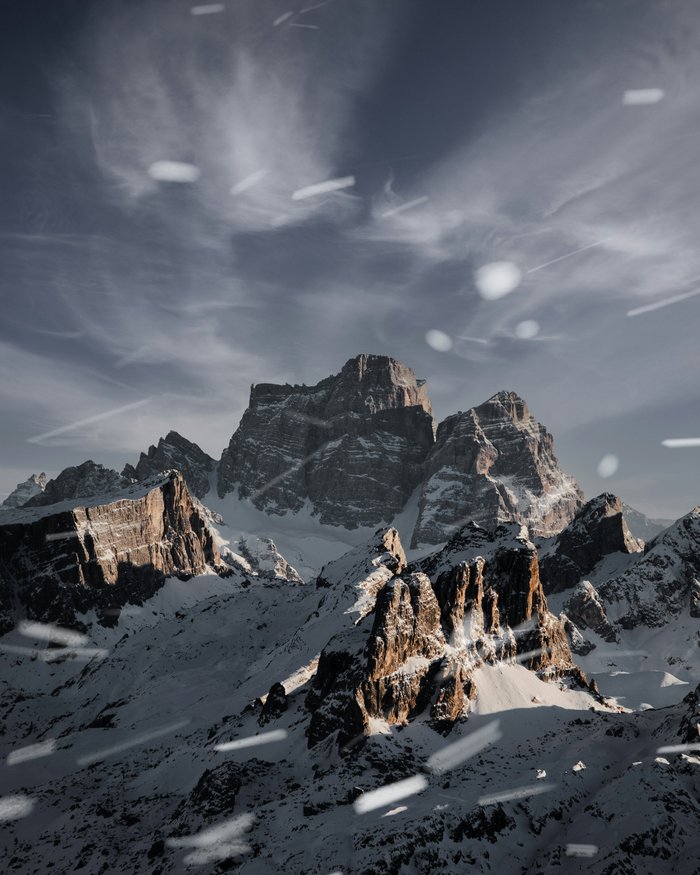
Cortina d’Ampezzo, Italy
The Queen of the Dolomites — Italian glamour, UNESCO spires and a 2026 Olympic makeover.
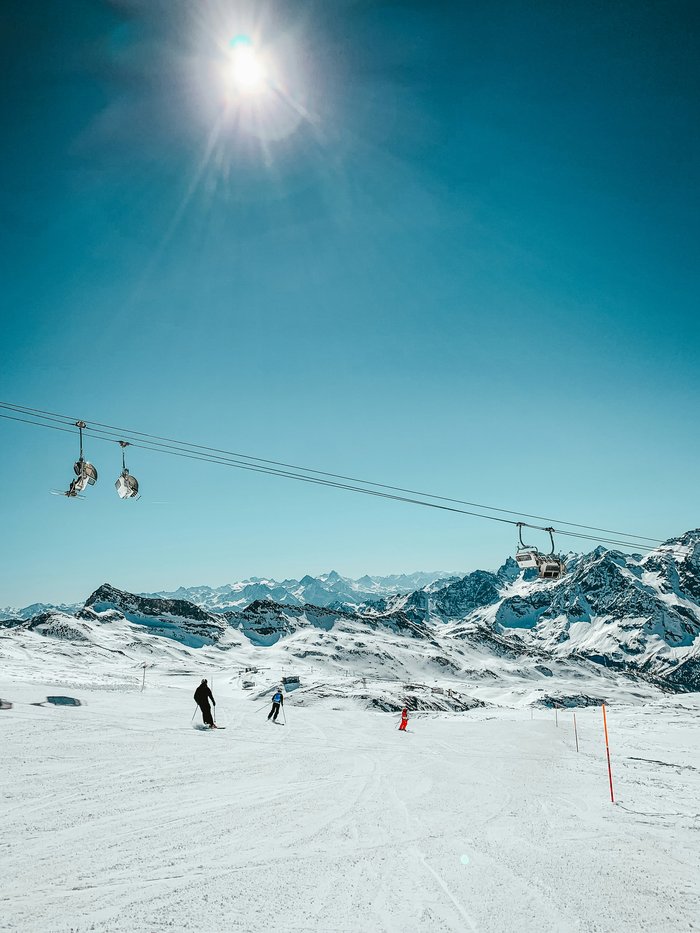
Cervinia, Italy
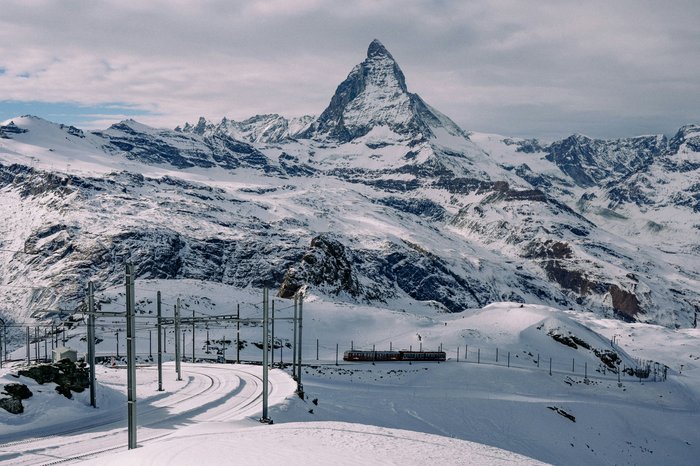
The Italian side of the Matterhorn — wide, high, snow-sure and half the price of Zermatt.
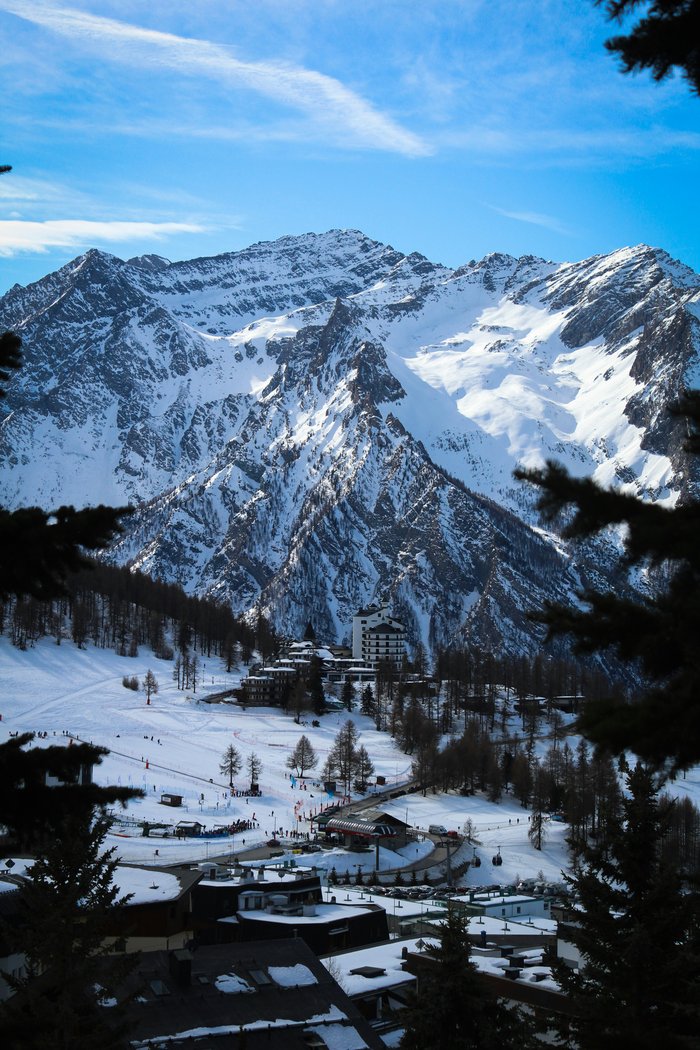
Sestriere, Italy
Europe’s highest purpose-built resort, the 2006 Olympic downhill and the best-value big area in Italy.
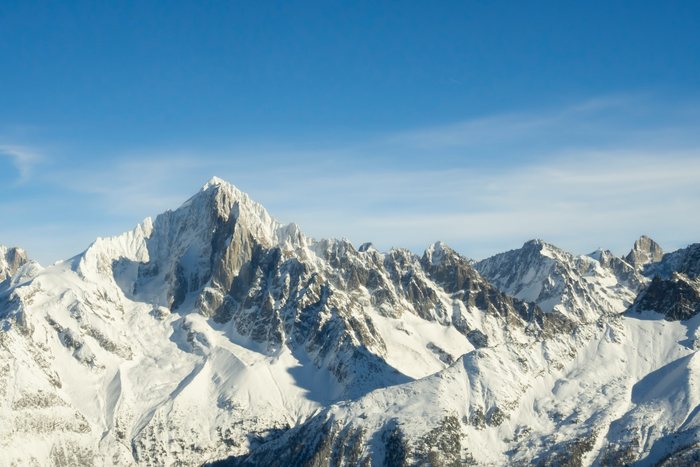
Chamonix, France
The birthplace of alpinism, under Mont Blanc.
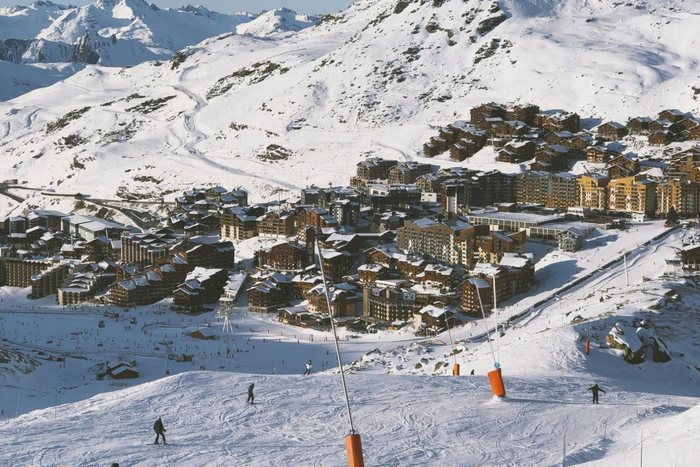
Val Thorens, France
Europe’s highest resort — snow-sure, and the gateway to the world’s largest linked ski area.
Val d’Isère, France
High-altitude, serious skiing with a village that actually feels like one.