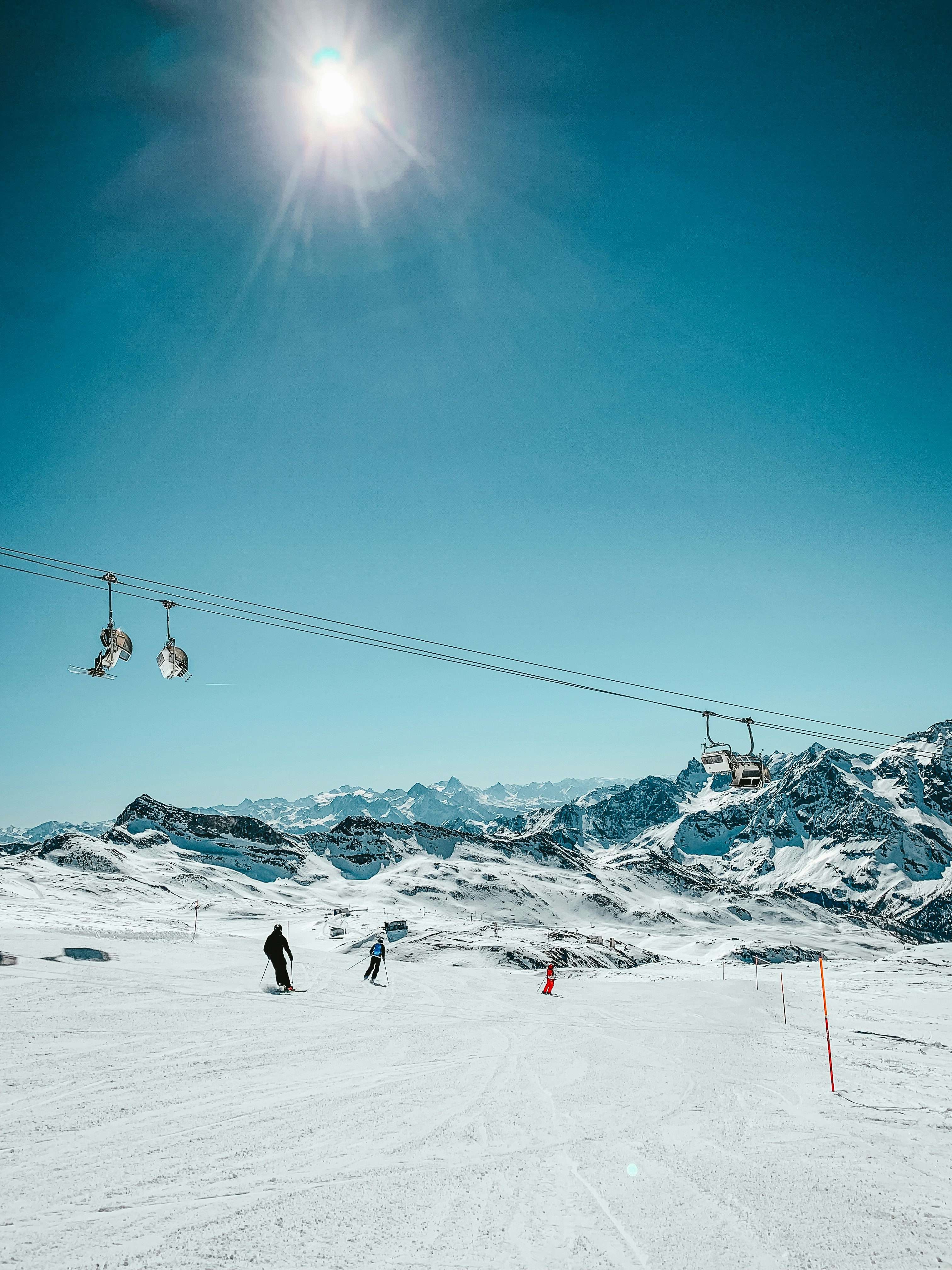
Cervinia, Italy
The Italian side of the Matterhorn — wide, high, snow-sure and half the price of Zermatt.
Breuil-Cervinia is the Italian answer to Zermatt, sharing the same glacier skiing via the Matterhorn Cervino Ski Paradise but at dramatically lower cost. The village sits at 2,050 m — one of Europe’s highest — and the lifts reach the Klein Matterhorn at 3,883 m, giving it one of the biggest verticals and longest seasons on the continent.
The terrain is broad, gentle and high: wide motorway-cruisers, almost no moguls, and reliable snow from November through May. It is an intermediate’s paradise and a nervous beginner’s dream — but experts will find it monotonously easy unless they cross to Zermatt or hire a guide for the off-piste.
The village is functional rather than charming — 1960s apartment blocks, not wooden chalets — but the Matterhorn (Cervino in Italian) dominates every view, the rifugio food is excellent, and the prices for passes, rentals and accommodation undercut Zermatt by 30–50%.
Highlights
-
Matterhorn Cervino Ski Paradise
Cross-border skiing from 2,050 m to 3,883 m — the highest lift-served point in Europe.
-
Glacier skiing
Plateau Rosa and the Klein Matterhorn keep snow almost year-round.
-
Wide, gentle pistes
Famous for its long, cruisy intermediate runs with very few steep sections.
-
Budget Matterhorn
All the altitude and views of Zermatt at roughly half the Swiss price.
Practical info
- Visa
- Schengen — visa-free for most Western passports (90 days).
- Currency
- EUR (€). CHF needed on the Zermatt side.
- Language
- Italian. Some French (Aosta Valley is bilingual). English in ski schools.
- Safety
- Safe; glacier terrain requires awareness of crevasse risk on the Zermatt link.
- Getting around
- Turin ~2h, Milan Malpensa ~2.5h by car. Bus from Chatillon station.
- Tap water
- Tap water safe.
- Plug type
- Type C Type F Type L 230V
- Money
- Cards accepted in most places; small rifugi may prefer cash.
General guidance — visas, safety, and health change, so check your government's travel advisory and the official sources before you go.
Common questions
- Can you ski from Cervinia to Zermatt?
- Yes — the Matterhorn Cervino Ski Paradise links both resorts via Plateau Rosa and the Klein Matterhorn. An International lift pass covers both sides; a Cervinia-only pass does not let you cross to Switzerland. The link closes in bad weather. See the ski area.
- Is Cervinia good for beginners?
- One of the best in the Alps. Wide, gentle, well-groomed blues with reliable high-altitude snow — the terrain is famously easy-going, and the Cretaz beginner area at the base has a dedicated children’s snow garden. The catch is that experts will find it monotonously flat unless they cross to Zermatt. See who it suits.
- How much cheaper is Cervinia than Zermatt?
- Roughly 30–50% across the board. A Cervinia-only day pass is about €30 less than Zermatt’s, and hotels, restaurants and rentals are all substantially cheaper. An International pass that covers both sides costs less than the Swiss equivalent bought from Zermatt. See what it costs.
- How do you get to Cervinia?
- Turin Caselle airport is the closest (~1h45 by car). Milan Malpensa is ~2h. There is no train to Cervinia — take the bus from Chatillon/Saint-Vincent station on the Aosta line, or drive up the Valtournenche valley. See getting there.
- When is the ski season in Cervinia?
- One of the longest in Europe: typically late October to early May (~190 days), with glacier skiing on Plateau Rosa open into the summer. The glacier link to Zermatt may close in the heat of August. See snow & season.
- Is there much après-ski in Cervinia?
- Limited compared with Austrian resorts. A handful of bars (Lo Yeti, Dragon Bar, Lino’s) and hotel lounges — the atmosphere is relaxed Italian rather than party-town Tyrolean. Slopeside dining is excellent, though. See après & dining.
- Do you need insurance to ski in Italy?
- Yes — since 2022 Italy requires mandatory third-party liability insurance for all skiers and snowboarders. You can buy it at the ticket office for about €3/day if your travel policy does not cover it. A GHIC covers emergency state healthcare but not mountain rescue or helicopter evacuation. See safety.
The ski area
Two countries, one glacier, the highest lifts in Europe
Cervinia shares the Matterhorn Cervino Ski Paradise with Zermatt — ~360 km of combined piste from the Italian village at 2,050 m to the Klein Matterhorn at 3,883 m.
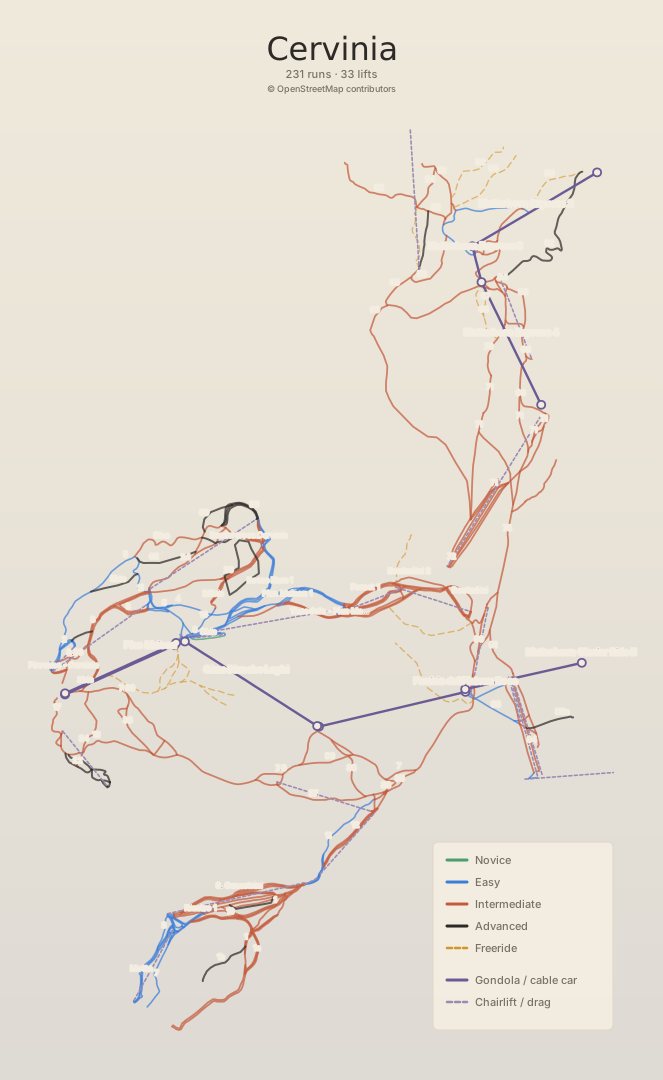
The terrain fans upward from the village through three broad tiers. Plan Maison (2,560 m) is the mid-station and the gateway to the upper mountain; Cime Bianche (2,885 m) links it to the glacier; and Plateau Rosa (3,480 m) is where the Italian and Swiss ski areas meet. The runs are wide, rolling and overwhelmingly intermediate — this is motorway-cruising country, not a steep challenge.
The Ventina run from Plateau Rosa back to the village is the showcase: 11 km and about 2,000 m of vertical, graded red but gentle enough for a confident intermediate, and one of the longest sustained descents in the Alps. The Valtournenche sector adds a secondary access via the Gran Sometta chairlift from the village of the same name, 9 km down the valley.
| Sector | Altitude | Best for | Notes |
|---|---|---|---|
| Cervinia–Plan Maison | 2,050–2,560 m | Beginners, families | Wide blues from the village; Cretaz nursery area at the base |
| Cime Bianche | 2,560–2,885 m | Intermediates | Connecting terrain between the base and the glacier |
| Plateau Rosa | 2,885–3,480 m | Glacier skiing, Zermatt link | The border crossing; reliable snow year-round |
| Valtournenche–Gran Sometta | 1,524–2,560 m | Quieter, budget base | Separate village access into the same ski area |
| Furggen | 2,050–3,492 m | Steep terrain | Limited access; the only seriously steep sector on the Italian side |
Piste split on the Italian side: ~88 km blue, ~232 km red (combined area), ~30 km black. The Furggen sector has the only steep pitches; the rest is overwhelmingly gentle cruising.
The Zermatt link closes in bad weather and is not guaranteed on any given day. If crossing to Switzerland is a priority, buy the International pass — a Cervinia-only pass does not cover the Swiss side.
Who it suits
The best intermediate cruising in the Alps — at half the Swiss price
If your idea of a perfect ski day is long, wide, groomed reds with a mountain-hut lunch and a Matterhorn backdrop, Cervinia is hard to beat. If you want steep challenges, it is hard to love.
- Beginners & nervous intermediatesSkipthe Furggen sector and off-pisteGoThe wide, gentle blues from Plan Maison and the Cretaz nursery area — this is one of the best beginner resorts in the Alps
- Cruising intermediatesSkipexpecting steep descents everywhereGoLap the Ventina (11 km, red), explore the Zermatt side for variety, and enjoy the widest pistes in the Aosta Valley
- Experts & off-pisteSkipthe Italian side for on-piste challenges (it is too flat)GoCross to Zermatt for steeper terrain, or hire a guide for glacier off-piste on the Plateau Rosa — crevasse risk is real
- Budget-conscious skiersSkipZermatt-side accommodation and restaurantsGoBase in Cervinia or Valtournenche, buy a Cervinia-only pass unless you specifically want the Swiss side, and eat on the Italian slopes
Cervinia’s honest weakness is experts’ on-piste terrain: the Italian side is so gentle that strong skiers will exhaust the steeps in a day. The answer is the International pass and a day or two on the Zermatt side, which is where the serious skiing lives.
Snow & season
Italy’s longest season — and glacier snow almost year-round
The village at 2,050 m, the glacier up to 3,883 m and ~554 cm of average annual snowfall give Cervinia a season that stretches from late October into May.
Months on the axis (10 = October). Crimson bars are the glacier and the crowd peaks. The Italian “white week” in mid-February and the Easter period are the busiest; January is quieter and colder.
Cervinia’s altitude is the engine: the village is already at 2,050 m, the main skiing starts higher, and the Plateau Rosa glacier sits well above 3,000 m. Natural snowfall (~554 cm/year) is supplemented by snowmaking on about 45% of the Italian pistes — lower coverage than some Dolomite resorts, but the altitude compensates. The glacier opens as early as late October for World Cup training and is the reason Cervinia can market a near-11-month season.
Best conditions run from January through March: cold, reliable cover down to the village, and quieter slopes outside the Italian school holidays. Late season (April) brings spring skiing with longer days and softer snow.
Lift passes
Cervinia-only or International — the price gap is the decision
The Italian-side-only pass saves about €20–€30 a day versus the International pass that adds Zermatt. The question is whether you’ll cross the border enough to justify it.
Cervinia uses period-based pricing rather than true dynamic pricing: rates are set by calendar period (low, mid, peak) and published before the season. The International pass is a single purchase covering both countries — it is not a Cervinia pass plus a Zermatt supplement.
| Pass | Covers | 1-day adult | 6-day adult |
|---|---|---|---|
| Cervinia–Valtournenche | Italian side only | €63–€87 | |
| International (Cervino) | Cervinia + Zermatt | €85–€110 | |
| Aosta Valley | All Aosta Valley resorts | varies |
Free under 5 and over 80. Children (8–16) and juniors (16–24) get reduced rates. Seniors (65+) get a discount on multi-day passes. Prices vary by period: low (early/late season), mid (January, March) and peak (Christmas, February). Buy online for modest early-purchase savings.
The honest call: if you are a cruising intermediate happy on the Italian side, a Cervinia-only pass saves you €100–€130 over six days. If you want steeper terrain or variety, the International pass is worth every euro for the Zermatt access.
Lessons & guides
Italian ski schools — and a guide for the glacier
Three main schools cover Cervinia’s gentle terrain. For the glacier off-piste, a mountain guide is essential — not optional.
The Scuola Sci del Cervino is the biggest school, with lessons from beginners to advanced. The Giorgio Rocca Ski School (named after the Italian slalom champion) is the more boutique option. Ride’em adds snowboard-focused instruction. English-speaking instructors are available at all three, though Italian dominates.
For the glacier terrain above Plateau Rosa, off-piste between Cervinia and Zermatt, or ski touring in the Monte Rosa massif, you need a mountain guide. The glacier is crevassed, and going off the marked runs without a guide, harness, rope and transceiver is genuinely dangerous — this is not resort off-piste.
Group ski-school lessons fill up fast during the Italian Settimana Bianca (mid-February). Book at least two weeks ahead for peak periods.
Families & kids
Wide, gentle terrain and a nursery from birth — a strong family choice
Cervinia’s broad, easy slopes make it one of the best family ski resorts in Europe, and the Biancaneve nursery accepts children from birth.
The terrain does the heavy lifting for families: wide, gentle, well-groomed blues from Plan Maison and the Cretaz area at the base, with reliable snow thanks to the altitude. Children learn quickly here because there is nothing steep or frightening to stumble onto.
The Biancaneve nursery (near the cable-car station) takes children from birth to age 10 — unusually young for an Italian resort, and it solves the problem of parents who want to ski while a baby or toddler is cared for. Snow gardens at Cretaz and Plan Maison offer play-and-ski sessions for small children. Ski-school lessons start from age 3–4.
| Option | Ages | What it is |
|---|---|---|
| Biancaneve nursery | birth–10 | Full childcare near the cable-car station; accepts babies and toddlers |
| Snow garden (Cretaz) | 3–5 | Play-and-ski on gentle terrain at the resort base |
| Snow garden (Plan Maison) | 3–5 | Mid-mountain play-and-ski; reached by cable car |
| Ski-school group | 4+ | Standard group lessons; half-day or full-day packages |
Lift passes: free under 5. Children (8–16) pay a reduced rate. The gentle terrain means children progress quickly — move them up to red runs sooner than you would at a steeper resort.
Cervinia’s gentle gradients are a double edge for families with teenagers: great for building confidence, but a 16-year-old who already skis well will be bored on the Italian side. Buy the International pass and point them at Zermatt.
Getting there
No train, no trick — you drive or bus up the Valtournenche
Cervinia has no rail link. The access road climbs from the Aosta Valley floor to 2,050 m, and it is the only way in.
From the motorway, take the A5 from Turin or Aosta to the Chatillon/Saint-Vincent exit, then 27 km up the Valtournenche valley road. In good conditions it is about 40 minutes from the motorway; in heavy snow with chains it can double. The road is kept open, but carry chains or winter tyres (Italian law requires them 15 Nov – 15 Apr on mountain roads).
SAVDA buses run from Turin airport and Milan Lampugnano to Cervinia in season. Local buses run 8+ times a day between Chatillon/Saint-Vincent rail station and Cervinia — the train from Turin to Chatillon takes about 1h30.
| From | To Cervinia | Notes |
|---|---|---|
| Turin Caselle airport | ~1h45 | Closest major airport; A5 motorway + valley road |
| Milan Malpensa airport | ~2h | The other common gateway; longer motorway section |
| Geneva airport | ~3h | Via Mont Blanc Tunnel or Grand St Bernard; Swiss side alternative |
| Chatillon station (bus) | ~40 min | Local bus up the valley; the no-car route from the Turin–Aosta rail line |
Private airport transfers from Turin: ~€110–150 per person (shared shuttle) or €250+ for a private car. Driving: Italy requires winter tyres or chains, 15 Nov – 15 Apr, on mountain roads.
Where to stay
Functional village, Matterhorn views, and a budget base down the valley
Cervinia village is compact and practical rather than beautiful — 1960s apartment blocks, not carved-wood chalets — but the Matterhorn towers over everything and the slopes start at the edge of town.
The village sits at the head of the valley with the cable-car station at the eastern end. Most hotels, shops and restaurants line the main street. It is walkable and flat, which is rare for a mountain resort at 2,050 m.
Hotel Hermitage & Spa is the only 5-star (from ~€330/night); the 4-star belt includes the Excelsior Planet (slope-side), Saint Hubertus (forest, Matterhorn views) and Valtur Cervinia Cristallo (all-inclusive with a kids’ club). Budget: 3-star hotels from ~€120–180/night.
For a lower-cost alternative, Valtournenche (1,528 m, 9 km down the valley) has its own chairlift link into the ski area and hotel/apartment prices 20–40% below Cervinia village.
Don’t expect Zermatt’s car-free charm — Cervinia is an Italian ski village with cars, concrete and a functional feel. The trade-off is the price: you get the same Matterhorn and the same glacier at a fraction of the Swiss cost.
Après & dining
Rifugio food, Italian wine and a quiet evening — not a party resort
Cervinia is a place to eat well and relax, not to dance on tables. The mountain restaurants outperform the nightlife by a wide margin.
On the mountain, the rifugi (huts) serve proper Italian food — pasta, polenta, local cheeses — at prices that undercut Zermatt by a third. Lo Baracon dou Tene is the standout for Valdostana specialities; Baita Cretaz at the base is reliable; Willy’s Bar is a popular lunchtime terrace. Expect to pay €12–18 for a pasta dish on the mountain and €25–40 for a full sit-down lunch.
In the village, Lo Yeti, Dragon Bar and Lino’s Après Ski are the main après spots — lively from 3 pm until about 7 pm, then the evening shifts to restaurants and hotel bars. Late-night options are few.
The rifugio lunches are the highlight — budget an unhurried hour, order the local fontina and a glass of Torrette, and treat the mountain food as part of the ski day rather than something to bolt between runs.
Non-skiers
The Matterhorn and not much else — but what a view
Cervinia’s non-ski offering is thinner than Zermatt’s or Cortina’s. The draw is the view.
4,478 m the Matterhorn / Cervino, from the village
Non-skiers can ride the cable car to Plan Maison for the Matterhorn panorama and a mountain lunch. An outdoor ice-skating rink at Lino’s stays open until midnight with floodlit Matterhorn views. Snowshoeing trails, cross-country tracks and the occasional helicopter scenic tour round out the list.
If you need a full day of non-ski activity, be honest: Cervinia is a ski resort first and does not have the museum, spa and shopping infrastructure of Zermatt or Cortina. The cable-car-and-lunch option is good for a day or two, not a week.
Dogs
Dogs on the gondola — with a muzzle and a lead
Italian rules are more permissive than French ones, but the practical details matter.
In Italy, dogs are permitted on enclosed lifts (gondolas, cable cars) provided they wear a muzzle and a lead. Small dogs may ride free; medium and large dogs may need a ticket (~€3). Dogs are technically allowed on the pistes but must be muzzled and leashed — in practice, this is impractical on busy runs and not advisable. Several hotels accept pets; check individual policies on size and breed.
GB → Italy: post-Brexit, you need a single-use Animal Health Certificate (AHC) issued by a UK vet within 10 days of travel. The dog must be microchipped and rabies-vaccinated at least 21 days before travel. The AHC must be bilingual (English/Italian) and endorsed by APHA. Cost: £100–300. A new AHC is required for every trip. Tapeworm treatment is not required for Italy but is required for re-entry to the UK.
Accessibility
A pilot resort for accessibility — with limits
Cervinia is one of five Aosta Valley pilot resorts for the “Lo sci per tutte le abilità” (Skiing for All Abilities) programme.
The accessibility programme offers adaptive skiing through the local ski schools, with sit-ski and dual-ski equipment available by arrangement. The village’s flat main area has wheelchair-accessible parking and paths at some properties, and Cervinia’s primary access is via large-cabin cable cars (easier for wheelchair users than chairlifts).
That said, the village was not designed with accessibility as a priority, and smaller hotels, streets off the main drag, and mountain huts vary widely. Contact the resort directly to confirm arrangements before travelling.
Safety
Glacier terrain, mandatory insurance and the limits of a GHIC
The glacier link to Zermatt crosses crevassed terrain, and Italy’s insurance rules have changed — both matter.
Since 1 January 2022, Italy requires mandatory third-party liability insurance for all skiers and snowboarders on the pistes. If your travel policy does not include it, you can buy it at the Cervinia ticket office for about €3 per day. This covers damage you cause to others — it does not cover your own rescue, medical costs or helicopter evacuation.
The Plateau Rosa glacier is real glaciated terrain. Off-piste above the marked runs involves crevasse risk, and a guide with glacier equipment (harness, rope, transceiver) is essential — not a suggestion. On-piste, the marked routes are maintained, but the altitude (up to 3,883 m) means weather can change fast.
A UK GHIC covers medically necessary state healthcare in Italy — but not mountain rescue, helicopter evacuation (which can cost €5,000+) or repatriation. Dedicated winter-sports travel insurance is strongly recommended, and policies that cover off-piste only with a qualified guide are common.
Buy the mandatory third-party insurance when you buy the lift pass if you are not sure your own policy covers it. Better to spend €3 than to argue the point at the ticket gate.
What it costs
What a day in Cervinia actually costs
The honest selling point: you get the Matterhorn, the glacier and one of the longest seasons in Europe at roughly half the Swiss price.
Here is the day-rate breakdown, so you can build your own number. Everything is per person per day unless noted.
| What | Typical day-rate | Notes |
|---|---|---|
| Lift pass — Cervinia-only | €63–€87 | From a 1-day pass; 6-day €333–€460 depending on period |
| Lift pass — International | €85–€110 | Adds the Zermatt side; 6-day ~€465 |
| Ski / board hire | €25–€55 | Full set (skis + boots + poles); cheaper pre-booked online |
| Group lesson (adult, half-day) | ~€34 | ~2.5 hours; 6-day package €210–€270 |
| Private lesson (2 hours) | €130–€150 | Season-dependent; up to 3–4 people at the same price |
| Mountain lunch | €15–€25 | Pasta/pizza at a rifugio; sit-down €25–€40 |
| Dinner in town | €25–€40 mid-range | Three courses with wine; Valdostana specialities |
| Bed for the night | €60 apt (Valtournenche) · €100 3★ · €200+ 4–5★ | Per person sharing; peak weeks higher |
| Tourist tax (tassa di soggiorno) | €4/night | Dec–Apr; first 7 nights only; under-15s exempt |
| Turin airport transfer | ~€110 pp shared · €250+ private | One-way; Turin Caselle ~1h45 away |
Rates read autumn 2026 for the 2025/26 season. Italian resorts use period-based pricing — low (early/late season), mid (January, March) and peak (Christmas, February). Peak-week accommodation roughly doubles.
The biggest saving lever: stay in Valtournenche instead of Cervinia village (20–40% cheaper) and use the Gran Sometta chairlift into the ski area. The second lever: buy the Cervinia-only pass unless you will specifically cross to Zermatt — the International pass premium is €20–30 a day.
Compare Cervinia, Italy
If you like Cervinia, Italy, also consider
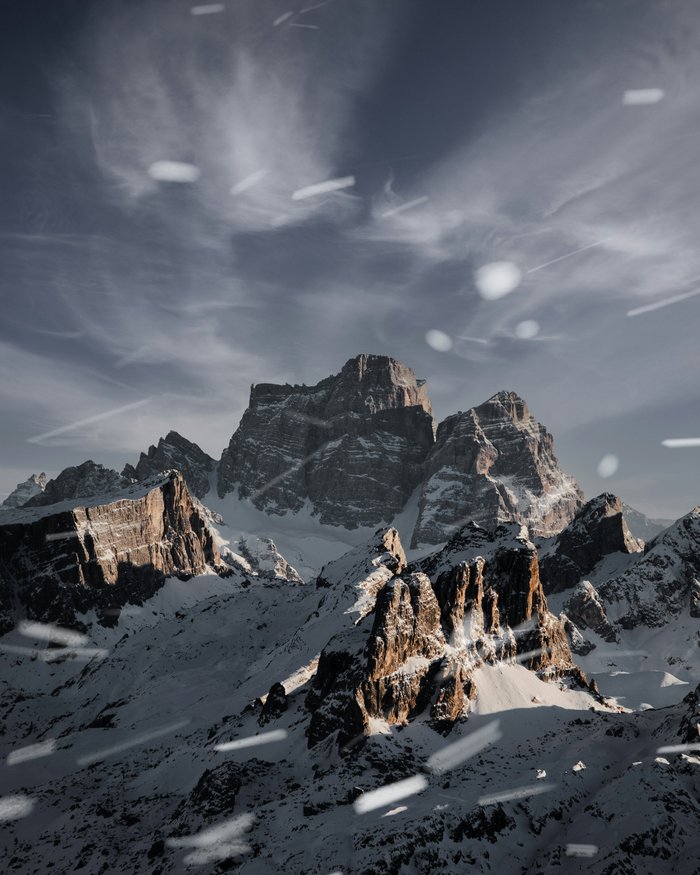
Cortina d’Ampezzo, Italy
The Queen of the Dolomites — Italian glamour, UNESCO spires and a 2026 Olympic makeover.
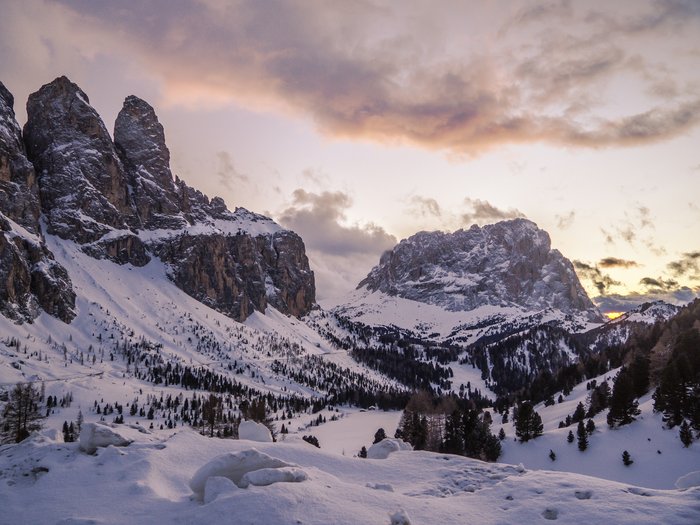
Val Gardena, Italy
The Sella Ronda, the Saslong World Cup and the best rifugio food in the Dolomites.
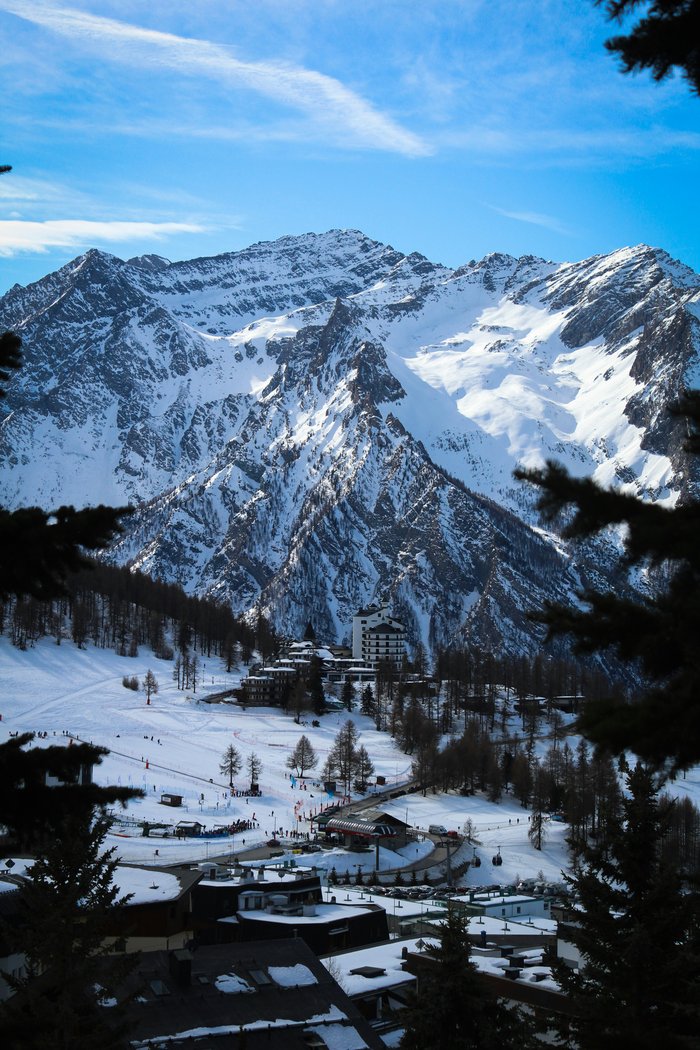
Sestriere, Italy
Europe’s highest purpose-built resort, the 2006 Olympic downhill and the best-value big area in Italy.
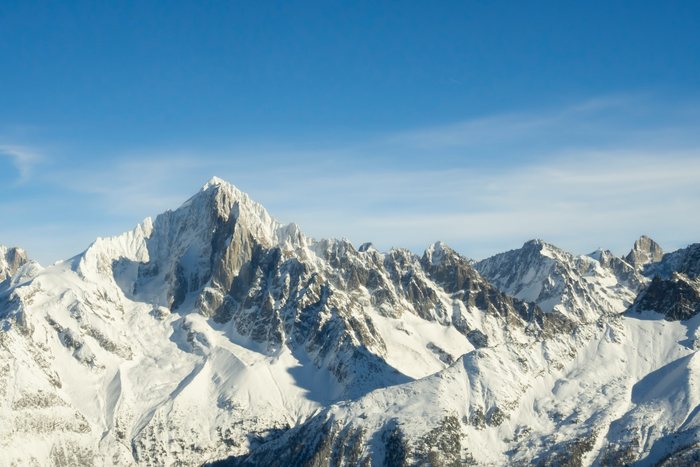
Chamonix, France
The birthplace of alpinism, under Mont Blanc.
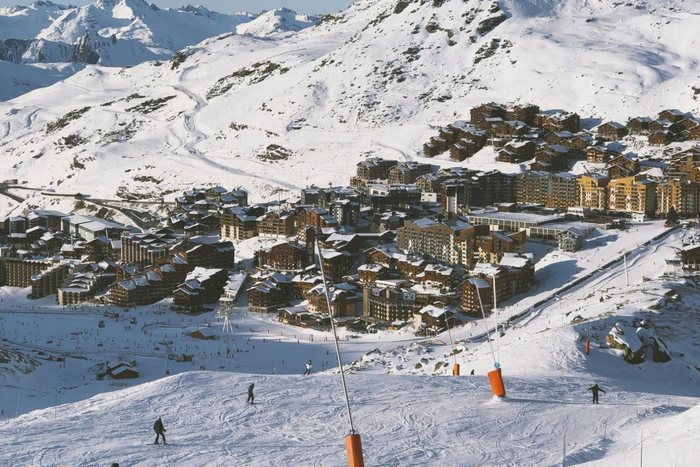
Val Thorens, France
Europe’s highest resort — snow-sure, and the gateway to the world’s largest linked ski area.
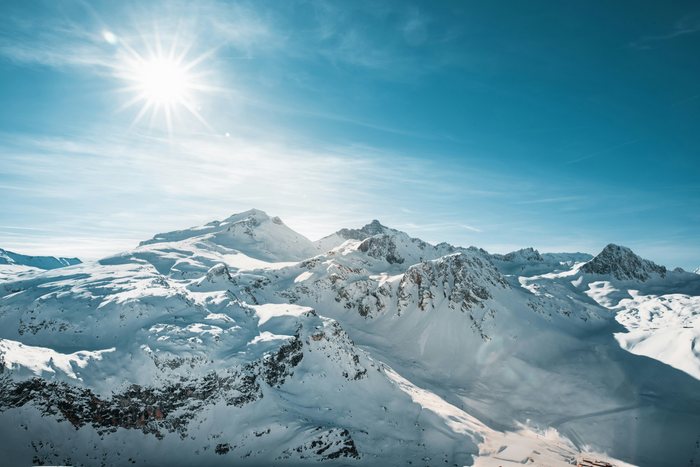
Val d’Isère, France
High-altitude, serious skiing with a village that actually feels like one.