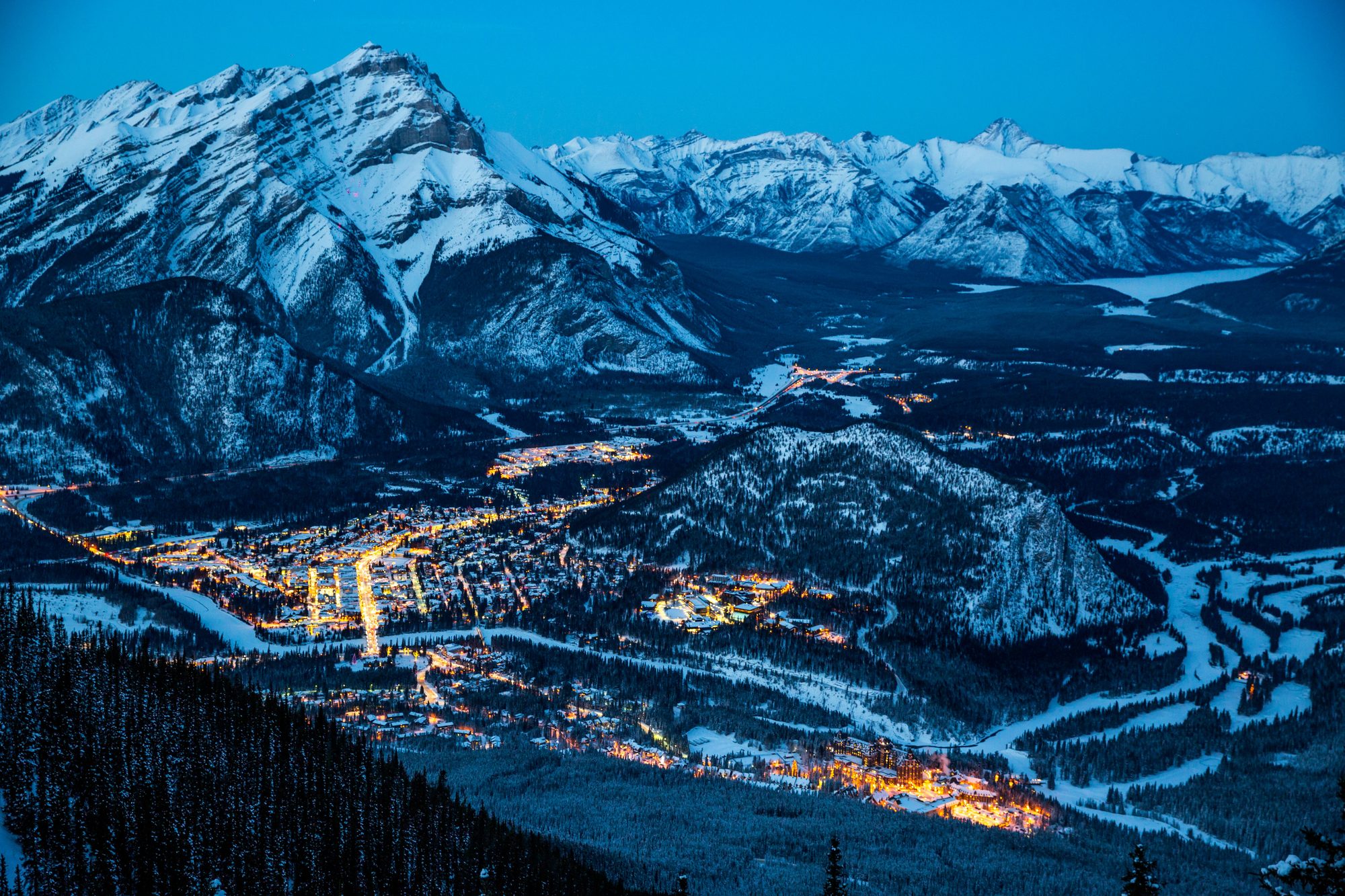
Banff & Lake Louise, Alberta
Three resorts inside a national park — dry Rockies powder and scenery that stops you mid-run.
Banff and Lake Louise sit inside Banff National Park in the Canadian Rockies, with three ski resorts on one SkiBig3 pass: Lake Louise (4,200 acres of terrain facing the Continental Divide), Sunshine Village (the highest base in Canada at 2,160 m, straddling the Alberta–BC border) and Mt. Norquay (a small local hill with night skiing). The combined area is nearly 8,000 acres of cold, dry Rocky Mountain snow in a setting that no purpose-built resort can match.
Lake Louise is the big draw — wide-open bowls, long top-to-bottom runs and a panorama of the Continental Divide that regularly stops skiers mid-turn. Sunshine Village sits higher, catches more snow and has a longer season (often open into late May), with the Delirium Dive and Wild West zones for experts. Mt. Norquay is the locals’ after-work hill, 15 minutes from Banff town, with floodlit night skiing and the Cliffhouse Bistro via ferrata.
The honest part: the town of Banff is charming but small, and it is inside a national park, which means Parks Canada rules, a mandatory park pass, and wildlife encounters that are real (elk on the main street, bears in the car parks). Lake Louise is 45 minutes from Banff, and the cold — regular −30°C mornings in January — is a different level from the coastal resorts. Calgary is the gateway and the cheapest major airport, but the 1.5-hour drive on the TransCanada in winter is not trivial.
Highlights
-
Lake Louise
The signature resort — 4,200 acres of terrain facing the Continental Divide, with the famous frozen lake below.
-
Sunshine Village
Highest base in Canada, straddling the Continental Divide — dry snow, long season, expert zones.
-
Banff National Park
A UNESCO World Heritage Site — hot springs, frozen waterfalls, elk herds and the Fairmont hotels.
-
SkiBig3
One pass, three resorts, nearly 8,000 acres — each mountain a different character.
Practical info
- Visa
- eTA or visa for most nationalities; visa-exempt for US citizens.
- Currency
- CAD (C$). Alberta has no PST — only 5% GST.
- Language
- English.
- Safety
- Safe; wildlife encounters (elk, bears, cougars) are real — follow Parks Canada rules.
- Getting around
- Calgary airport (YYC) ~1.5 hours; free Roam transit bus within Banff and to Lake Louise.
- Tap water
- Tap water safe.
- Plug type
- Type A Type B 120V
- Money
- Cards everywhere; tips expected (15–20%).
General guidance — visas, safety, and health change, so check your government's travel advisory and the official sources before you go.
Common questions
- What is SkiBig3?
- SkiBig3 is the tri-area pass covering Lake Louise, Sunshine Village and Mt. Norquay — three separate resorts inside Banff National Park, sold on one lift ticket. It is also the brand behind the free shuttle bus that connects them. You do not need the tri-area pass — each resort sells day tickets — but for a week it saves money and gives variety. See lift passes.
- Do you need a Parks Canada pass to go skiing?
- Yes. All three resorts sit inside Banff National Park, and every vehicle entering the park needs a valid Parks Canada pass (C$10.50/day per adult, or C$72.25/year for a Discovery Pass covering all national parks). You can buy it at the park gate or online. Pedestrians arriving by bus do not need one individually — commercial operators hold group passes. See getting there.
- Which Banff resort is best for beginners?
- Mt. Norquay for absolute first-timers (small, quiet, affordable) and Lake Louise for progressing intermediates (huge front side of gentle groomers). Sunshine Village’s terrain is more intermediate-to-expert and the runs back to the gondola base are narrow. See who it suits.
- How far is Banff from Calgary airport?
- About 1.5 hours by car or shuttle on the Trans-Canada Highway (Hwy 1). Lake Louise is another 45 minutes beyond Banff. Banff Airporter and Brewster Express run scheduled shuttles from Calgary airport (YYC). See getting there.
- Is Banff on the Epic Pass or Ikon Pass?
- Banff’s three resorts are on the Ikon Pass (not Epic). The full Ikon gives unlimited days at all three; the Ikon Base Pass gives 5 days. SkiBig3 also sells its own multi-day passes, which can be cheaper for a single trip. See lift passes.
- Is Banff cheaper than Whistler or the US resorts?
- Significantly. Alberta has no provincial sales tax (only 5% GST), lift passes and lodging cost less than Whistler or Colorado, and the town of Banff has a real, year-round economy that keeps dining and groceries competitive. The main extra cost is the Parks Canada pass. See what it costs.
- Are there bears on the ski slopes?
- Not during the ski season. Bears hibernate from roughly November to April, which coincides with the ski season. You will see elk in the town of Banff year-round, and Parks Canada requires you to keep 30 m from elk and deer and 100 m from bears and cougars. The wildlife is real — this is a national park, not a resort bubble. See dogs & wildlife.
The ski area
Three resorts, one national park, one pass
SkiBig3 is three separate mountains inside Banff National Park — each with a different character, linked by a free shuttle, not by piste.

Lake Louise Ski Resort is the flagship: 4,200 acres across four mountain faces, a long front side of wide groomed runs facing the Continental Divide, and a back side with steep chutes and bowls. The views of Lake Louise and the Victoria Glacier from the top are among the most photographed in skiing.
Sunshine Village is the high one: a gondola from the valley floor delivers you to a treeless alpine village at 2,160 m, with terrain that straddles the Alberta–British Columbia border. It gets the most snow (~9 m), holds it the longest, and has the most consistently cold, dry conditions.
Mt. Norquay is the small local hill, 10 minutes from Banff town: 190 acres of steep, short runs, a tubing park, night skiing, and the cheapest day ticket of the three. It is also the home of the Cliffhouse Bistro and the Via Ferrata climbing route in summer.
| Resort | Skiable area | Vertical | Best for |
|---|---|---|---|
| Lake Louise | 4,200 acres | 991 m | Big-mountain grooming, intermediate cruising, back-bowl experts |
| Sunshine Village | 3,358 acres | 1,070 m | Snow-sure alpine, longest season, above-treeline bowls |
| Mt. Norquay | 190 acres | 503 m | Quick sessions, beginners, families, night skiing |
The three resorts are not connected by piste. The free SkiBig3 shuttle runs between them and the town of Banff every 30–45 minutes.
The three mountains are genuinely different days out. Planning a week around one resort per day, with a rest day in Banff town, is the right approach.
Who it suits
Who Banff is — and isn’t — for
Three resorts covering every ability, but you need to pick the right mountain for your day.
The combined area has genuine terrain at every level, but the three mountains split it unevenly. Match the mountain to the skier:
- First-timers & nervous beginnersSkipSunshine Village’s narrow gondola-base return and the Lake Louise back bowlsGoMt. Norquay (small, quiet, cheap) for day one, then the Lake Louise front side for gentle progression
- Cruising intermediatesSkipMt. Norquay (too small for a full day) and Sunshine’s flat traversesGoLake Louise’s front side for miles of groomed blue runs with the Divide as a backdrop
- Advanced & expertsSkipthe front-side groomersGoLake Louise’s back bowls (Paradise, Larch, Ptarmigan), Sunshine’s Delirium Dive and the Wild West, and Norquay’s steep face runs for a quick morning hit
- Families with young childrenSkiphauling toddlers up the Sunshine gondola on a powder morningGoMt. Norquay for the tubing park and affordable lessons, Lake Louise for the Koala Club and gentle front side
Delirium Dive at Sunshine is a controlled-access extreme zone requiring an avalanche transceiver, probe and shovel — it is not a normal black run. The resort rents the kit at the top if you don’t have it.
Snow & season
Cold, dry Rockies powder — and Sunshine holds it longest
Banff’s snow is cold and dry thanks to the continental climate and the high elevation — wetter coastal snow stops at the BC border.
Sunshine’s high base and north-facing terrain give it the longest season in the Canadian Rockies. Lake Louise runs close behind. Mt. Norquay is lower and shorter.
The key difference from BC’s coastal mountains (Whistler, Revelstoke) is that Banff’s snow is dry and cold — continental air off the prairies, not Pacific moisture. It doesn’t dump as heavily as the coast, but what falls stays light and powdery. Sunshine Village, at 2,160 m, gets the most (~9 m) and regularly holds cover into late May; Lake Louise’s 4.5 m is less but the cold, high terrain preserves it well.
Quietest weeks are early-to-mid January after New Year and the first half of December before the holidays. Avoid the Alberta Family Day long weekend (third Monday of February) and the spring-break fortnight that follows — the town and the lifts are packed.
Early and late season are Sunshine’s domain. If you are coming in November or May, plan most of your skiing there — the other two resorts may be partially or fully closed.
Lift passes
SkiBig3, Ikon, or single-resort — three ways in
You can buy a pass for one resort, a tri-area pass for all three, or use an Ikon Pass — the right choice depends on how long you are staying and how many resorts you want.
The SkiBig3 Tri-Area Lift Ticket is the local multi-day option — 3 to 10 consecutive days on all three resorts, cheaper per day the longer you buy. Single-resort day tickets are sold at each mountain. The Ikon Pass covers all three resorts with unlimited or limited days depending on tier and can be good value if you also ski elsewhere that season.
| Pass | Covers | Adult price | Per day |
|---|---|---|---|
| SkiBig3 Tri-Area (6-day) | Lake Louise + Sunshine + Norquay | ~C$750 | |
| Lake Louise day ticket | Lake Louise only | ~C$165 | |
| Sunshine Village day ticket | Sunshine only | ~C$155 | |
| Mt. Norquay day ticket | Mt. Norquay only | ~C$95 | |
| Ikon Pass (full) | All three + 50+ resorts worldwide | ~C$1,600 |
Youth (13–17) and child (6–12) rates are roughly 20–40% less. Under-6 ski free at all three resorts. Prices are 2026/27 published rates; buy online in advance for the best price. The Parks Canada entry fee (C$10.50/day adult) is separate from and additional to every lift pass.
For a week in Banff only, the SkiBig3 Tri-Area pass usually beats the Ikon. The Ikon makes sense if you are also skiing Whistler, Jackson Hole or other Ikon resorts that season.
Lessons & guides
Three ski schools, three price points
Each resort runs its own ski and snowboard school — Lake Louise and Sunshine are the bigger operations, Norquay the budget option.
Lake Louise has the largest school, with group lessons from beginner through expert and a dedicated learning area on the front side. Sunshine Village’s school is strong for intermediates wanting to progress into the alpine bowls. Mt. Norquay offers the most affordable lessons and is the quietest place to learn — small classes, no crowds, and a fraction of the price.
Backcountry guiding around Banff is well-developed. Several operators run avalanche-safety courses, guided touring, and ice-climbing days. For Delirium Dive at Sunshine, no guide is required but you must carry avalanche rescue gear.
Norquay’s group lessons cost roughly 30% less than Lake Louise’s. For a first-timer’s first day, it is the better value.
Families & kids
Childcare, kids’ lessons and the practical details
All three resorts have kids’ programmes, but the split between nursery care, snow play and proper ski school matters.
Lake Louise has the Koala Club (non-skiing daycare from 19 months) and kids’ ski/snowboard lessons from age 3. Sunshine Village runs Sunshine Kids (lessons from age 3, daycare from 19 months at the top of the gondola). Mt. Norquay has a smaller kids’ programme plus the tubing park, which is the single easiest win with small children who are not yet ready for a full day on skis.
| Option | Ages | Where |
|---|---|---|
| Koala Club daycare (non-skiing) | 19 months – 6 yrs | Lake Louise |
| Kids’ ski/snowboard lessons | 3+ | All three resorts |
| Sunshine Kids daycare | 19 months – 6 yrs | Sunshine Village (top of gondola) |
| Tubing park | all ages | Mt. Norquay (separate ticket ~C$30) |
Under-6 ski free at all three resorts. Book daycare and kids’ lessons in advance — holiday-week spots sell out.
The nappy / toilet-training rule applies at the ski-school stage, not the daycare stage. Children in nappies go to daycare; children in ski school must be toilet-trained.
Getting there
Calgary airport, the Trans-Canada, and no other shortcut
Calgary (YYC) is the gateway. There is no closer commercial airport and no rail service — it is road only.
Banff Airporter and Brewster Express run scheduled shuttles from Calgary airport to Banff and Lake Louise (C$65–C$80 one way, ~2 hours). Rental cars are straightforward but winter tires are legally required from November to April on the Trans-Canada through the park. The park gate is at the east end — buy your Parks Canada pass here or online in advance.
Once in Banff, a car is helpful but not essential. The free SkiBig3 shuttle connects the town to all three resorts; the Roam Transit public bus covers Banff town and runs to Lake Louise. Taxis and ride-shares fill the gap. For a week based in Banff town skiing all three resorts, the shuttle system works.
| Option | Route | One-way fare | Time |
|---|---|---|---|
| Banff Airporter | YYC → Banff / Lake Louise | C$65–C$80 | ~1.5–2 hrs |
| Brewster Express | YYC → Banff / Lake Louise | C$65–C$75 | ~1.5–2 hrs |
| Rental car | YYC → self-drive | C$50–C$100/day | ~1.5–2 hrs |
| SkiBig3 shuttle | Banff → resorts (free with pass) | Free | 20–45 min |
| Roam Transit | Banff ↔ Lake Louise | C$10 | ~45 min |
All fares approximate 2026/27; book shuttles in advance during holiday periods. Rental cars require winter tires (legally mandated Nov–Apr on the Trans-Canada).
Winter driving conditions on the Trans-Canada can be serious — heavy snow, ice, reduced visibility. Check DriveBC and 511 Alberta before setting out. If you are not used to winter mountain driving, take the shuttle.
Where to stay
Banff town for life, Lake Louise for convenience, Sunshine for snow
There is no ski-in/ski-out village at any of the three resorts in the conventional sense — you stay in Banff town or the Lake Louise hamlet and shuttle to the lifts.
Banff town is where most visitors stay: a real town with 60+ restaurants, bars, shops, a supermarket and a wide range of hotels and hostels. It is equidistant from the three resorts. The Fairmont Banff Springs is the castle-hotel landmark; budget travellers use the Samesun or HI hostels.
Lake Louise hamlet is small and quiet — a few hotels (including the Fairmont Chateau Lake Louise), a general store and a gas station. It is 5 minutes from the Lake Louise ski resort and 45 minutes from Banff town.
Sunshine Village has one on-mountain hotel, the Sunshine Mountain Lodge, at 2,160 m — the only true ski-in/ski-out option. It is expensive and books out fast, but waking up on the mountain while everyone else is queuing for the gondola is the payoff.
Banff town is the best base for a week: the most choice, the best value, and the shuttle covers all three resorts. Lake Louise is the base for snow-obsessives who want first chair at the biggest mountain.
Après & dining
A real town with real restaurants — not a resort food court
Banff is a year-round mountain town with a food scene that punches well above its size, from C$15 pub burgers to C$60 elk tenderloin.
On the mountain: Lake Louise’s Whitehorn Bistro and Temple Lodge are the standout mid-mountain lunch spots. Sunshine’s on-mountain dining is functional rather than memorable. Norquay’s Cliffhouse Bistro, perched on the cliff edge, has the best view-to-food ratio of the three.
In Banff town: The Bison (Canadian game and local sourcing), Park Distillery (Alberta beef and house-distilled spirits), Melissa’s Missteak (the legendary breakfast queue) and Wild Bill’s (the live-music saloon après institution) anchor the main strip. Banff Avenue has more than enough variety for a week without repeating.
Alberta beef is genuinely excellent and appears on every menu. The elk and bison dishes are worth trying. Vegetarian and vegan options are better in Banff than at most ski towns.
Non-skiers
A national park, a hot spring, and a frozen canyon
Banff has more for non-skiers than almost any ski destination because it is a national park first and a ski town second.
The Banff Upper Hot Springs (C$10 entry) are the obvious non-ski draw — a natural hot-spring pool on Sulphur Mountain with a valley view. The Banff Gondola (C$72 adult) rides to the summit of Sulphur Mountain for a boardwalk and panorama. Johnston Canyon is a frozen-waterfall hike (icewalk tours in winter) that is one of the most popular non-ski activities in the park.
Lake Louise itself — the frozen lake below the Chateau — is open for ice skating and snowshoeing, and the turquoise colour (in summer) is one of the most photographed scenes in Canada. The town of Banff has a small museum, hot springs, and shopping on Banff Avenue.
A non-skiing partner or parent will not be bored in Banff. The national-park setting means there is more to do off the slopes than on them, which is unusual for a ski destination.
Dogs & wildlife
Dogs are guests; the wildlife owns the park
Banff is a national park with real megafauna. Dogs are allowed in the town and on some trails; they are not allowed on the ski slopes.
Dogs are not permitted on ski runs at any of the three resorts. In Banff town and on designated park trails, dogs must be on a leash at all times — Parks Canada enforces this strictly because of wildlife. Off-leash areas exist but are very limited.
The wildlife is the reason for the rules. Elk roam through Banff town year-round and can be aggressive, especially cows with calves. Bears (black and grizzly) hibernate during the ski season but are active in the shoulder months. Cougars and wolves are present in the park. Parks Canada requires 30 m distance from elk and deer, and 100 m from bears, wolves and cougars.
This is not a theoretical wildlife warning. Elk walk down Banff Avenue. If you bring a dog, the leash rule is non-negotiable and the fines are real.
Accessibility
Adaptive skiing and access on the mountain
Banff’s adaptive programmes are well-established, especially at Lake Louise.
Lake Louise has the most developed adaptive-skiing programme, run through the ski school with sit-skis, outriggers and guide skiers. Sunshine Village has adaptive options but the gondola access creates a bottleneck. Mt. Norquay is small and accessible from the car park.
In Banff town, most hotels and restaurants are step-free. The Roam Transit buses are wheelchair-accessible. The Banff Gondola and the Banff Upper Hot Springs are both accessible.
Book adaptive lessons well in advance, especially during holiday weeks. Lake Louise is the first choice for sit-skiing and visually impaired programmes.
Safety & insurance
Canada has public healthcare — but not for you
Canadian residents have provincial health insurance. Visitors do not. A broken leg at Lake Louise without travel insurance can cost C$20,000–C$50,000.
Travel insurance with ski and mountain cover is essential. Canada’s public healthcare system does not cover foreign visitors, and Alberta’s hospital and ambulance fees for uninsured patients are among the highest in the country. Helicopter evacuation from the backcountry is billed directly to the patient.
On the mountain, all three resorts are patrolled by certified ski patrol teams, and avalanche control is active on all inbounds terrain. Delirium Dive at Sunshine is a controlled-access extreme zone that requires an avalanche transceiver, probe and shovel — the resort rents the kit at the gate but you must have it to enter.
Helmets are not legally required in Alberta but are strongly recommended and worn by most skiers. All three resorts sell or rent helmets.
Buy travel insurance before you fly, not after you arrive. Policies bought after departure may exclude pre-existing conditions or have waiting periods. Confirm it covers skiing and, if relevant, backcountry or heli-skiing.
What it costs
C$200–C$450 a day, and Alberta’s tax advantage
Banff is cheaper than Whistler and the big US resorts, partly because Alberta has no provincial sales tax — you pay only 5% GST.
A day in Banff breaks down roughly as follows. These are 2026/27 rates for one adult.
| Item | Budget | Mid-range | High-end |
|---|---|---|---|
| Lift pass (per day of 6-day SkiBig3) | ~C$125 | ~C$165 (day ticket) | |
| Equipment hire | C$40–C$55 | C$80–C$120 (demo) | |
| Lessons (group half-day) | — | ~C$750+ (private full day) | |
| Food & drink | C$30–C$50 | C$120+ | |
| Accommodation (per person, shared) | C$40–C$70 (hostel) | C$250+ (Fairmont / lodge) | |
| Parks Canada entry | C$10.50 | C$10.50 | |
| Transfer (shuttle, per day amortised) | ~C$15–C$20 | C$50+ (private) |
All prices CAD, per person per day, 2026/27 season. GST (5%) is included in most quoted prices. The Tourism Improvement Fee (~2%) is added to accommodation. Tips (15–20%) are expected at restaurants and for ski instructors.
Alberta’s no-PST advantage is real: a C$500 set of skis costs C$25 less in tax than the same purchase in BC. Over a week of dining, shopping and lift passes, it adds up.
Compare Banff & Lake Louise, Alberta
If you like Banff & Lake Louise, Alberta, also consider
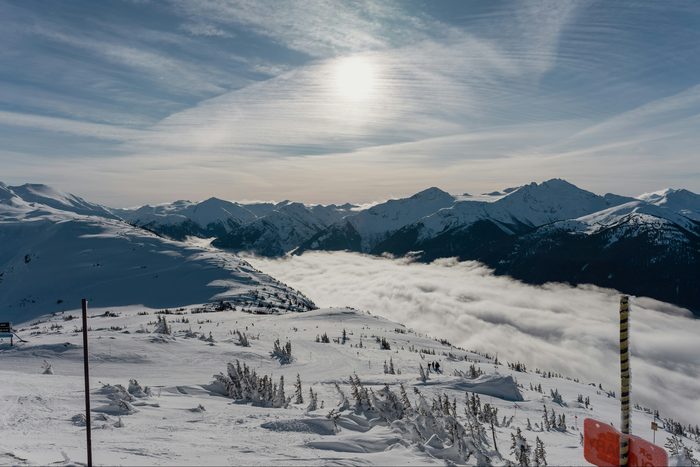
Whistler Blackcomb, BC
North America’s largest ski resort — two mountains linked by the PEAK 2 PEAK Gondola.
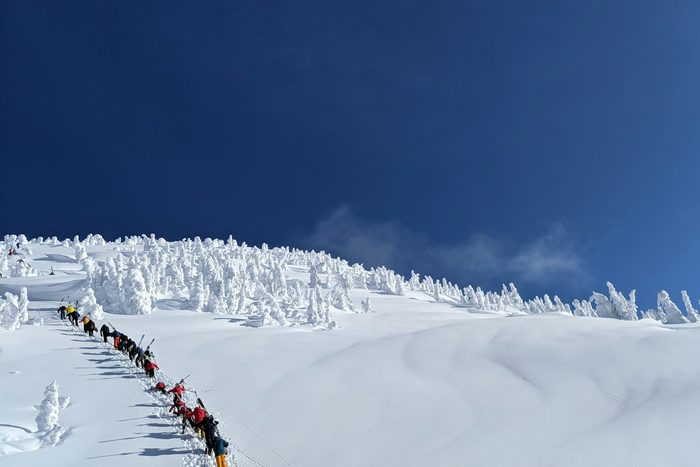
Revelstoke, BC
The longest vertical drop in North America — a powder town that went big.
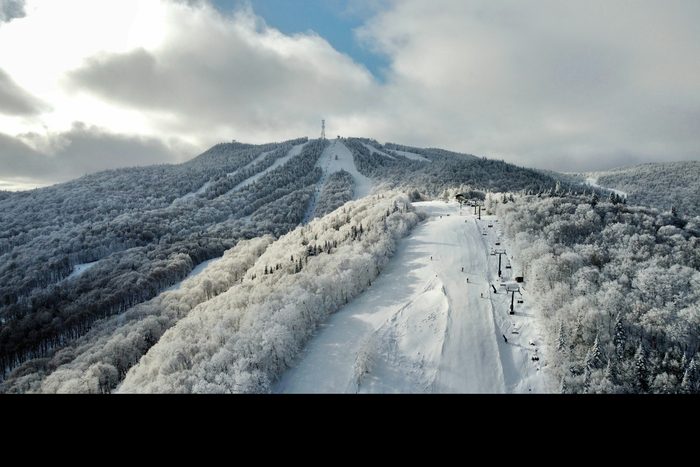
Mont Tremblant, Quebec
Eastern Canada’s best ski resort — a colourful Quebec village with snowmaking that never quits.
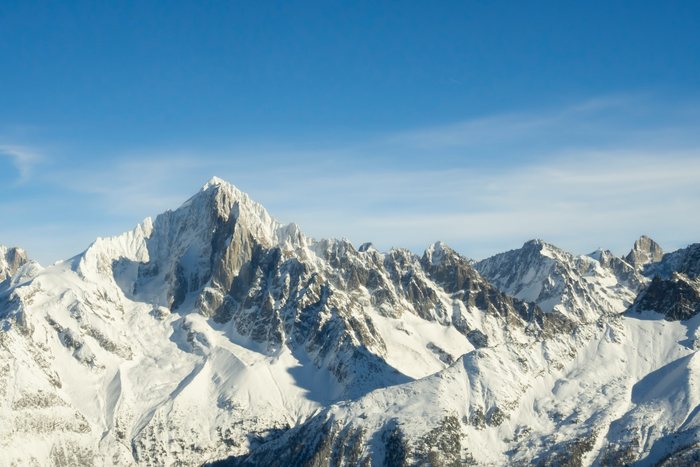
Chamonix, France
The birthplace of alpinism, under Mont Blanc.
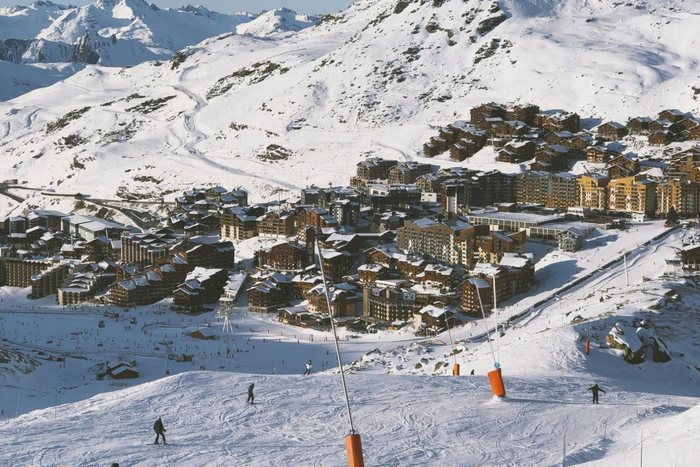
Val Thorens, France
Europe’s highest resort — snow-sure, and the gateway to the world’s largest linked ski area.
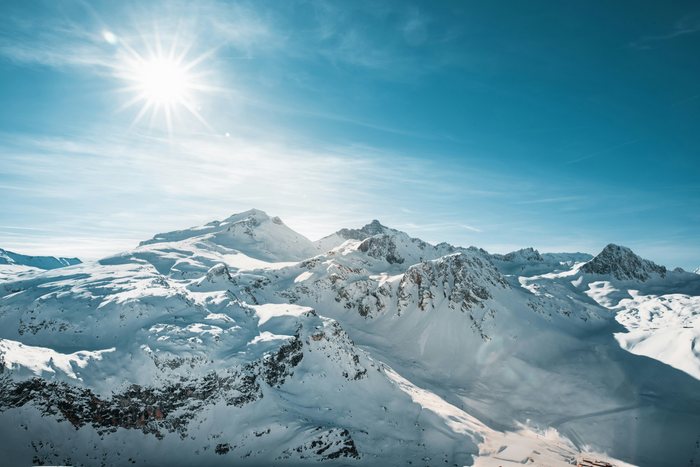
Val d’Isère, France
High-altitude, serious skiing with a village that actually feels like one.