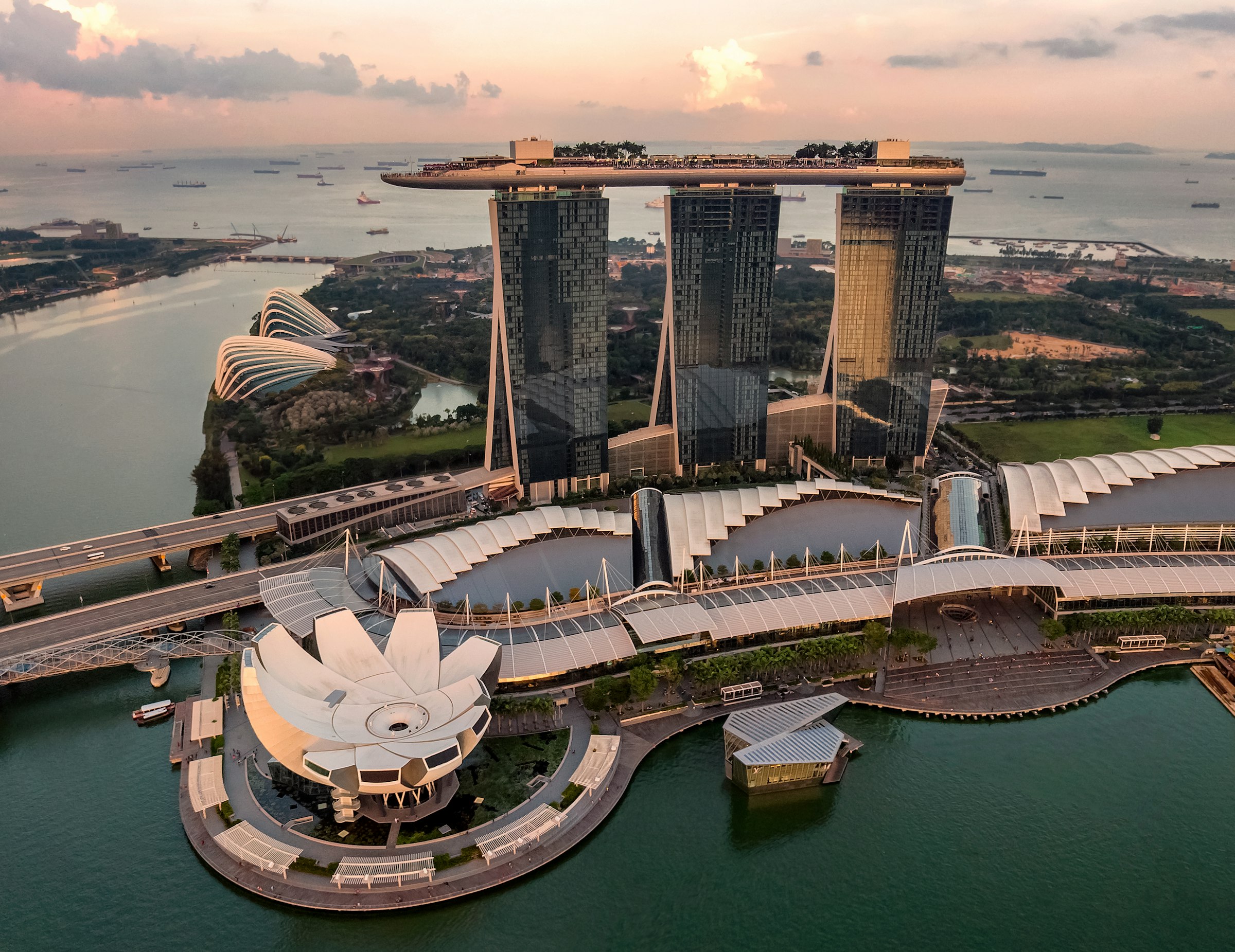
Singapore
The best two days you can spend between flights — or on their own.
Singapore is small, hot, and ruthlessly well-run. The food is the reason to come: hawker centres serve some of the best cheap eating on earth, a block from three-star restaurants. Add gardens engineered like science fiction and neighbourhoods that reward walking. Two or three days is plenty, and it pairs with anywhere in the region.
Days here are eating itineraries. Breakfast is kaya toast and kopi, lunch a hawker centre — chicken rice at Maxwell, char kway teow at Old Airport Road — then a walk through Kampong Glam or Tiong Bahru before the heat peaks. Gardens by the Bay at dusk, satay at Lau Pa Sat or a rooftop bar after. The MRT gets you everywhere for pocket change; what you spend depends entirely on whether you eat hawker or hotel.
The flip side: it's expensive for the region — alcohol especially, thanks to heavy duties — and the heat and humidity are relentless year-round. There's little grit or spontaneity, and some travellers find it sterile after a week in Vietnam or Indonesia. Sentosa is skippable without kids. Stay past day three and you may run out of things to do. As a two-to-three-day stop, though, almost nowhere delivers more per hour.
Highlights
-
Hawker centres
Maxwell, Old Airport Road — a near-Michelin meal for a few dollars.
-
Gardens by the Bay
The Supertrees earn the hype. Go at dusk.
-
Tiong Bahru & Kampong Glam
Low-rise streets for coffee, murals, and browsing.
-
Sentosa
Beaches and theme parks if you're travelling with kids.
Practical info
- Visa
- Visa-free for most Western passports (30-90 days).
- Currency
- SGD (Singapore Dollar), roughly 1.35 SGD ≈ 1 USD.
- Language
- English is official, alongside Mandarin, Malay, and Tamil.
- Safety
- Among the safest cities in the world; laws are strict, so read up.
- Getting around
- World-class MRT and cheap taxis; you will not need a car.
- Tap water
- Tap water safe.
- Plug type
- Type G 230V
- Money
- Cards and contactless everywhere.
General guidance — visas, safety, and health change, so check your government's travel advisory and the official sources before you go.
Common questions
- Do you need a visa for Singapore?
- Most Westerners get 90 days visa-free, but you must submit the SG Arrival Card online — free, within three days before you arrive — and it includes a health declaration. It’s mandatory even for visa-free travellers, and you can be refused entry without it. Ignore any site that charges for it; the official one is free.
- How many days do you need in Singapore?
- Two to three. It’s a city-state of about 730 km² where everything is a short MRT ride apart, and the core — Marina Bay, Gardens by the Bay, Sentosa, a hawker centre — fits comfortably in a couple of days. It works best as a polished stopover or a bookend to a longer regional trip rather than a standalone two-week holiday.
- Is Singapore expensive?
- It’s regularly ranked among the world’s most expensive cities — but with a crucial exception: hawker-centre food is genuinely cheap, S$4–8 a meal, including Michelin-recognised stalls. It’s alcohol, hotels and taxis that hurt. A pint in a bar is S$12–16 thanks to heavy alcohol duty, so drinks are the budget-killer.
- Can you use the Marina Bay Sands infinity pool as a day visitor?
- No — the famous rooftop infinity pool is for hotel guests only. Buying a SkyPark observation-deck ticket does not get you in; only booking a room at Marina Bay Sands does. It’s the most common tourist letdown here, so plan around it.
- Is Singapore or Malaysia the better trip?
- Different trips: Singapore is a polished two-to-three-day city-state, Malaysia a whole country you could spend a month in at a third of the cost. Most people who ask end up doing both — they’re a short hop apart and complement each other. See our full comparison.
Getting in
The card is free — the copycats that charge aren’t
Entry is frictionless, with one online form that must be done — and one scam to sidestep.
Most Westerners get 90 days visa-free, but the SG Arrival Card is mandatory — including for visa-free travellers — and must be submitted within three days before arrival through the official ICA e-Service or MyICA app. It’s free, it carries a health declaration, and you can be denied entry without it; ICA explicitly warns against commercial sites that charge for it. Changi’s passport-free biometric clearance is fully rolled out, but a first-time visitor still presents a passport on arrival — the convenience is mainly for departure and residents.
How long
Two or three days, honestly
It’s a city, not a country — and it reads best as a bookend, not the whole trip.
Singapore is about 730 km², crossable by MRT in under an hour, and its headline sights — Marina Bay and Gardens by the Bay, Sentosa, a hawker centre, one neighbourhood — fit comfortably into two or three days. That isn’t a knock; it’s the shape of the place. It works best as a frictionless stopover or a bookend to a longer regional trip through Malaysia, Indonesia or Thailand. “Not much to do beyond two or three days” is the single most common visitor sentiment, and it points at the same conclusion.
Costs
World-expensive — except at the hawker centre
The reputation is real, but the split is sharp: food cheap, everything with alcohol brutal.
S$4–8 a hawker meal — the affordable half of an expensive city
Plan the budget around that split: eat at hawker centres — Maxwell, Lau Pa Sat, Chinatown Complex, Old Airport Road — and the food bill stays small; it’s the drinks, hotels and taxis that make Singapore expensive. Tap water is safe and there’s no tipping (a 10% service charge is usually already on the bill).
Getting around
The MRT does everything — just tap a card
No car, no hassle — and one tapping mistake to avoid.
The MRT is world-class, cheap and covers the tourist map, with fares from about S$1.28; you don’t need a car. The easy way to ride is to tap any contactless bank card or phone wallet straight at the gate — same fare as a stored-value card, nothing to buy — but tap the same card in and out, since using two different cards double-charges you. Changi is on the MRT (about S$2 to the centre), and Grab and taxis fill the gaps. Changi itself is an attraction — Jewel and its 40-metre indoor waterfall sit landside, no ticket needed, worth arriving early for or breaking a layover.
The big sights
Great sights — and one famous letdown
Book the timed ones, and know the infinity pool gotcha before you arrive.
Gardens by the Bay is the signature: the two cooled Conservatories are around S$46 for a non-resident adult, while the outdoor gardens and the nightly Supertree light show are free. Marina Bay Sands carries the city’s biggest gotcha — its SkyPark observation deck (around S$32–36) is open to all, but the rooftop infinity pool is hotel-guests-only; a ticket does not get you in, only a room does. Sentosa is the resort island — Universal Studios (around S$83–89), the cable car, aquarium and casino — and the Night Safari at the Mandai zoo cluster is the standout of the rest. Orchard Road is the shopping belt, and the hawker centres are a headline experience in their own right.
The rules
The strict-laws reputation is real — one can end your trip
Most of the famous rules are harmless to a tourist. One is not.
Vaping is the one that catches people. E-cigarettes and pods are banned outright — possession itself is illegal, with no tourist or transit exemption and no carve-out for checked luggage — and from 1 May 2026 the penalty rose to fines up to S$10,000, with deportation and entry bans for foreigners. Do not bring a vape, even connecting through Changi. The rest is milder: chewing gum can’t be bought or imported for sale (chewing it isn’t itself prosecuted), and eating or drinking on the MRT, littering and jaywalking all carry fines. And the warning printed on arrival materials is literal — drug trafficking carries the death penalty.
The upside of all this is the everyday experience: English is universal, tap water is safe, the transport is spotless and Singapore has among the lowest crime rates in the world. The strictness that reads as intimidating on paper is what makes it the easiest, safest city in the region to travel.
Sources
Where this comes from
The detail above was read off primary sources on — operator timetables, municipal ordinances, regional tourism boards, national statistics offices and first-hand traveller reports, rather than other travel articles. Researched and maintained by Dmitrii Romashchin — how we research.
Compare Singapore with

If you like Singapore, also consider
Not sure where to go
Take the 5-minute quiz
Answer a few honest questions and get matched to destinations that actually fit how you travel.
Start the quiz